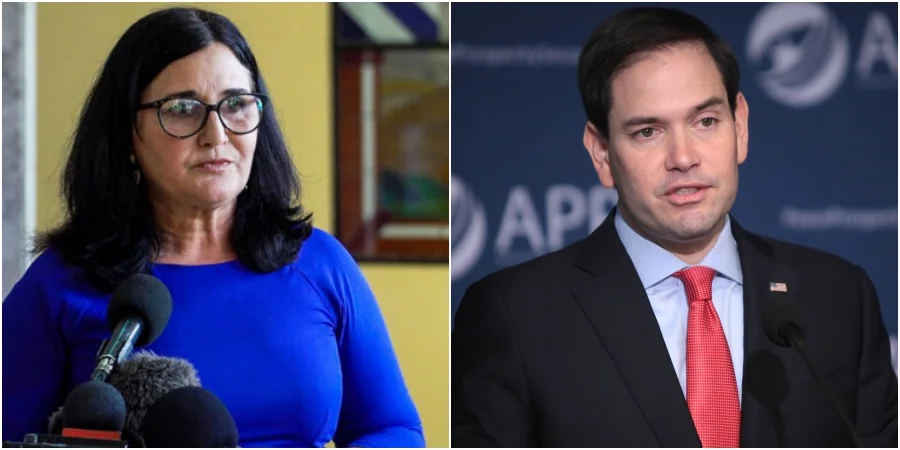
The Cuban regime official says that Rubio is head of the National Archive to “eliminate, fabricate or use information.”
MIAMI, United States. – Johana Tablada de la Torre, ambassador of the Foreign Service of the Cuban regime, posted an insulting text on Facebook against the Secretary of State of the United States, the Cuban-American Marco Rubio, in which he calls him a “bandit”, “Torquemada” and a “fascist”, accuses him of sabotaging Cuba and promoting an escalation towards a “military confrontation”, and presents him as directly responsible for a network of “economic and psychological war” against the Island.
The message, published this Sunday and loaded with adjectives and analogies, does not provide verifiable evidence of its most serious accusations and focuses on a single enemy narrative that attributes to Rubio—and, by extension, Washington—the central explanation for Cuba’s internal deterioration.
Tablada says that, among other positions, Rubio is head of the National Archive to “eliminate, fabricate or use information.”
The Cuban diplomat’s text is not limited to describing or criticizing policies: it appeals to personal discredit. Remember the episode of the “buchito” of water —a recurring mockery in American politics associated with Rubio—and maintains that Trump ridiculed him for not being able to speak without “talking point”. That episode has existed in the media imagination for years, when Trump publicly mocked Rubio for his well-known scene of drinking water on camera. However, Tablada uses the event as “proof” of alleged moral and political ineptitude, without connecting that anecdote with verifiable data on specific government decisions.
The ambassador also affirms that Rubio “has destroyed secular mechanisms” and “dominates” key instances of the national security apparatus, and accuses him of acting as “executioner of Venezuela, Cuba and Palestine”, “at the service” of “reactionary” interests and Benjamin Netanyahu. These are statements with high rhetorical tension, but the publication does not cite documents, specific official statements, votes, executive orders or specific measures that support what it denounces. The message moves more in emotional propaganda than in verifiable terrain: the central resource is demonization (“killer hyena”, “fascist”), not argumentation.
One of the most delicate passages is when Tablada assures that Rubio intends to “take” Trump “as something inevitable to a military confrontation at Christmas” and that, in the past, “he embarked on Trump” with a “failed coup d’état” and a “naval blockade” that the military command would have refused to execute, “as Bolton and the former Secretary of Defense recognize in their memoirs.”
In parallel, the publication contains a classic political accusation of the Cuban official discourse: that Washington “cuts off” resources (fuel, travel, health cooperation), and then displays the deficiencies (“there is no electricity or medicine”) to blame the Cuban Government itself. Tablada formulates it with an analogy of an “abusive neighbor” who breaks pipes and threatens other neighbors to isolate the victim. The metaphor works as a propaganda piece, but it does not in itself prove direct causality nor does it replace the discussion of internal responsibilities in the Cuban crisis, which the regime continues to avoid making transparent with auditable figures, complete public reports and accountability for its own economic management.
The publication closes with an epic call to resistance: “There are millions” of us who “would give our lives” rather than “capitulate” to military aggression. Thus, the official reinforces a logic of a besieged plaza, politically useful for the power in Havana: when the discussion is framed as total war, any domestic criticism can be presented as “service to the enemy.”
Just last Friday, Rubio stated that “any US government would like to see a radical change in Cuba” and once again disqualified the island’s regime, which he called “terrorist” and “incompetent” and blamed for having “destroyed” the country “in its more than 65 years in power.”
Asked if Washington would want a change of government in Cuba, the Secretary of State maintained that this position “is not only a policy of this administration. [del presidente Donald Trump]“I think any administration would like to see a different situation. It was a disaster. It’s a disaster. It’s not just because they are Marxists and terrorists. They are incompetent. They are incompetent people who destroyed that country,” he asserted.
Rubio, one of the most important figures in Trump’s cabinet, is originally from Florida and the son of Cuban exiles.