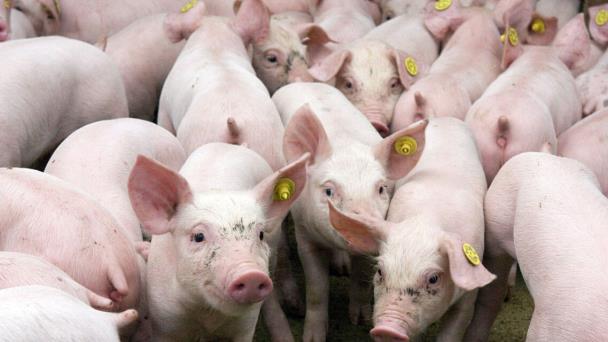
The endemic presence of the Swine plague African (PPA) has become a Latent threat For large, small and backying farms, slowing down production and giving way to a volume of Imports that already supplies more than half of the demand for this meat in the domestic market.
The Pork production It reached 66,380 quintals in June, for a 50 % drop compared to the 132,980 quintals produced in May and a decrease of 55.8 % compared to 150,274.5 quintals recorded in January.
In the first half of 2025, the accumulated production It was from 746,338.4 quintals – Equivalent to 33.8 million kilograms-, according to data from the Ministry of Agriculture.
The Disease rebates In high production provinces such as Mirabal sisters, Vega and Espaillat have affected the pace of production in the last three months. The most notorious decrease was in April, in which 93,011 quintals were produced less than in March, the month of greatest production so far this year, with 172,971 quintals.
According to the president of the Dominican Association of Swine Farms (Adagranja), Luis Brache, The situation in large and small farms has not improved until now.
If the large pig farms produced more than 8 million pounds monthly before the PPAnow They barely reach 4 million monthly pounds.
“Right now there is a Reword in Dajabónwith small farmers. In Moca, the Espaillat province, organized farms have been very affected. The subject is already that it has come out of small farms and has already gotten into commercial farms… This year has been very aggressive, “he emphasized.
In July, the kilo of pork It was sold to 150 Average pesos on farm, but producing this same amount cost 128 pesos to the producer, according to the National Council of Livestock Production (Conaprope). This indicates that the gain for the producer did not exceed 22 pesos per kilo.
Sacrificed pigs
The general director of Livestock, Abel Madera, said The ppa spotlights have decreased in the last 15 daysindicating greater control, but not a total eradication of them.
This has led to the sacrifice of more than 25,000 pigs Affected by the disease so far this year, for which compensations of up to 80 million pesos have had to be paid to the affected producers, although the payment commitments are raised to 160 million pesos, according to the official.
From the detection of the disease to date, the government has had to invest more than 2,000 million pesos to combat the PPAboth in the payment to the producers, and in the sampling and application of biosafety measures, the Deputy Minister of Production and Marketing of the Ministry of Agriculture, Eulalio Ramírez, points out.
Ramírez says that the last samples made nationwide indicate a positivity rate Less than 2 % and, in those farms that give positive, the measure is taken to completely eliminate sick pigs and compensate producers for their losses.
Imports
The production drop National has forced the country to import more and more pork To meet domestic demand.
In 2019 – before the detection of the PPA which was in 2021– Imports They represented only 28.9 % of the offer in the market, with about 688,992 quintals, a volume much lower than 1,754,993 quintals produced in that period.
By 2024that proportion had risen to 61.18 % with the purchase of 2,248,018 quintals, compared to 1,426,040 quintals that contributed the local production to the total offered.
According to data from the Ministry of Industry, Commerce and MSMEs (MICM), the country imported the equivalent of 538,267.1 quintals of pork In the first quarter of 2025, equivalents to 53.54 % of the total available In the domestic market. In that same period, local production reached 467,017 quintals.
“The Pork production And there is more import, but it is logical, because we are living a situation of health crisis and until that part is not corrected, (production) can continue to descend, “wood said about it.
94 % of the imported in the last four years have come from USAfollowed by Brazil (3.29 %), Canada (1.45 %), among others (1.25 %).
“Repopulation is still not allowed (in the country). Only production is allowed to the farms they meet,” said Ramírez, who indicated that it has been considered to repopulate pigs in farms organized in some specific areas, but that this project has not yet begun. this, he assured that the agricultural authorities continue to inspect the fulfillment of the sanitary measures, which consist of a quarantine process and disinfection of the farms and their surrounding areas, in addition to the prohibition of the transfer of pigs between one region and another.