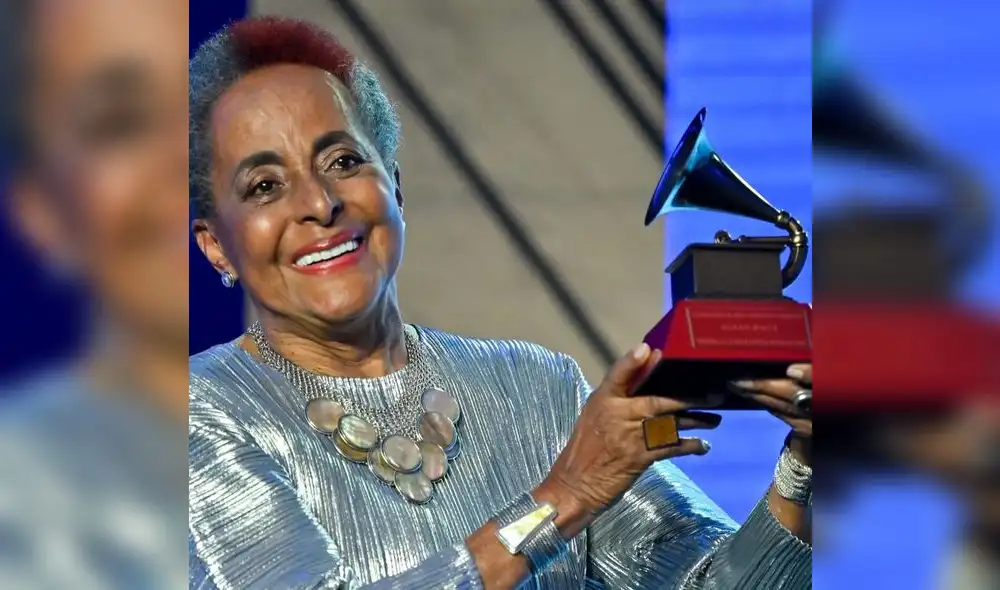
“Whenever they call a march, I want to go. When I was young, I remember walking from La Cantuta to Lima,” Susana Baca tells us at her home in Chorrillos at the end of 2025. She resumed international tours, went to Paris as a guest of the UNESCO Olympic Arts Committee and, in the United States, received the Grammy for Excellence. The singer has also spoken out about the situation and, despite her detractors, says that she feels the recognition of her career in Peru. “Now I have an audience here that we have been building.”
Baca closed the year with Voces de Libertad, a concert in Lima in which he paid tribute to Víctor Jara and Javier Heraud. “On television they told me that poetry didn’t sell,” he remembers about his beginnings. That month it was part of the Latin American Echoes Festival in Brazil. “It was very beautiful. The first day I had a full theater, the second day and the third day too. There were people who bought to go all 3 days.”
YOU CAN SEE: ‘Kinra’: Peru’s difficult journey towards the 2026 Oscars
Susana Baca’s moments are being recorded for a documentary directed by Josué Méndez. At a time when the current film law is questioned because it harms national productions and several filmmakers point out that there are different forms of censorship, a film by the singer would be uncomfortable for a sector. In Tacna, at an event held by a public organization, he made a statement that was not well received. However, the recognitions for Baca continue. The Peruvian will be at the Cosquín Festival in Argentina.
Can you summarize 2025 musically?
(Laughs) How outrageous! It seemed like they had put a new battery in me. And changing the program, because we have not sung the same thing at the Alliance Française as in other concerts.
In parallel to music, he has expressed himself about the situation, even from the stage. For example, Hasta la Root, he dedicates it to those who died due to the repression of the protests. Have you felt censorship closely in 2025?
Well, for the concert for Creole Song Day they asked me to please not make any political statements. Of course, I sang Hasta la Root, in Tacna, and I dedicated it to the young people who lost their lives defending democracy. So, here in Lima they asked me not to do it, because it is a group of people who organize this and, apparently, they had an indication. It is total intolerance.
And what was your response?
I told them, so that they don’t have problems: “don’t worry, I won’t make any statements.” But I couldn’t (smiles). At the end, I said: “dedicated to Trvko (Mauricio Ruíz).”
And how did the concert at the Grand National Theater go? A room that she officially handed over when she was minister.
Now you can’t take photos, they prohibit you (they had to tell in a signed document what they were going to say on stage). I feel that what is happening, in general, is what Franco did in Spain. Mercedes Sosa couldn’t sing Juana Azurduy in full. I remember she said: “These idiots have censored this part of the song!” This is what they are doing now.
In the midst of this, she was invited by UNESCO and later won the Grammy for Excellence. What is pending?
It was a very busy year. I could hardly go to my little house, to Cañete. I’ve had a dream for a long time, right? To make the Spanish poetry of ’36. There are many passages of that poetry that are as if you were looking at Peru. That’s happening now. And the poets of that time published despite fascism.
YOU CAN SEE: Theater 2025: art as an act of resistance
The Ecos Festival was also a meeting point, right?
Yes, they bring together musicians, for example, there was a musician from this persecuted people, the Kurds. He is a boy who lives in Sweden, probably from refugee parents, right?, extraordinary violinists; There was a trumpeter and a classical guitarist with arrangements of several of my songs. We opened the concert with Canto Eleggua! From the second song, people were already crying; I was already crying on stage, the musicians were crying.
So, Josué Méndez is going to have quite a year’s worth of material to choose from.
(Laughs) There were no longer cameras in São Paulo, but there were at the Grammys and we had activities every day. In addition, they invited me to pay tribute to the Person of the Year, Raphael, and I sang Chabuca Limaña with Rozalén.
Now that you mention Chabuca Granda, for your concert at the Cúpula you chose, let’s say, his “most combative” songs.
Chabuca was closely linked to poets. It was very possible that you arrived at Chabuca’s house and Arturo Corcuera was talking to her. There was César Calvo, anyway. One day they were sad, they cried. What had happened? They had murdered Javier Heraud. She was shocked by this boy’s death and makes all these songs. I haven’t sung all of them. In 2024, when I was admitted to the hospital, I had left some recorded material and they released Cántenme. There are a lot of songs that are not sung just like that. That is one side of Chabuca.
The side that a sector would not like?
(Smiles) Look, I was intrigued by why he said and sang Sleeping Beauty. And she calls Peru a sleeping beauty because it is a beautiful country, but it is asleep. She writes that song because a person who didn’t look like her had won. She was a very lucid woman.
This year he begins as a figure of the Cosquín festival in Argentina. Can I infer that you will continue to show your political stance?
I never forget my country. I live here and I have had many opportunities to leave during the most terrible time, when distraught friends told us: “come.” The Spanish ambassador told us: “we give you everything to go.” But we never wanted to leave. You cannot leave the mother and the country is the mother.
And should one get involved?
Sure, you can not get involved, but I understood that the artist has to get involved. Sometimes you are in a state of unconsciousness to be able to work, but you have to be conscious. I think that an artist like Fito Páez, with whom I have rehearsed, does not escape what is happening in his country. You must be worried.
Like you, despite the achievements?
Yes, despite everything achieved. Trvko’s death casts a shadow over everything, doesn’t it? I have celebrated having my Grammy for Excellence, but there are sad things and that is why I dedicated it to the kids of generation Z. Rappers are very aware of what is happening. They are angry and they say it. Therefore, they create ways to contain that, they can persecute and silence them.
From what he tells me, artists are observing various forms of censorship.
Yes, but historically, censorship has given more strength, much more strength, for artists to invent ways to continue fighting, telling their truth. Some have been arrested or have disappeared. And here there is censorship for what you can say against the parties that are in Congress.
Do you have any hope in the next elections?
I still don’t know how I’m going to vote, but I’m going to study the symbols to say: for this no, this no and this no. Now, perhaps, they are going to want to arrest whoever says that. There we have to march more or do what the Mothers of May did, right? Sit and wait until they come out.