*By Edith Febles
Santo Domingo.-The National Health Insurance (Senasa) was mired in disorder. In an operational and organizational chaos that affected the stability of the institution and its ability to respond to its financial commitments, but that, at the same time, lavished million-dollar economic benefits on third parties that are now being investigated by the Public Ministry.
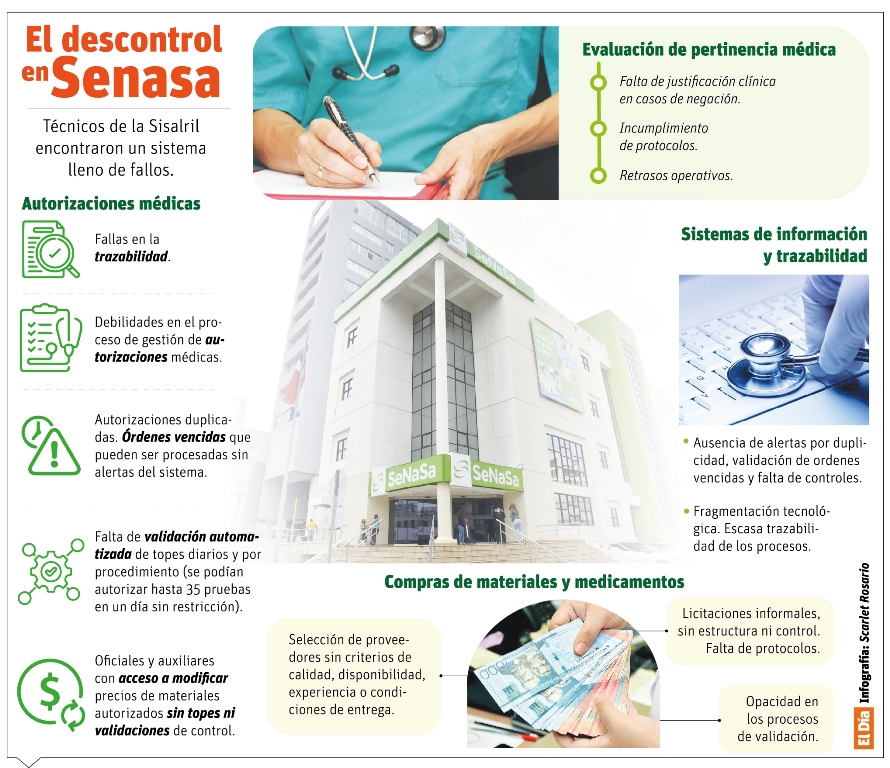
A report from May 2025, prepared by the Superintendence of Health and Occupational Risks (Sisalril), found in Senasa: structural weaknesses, failures in the management of medical authorizations, lack of essential protocols in medical authorization or contracting processes, informal purchasing processes, contested tenders, a fragmented computer system, manually calculated payment processes and preferential treatment to private centers that, through different modalities, accessed resources millionaires who were often not held accountable.
The document, obtained under the protection of Law 200-04, on Free Access to Public Information, reports on a process of inspection, surveillance and control over the ARS Senasa, “motivated by the inconsistencies detected in the administrative financial reports sent by the institution.”
For months the news about the operations in Senasa had been warning. The calls for attention and even the sanction procedures of the regulatory body did not obtain results. In those days, a source revealed to us, “Senasa hindered access to the data required by authorities in different areas.”
After many fruitless meetings and requests for data, a technical team, including some members of the Social Security Council, arrived at Senasa and settled in the key offices. “We believed that they were dedicated to the dispatch of daily activities,” said a Senasa employee with reservations of his identity.
In reality, and as established in the report, “a comprehensive, transversal audit was carried out, which covered processes linked to information technology, actuarial analysis, legal aspects, financial administration and health management.”
The team had access to required documentation live from department managers: “They asked for all kinds of things from our files,” commented one of the workers.
The inspection included the review of documents, interviews with personnel, observation of processes in real time where the auditors controlled the computer system, which allowed them to make visible all the operations carried out. The procedure was crucial. It was there where the supervisory body was able to document a data deletion operation whose action would be part of a criminal investigation for data manipulation, according to sources linked to the process.
Senasa operates with three computer platforms that are not integrated with each other, the report says. This situation “generates fragmentation of processes, makes traceability difficult and increases the risk of errors.”
In contrast, we have been able to document the stoppage without clear motivation of a project that had been in development for years to provide the institution with a comprehensive IT solution.
The Sisalril report also establishes that Senasa was developing “fragmented and manual medical authorization processes, with failures in automatic controls (…) traceability deficiencies, including duplicate authorizations and amounts authorized without defined limits.”
In the auditors’ opinion, Senasa required a change that involved “new protocols, integration of technological platforms, segregation of operational functions, clear clinical-administrative rules and implementation of a monitoring system.”
In this, they warned, Senasa was risking its life: “It is essential to strengthen transparency, operational efficiency, institutional sustainability and quality of services.”
Only in this way could they “guarantee the protection of the rights of members, the appropriate use of resources and compliance with the regulatory standards of the Dominican social security system.”
The investigation ended on August 14 of this year.
Three days later, on Sunday, August 17, the President of the Republic, Luis Abinader, dismissed Dr. Santiago Hazim as director. This is how Hazim’s administration ended one day after completing five years in office.
By then the anomalies in Senasa were spreading from mouth to mouth. Several weeks later, on September 13, the president ordered that the director of Sisalril, Miguel Ceara Hatton, and that of Senasa, Edward Guzmán, deliver to the Attorney General’s Office “a report that addresses serious irregularities detected in Senasa.”
The statement was clear: in Senasa there were signs of corruption.
Since then, the country has been awaiting the results of investigations that, according to the Public Ministry, had already been on the agenda for a year.
No priorities
— Trail of money
Investigations that trace billions of pesos spent on programs that did not respond to the priorities that the institution should have had in accordance with its legal mandate.
Other findings
—1— Tenders
Lack of protocols in bidding for materials, supplies and high-cost medicines.
—1— Informality
Use of informal channels such as WhatsApp for the management of clinical and administrative cases.
—1— Delays
Delays and lack of documentation in the evaluation of medical relevance.
—1— Privileged
Significant concentration of payments to a small number of suppliers without protocols to ensure quality.