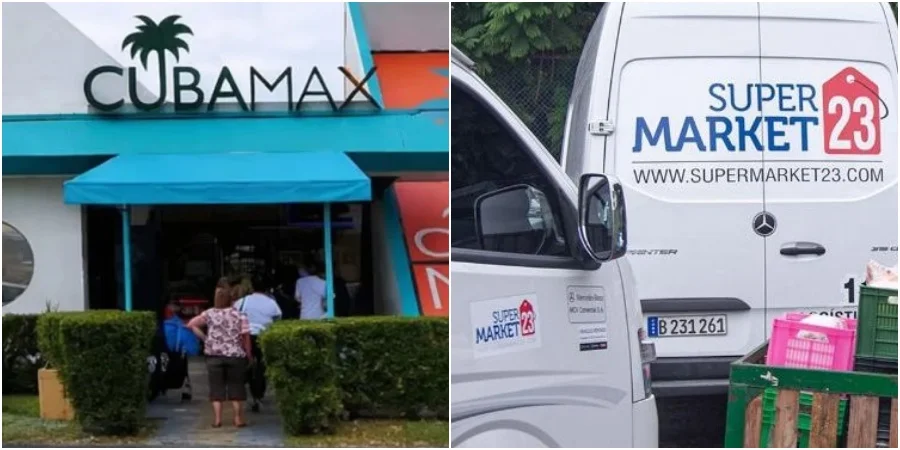
MIAMI, United States. – In the midst of the most serious energy crisis experienced by Cuba at least since January 1959 ―which has hit transportation, electricity generation and internal logistics on the Island―, Supermarket23 and Cubamaxtwo of the private platforms most used by the diaspora to send products to their families, resume their services “normally.”
Supermarket23 communicated on February 28 that it was operating “normally” again for Havana, after a “brief pause,” while Cubamax public on February 24 that it was still “operating normally” and that its offices were still open to receive shipments.
Supermarket23 reported on networks that “it is now available again” for purchases with “the same delivery times” and that its team was “processing orders and resuming deliveries”, with a “gradual” reincorporation of other provinces.
For its part, Cubamax sought to deny closure rumors, assured that it continued to “accept all types of shipments” and promised “fast” and “safe” deliveries.
On February 11, Cubamax acknowledged “significant delays” in its services and announced restrictions that included the suspension of home deliveries and limitations on products and volumes due to “severe fuel shortages.” The company even had to temporarily suspend its door-to-door service and establish package pickup at authorized points, in addition to limits of one shipment per customer and restrictions on food and medicine.
Ahead of the February 28 reopening, Supermarket23 had temporarily suspended new orders due to the impact of fuel shortages on its logistics operation.
How they managed to restart
Regarding the “how”, the available public information is uneven and, in both cases, does not include a detailed explanation of fuel supply or a specific mechanism that guarantees diesel for internal distribution.
Supermarket23 limited itself to communicating the return to Havana “maintaining the same delivery times” and promising a provincial expansion “gradually”, without describing specific transportation or energy supply measures.
In the case of Cubamax, the company itself stated on February 24 that it was continuing to operate “with total normality,” but it did not specify in that publication whether it had completely reversed the restrictions reported weeks before—such as the suspension of door-to-door service—or whether its “normality” referred mainly to the receipt of shipments in its offices and the continuity of the service under internal adjustments.
The fuel shortage in Cuba has had a direct impact on the distribution of goods and services that depend on internal transportation. Last month the regime launched a “contingency plan” with severe fuel rationing and impacts on transportation and services, within an energy crisis scenario that has been going on for more than a year.
However, on February 25, the United States Department of the Treasury, through its Office of Foreign Assets Control (OFAC), advertisement that would approve certain requests for the sale of oil of Venezuelan origin to Cuba, as long as the transactions supported the “Cuban people” and did not involve or benefit people or entities linked to the army, intelligence services or other government institutions of the Island.
“In accordance with the support and solidarity of the United States to the Cuban people, OFAC would implement a favorable licensing policy regarding specific license applications seeking authorization for the resale of oil of Venezuelan origin for use in Cuba,” indicated the entity itself.
The text specifies that, to qualify for this favorable criterion, “the requested transactions would have to be consistent with the terms and conditions of the Venezuela General License (GL) 46A“, although it clarifies that “applicants do not necessarily have to have an entity established in the United States and the limitations in GL 46A with respect to Cuba would not apply.”
OFAC also defines the scope of this policy, indicating that “it is directed at transactions that support the Cuban people, including the Cuban private sector (for example, exports for commercial and humanitarian use in Cuba).”
At the same time, it defines which operations would be excluded. According to the official text, transactions that involve or benefit “any person or entity associated with the Cuban army, intelligence services or other government institutions, including entities listed in the State Department Cuba Restricted List of the USA.”
So far, there is no confirmation that Supermarket23 or Cubamax have purchased fuel in the US market with the approval of Washington.