Having something cold to drink in the middle of a carnival block under the scorching sun in the city of Rio de Janeiro can be a relief. Those responsible for selling drinks among crowds are street vendors, who circulate throughout the festivities. 
These workers face precarious conditions to spend hours under the sun, long hours and take care of their own children during public holidays. Without open schools and without support from other caregivers, the solution for many is to take the children along with the Styrofoam.
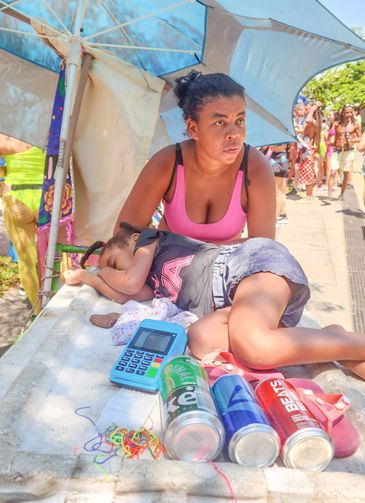
Street vendor Taís Epifânio with his 4-year-old daughter. Photo: She for Her Movement
This is the situation of Taís Aparecida Epifânio Lopes, 34 years old. She lives in the Arará favela, in the North Zone, and goes by bus, with drinks and a cart to sell in the blocks in the South Zone. Her 4-year-old daughter accompanies her.
“Carnival is when we can earn more money, it’s a big event, so, if I don’t do it, we won’t eat, we won’t drink. And I can’t leave her alone”, he explained.
The eldest son, 16 years old, stays at home. “Which also worries me because I live in a community,” he said, due to armed conflicts and drug trafficking in the region.

Lílian Conceição Santos has no one to leave her children with to work Photo: Women for Women Movement
In the city center, Lílian Conceição Santos, 34, also carries her children close to her. She spends the day with three children and nephews, aged between 2 and 14, inside the tent. “Carnival helps a lot with the bills, I can’t help but come,” he says.
She sells cookies, candies and drinks, while the children, on mattresses on the floor, cooled by fans, stare at their cell phones. At night, they return home with their grandmother, who helps with sales during the day.
“It’s precarious here. The bathroom we use is the manhole, we shower with police water [do posto] and food is in the electric cooker”, he said.
Support
Carnival, which is expected to generate R$5.8 billion in Rio’s economy, represents the highest revenue of the year for street vendors and is considered the thirteenth salary. Therefore, the effort is necessary, according to the Women’s Movement of Street Vendors Elas por Elas Providência.

Space to welcome the children of street vendors during Carnival. oto: Fernando Frazão/Agência Brasil
In search of better conditions to operate, they demand support from public authorities, with the installation of living spaces for children and for them to rest, day and night, in central areas and close to large blocks.
This carnival, the They for Themin conjunction with the Regional Labor Court (TRT), managed, with the 1st Children and Youth Court and the city hall, a space to leave children at night, but only on parade nights.
There, children aged 4 to 12 participate in recreational activities, rest, take a shower, receive meals and sleep more comfortably while their fathers and mothers sell on the street. The unit, which operates between 6pm and 6am, receives around 20 children per night.
Taís even dropped off her daughter at the center on the first day, Saturday (14), and said it was a huge relief.
“My daughter liked it, I also went in and thought it was a super cool space, when my daughter woke up, she told me that she played, watched TV, had a bed, things that we can’t afford on the street”, said the street vendor. “We are struggling to try to expand opening hours to serve mothers who work in the morning,” he added.

Luna Cristina and her son Eduardo Photo: Fernando Frazão/Agência Brasil
Selling barbecue almost in front of the children’s area, Luna Cristina Vitória, 26, also left her two children, aged 5 and 9, there for the last few days. She lives in the west zone and has a tent close to the sambadrome. Her parents help with sales and the solution was to join the project.
“They provide all the support there, the children have dinner, take a shower, sleep, leave at around 5:20 am, when we can pick them up and take them home”, said Luna. His son, Eduardo Vitor Nunes Silva, aged 9, approves. “I like staying in the space where I can draw,” he said, about the experience on Sunday (15).
On Monday (16), he returned so his family could work. “There we eat, play, sleep, there’s a television, it’s more comfortable”, he added.
Lílian Conceição, who works in Largo da Carioca, would like the city hall to provide this type of service closer to where she is. “In Sapucaí, it’s too far for me. But if it was here, I’d put it in, because otherwise, it’s just a telephone (screen)”, he lamented.
In the opinion of street vendors, they provide a service to Rio’s carnival and receive little support in return. “We are talking about our rights, as workers, and those of children”, said Caroline Alves da Silva, one of the leaders of the Movement They for Them.
“However, we are invisible. We lack everything from public policies to basic protection items, such as umbrellas, UV blouses and hats.” For her, the profit from Carnival should provide benefits for those who deliver the products to the final public.

Caroline Alves da Silva, one of the leaders of the Elas por Elas Movement Photo: Fernando Frazão/Agência Brasil
“The vast majority of street vendors at Carnival are black women, single mothers, who sleep under marquees,” said Caroline.
“We are part [da economia do carnaval]we carry beer, we carry heavy carts under the sun, in the blocks, in Sapucaí, but we are invisible.” The movement demands more dialogue about the organization of the carnival and the installation of support points for them and the children.
Councilor Leniel Borel (PP), published videos on his social networks showing children and teenagers working or with their parents walking at night. He also warns of approaches by pedophiles and disappearances. In the images, he talks to parents and demands action from the city hall.
Prevention actions
The Municipal Department of Social Assistance says it carries out permanent actions and during Carnival with a focus on preventing situations such as child labor, but did not give details. And he highlighted the coexistence space near Sapucaí.
“Our teams circulate around Sapucaí and offer the service whenever they identify the need”, explained secretary Martha Rocha, in a note. “The street vendors themselves can look for our professionals, identified with a SMAS vest, or take their sons and daughters directly to the space”, he says.
The center is located in the Rachel de Queiroz Child Development Space, in front of the Balança Mas Não Cai Building.
To alleviate wear and tear on workdays, the They for Them managed to include street vendors this year in Centro do Catador, near Sapucaí and a 15-minute walk from the children’s center.
“There’s no point in leaving our children in a safe space and going to sleep under an awning,” said Caroline. “There are some women who work around Sapucaí, but others only work in blocks and sleep on the street.”
At the Catador Center, which is located on Rua Viscondessa de Pirassununga, street vendors can rest, drink water, eat meals, take a shower and spend the night.

Casa do Catador expanded service to street vendors Photo: Fernando Frazão/Agência Brasil
Casa do Catador is an unprecedented initiative by the Municipal Department of Environment and Climate designed to serve recyclable material collectors. Many come from municipalities in the Baixada Fluminense region and work at the sambadrome. At the location, service to street vendors was expanded with support from the Legislative Assembly of Rio de Janeiro (Alerj).
The president of the House’s Commission for the Defense of Human Rights, deputy Dani Monteiro (PSol), knows about the limitation of space, away from the blocks. But he said that, even so, there is recognition of the role of workers in carnival.
“Ensuring water, care and a dignified space is recognizing that human rights are also income, health and respect for those who keep the city standing on a daily basis and during major festivals,” he said in a statement.
The city hall did not comment on the criticisms about the provision of protective equipment to street vendors and the need to extend the center’s opening hours for children.
In 2026, the city hall limited accreditation to 15,000 street vendors, although around 50,000 have registered. In the movement’s accounts, this is the number of workers on the streets.