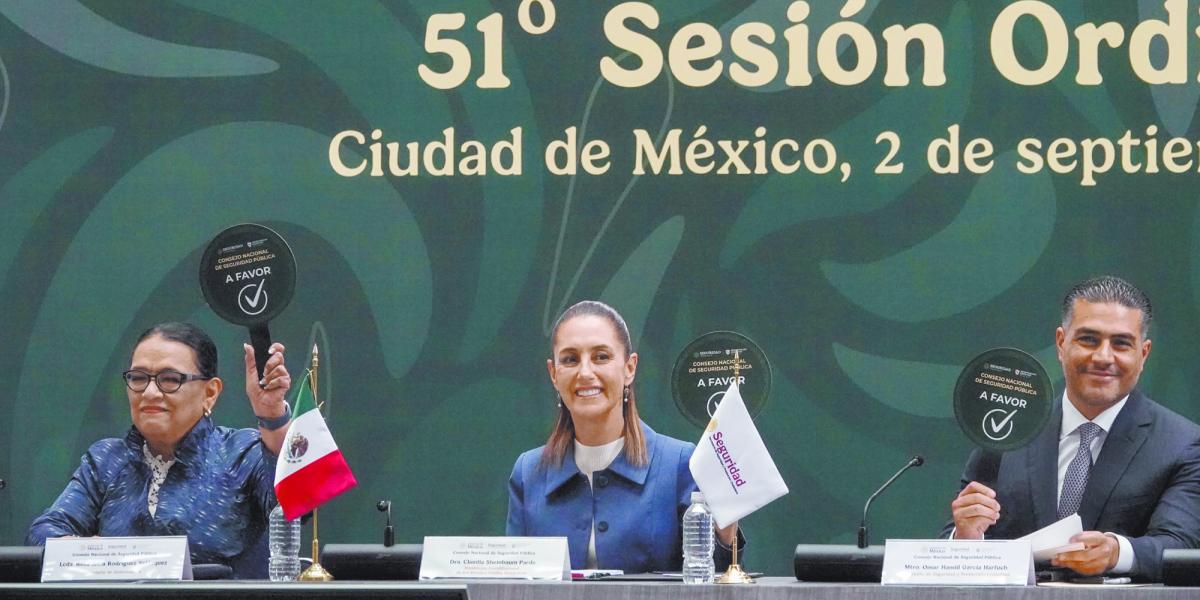
During the National Public Security Council session, several governors took advantage of the space to raise disagreements and propose adjustments to security policies, with emphasis on the lack of resources, the impact of official statistics and the need for coordination with the federal government.
The governor of Campeche, Layda Sansores, questioned the way in which criminal statistics are presented, because, “they generate distorted perceptions that negatively affect small states. He explained that his entity went from five to 17 homicides in a semester, between 2024 and 2025, so the increase resulted in 260%, so he complained that media and journalists resume the data as criticism of their management.
The governor of Jalisco, Pablo Lemus, requested support for the Ministry of Finance to make the financial discipline law more flexible, since the contracting stops of police and prosecutors are limited to inflationary growth. “If they ask us to hire more elements, we need legal and budgetary margin to do so,” he said.
Foreigners and prisons
For his part, Alfredo Ramírez Bedolla, governor of Michoacán, warned about the increase in the participation of foreigners in organized crime, mainly Venezuelans and Colombians, and requested a joint strategy with the National Institute of Migration in airports and trucks.
Margarita González, governor of Morelos, requested mechanisms for municipal resources to align with state strategies, and warned about the crisis in penalties derived from the increase in arrests. “A national strategy is needed to separate common crimes from serious,” he said.
While, Samuel García, governor of Nuevo León, shared that, although they managed to reduce crimes up to 82% in July, the perception of insecurity grew, especially among women victims of domestic violence, which proposed a federal program for denunciation and protection of women who live violence within the home.
Decrease in crimes
The Secretary of Citizen Security and Protection, Omar García Harfuch, said that Mexico records a 25% reduction in malicious homicides in the first 11 months of the Government of Claudia Sheinbaum, reaching the lowest levels since 2016.
García Harfuch stressed that 23 federative entities have decreased this crime.
Agreements reached
Marcela Figueroa, head of the Executive Secretariat, announced the two national agreements of the Council.
The plan is structured in three axes with 16 actions, which include: increase the state of police and ministerial force through state recruitment plans (2026-2030); Strengthen professionalization through certified academies that must be in operation for January 2028; Modernize intelligence and research, with new models and training programs that must be adopted since January 2026.
In addition, fighting extortion with the future general law to prevent, investigate and sanction this crime, which will establish a homologated criminal type, ex officio investigation and specialized prosecutors, and it was announced that in January 2026 the National Registry of Criminal Incidence will enter into force.