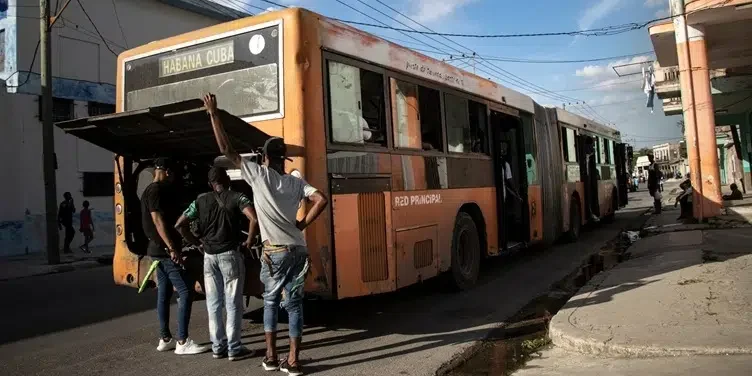
The most marked decrease was recorded with freight, which includes buses from state companies and plummeted by 97%.
LIMA, Peru – Passenger transportation services managed by the Cuban Ministry of Transportation (MITRANS), including interprovincial mobility, registered a 93% annual drop during the first nine months of 2025, according to data published this Friday by the National Office of Statistics and Information (ONEI) and cited by the EFE agency.
The most marked decrease was freight, which includes buses from state companies, which plummeted by 97%. While between January and September 2024 some 40.2 million passengers moved, in the same period last year there were only 900,000.
In turn, the number of Cubans who used buses experienced an annual decrease of 17.5% while the transportation of goods (freight) contracted by 6%.
In contrast, a notable increase was recorded in the form of suburban transport (vehicles that move passengers from towns to cities), which quintupled (from 6 to 28.8 million). Rural services, on the other hand, grew by 36%, publishes the Spanish agency.
“This situation has worsened in 2026, especially in recent weeks after the stoppage of oil shipments from Venezuela,” reports EFE.
The numbers reflect a reality very familiar to the people of the Island: public transportation in Cuba is in crisis. The problem is an old acquaintance that, although it has received specific relief in recent decades, has always been present to one extent or another.
Cuba’s transportation in 2025: portrait of the crisis
Last July, the Cuban regime recognized during the sessions of the National Assembly of People’s Power, the magnitude of the crisis that public transportation is going through in the country, admitting that only 68% of the passenger transportation plan had been fulfilled so far this year. This implies that more than 400 million planned trips were not made, a figure that shows the operational collapse of the sector.
The official data, released by the state mediashowed that the situation equally affects urban, interprovincial, rail, maritime and air transport. Urban automobile transportation, for example, only managed to cover 35% of the planned plan, while rural services—essential for connecting isolated areas of the country—collapsed to 19-26% compliance, with provinces such as Granma, Las Tunas and Cienfuegos among the hardest hit.
The report presented by the Minister of Transport exposed a bleak panorama: an obsolete fleet, lack of spare parts, low technical availability, canceled routes and fuel shortages. In Havana, more than 50% of the buses were out of service, and more than 90 urban routes had been suspended, which has forced thousands of citizens to depend on informal transportation, whose prices skyrocket due to the lack of state control and supply.
The railway system is practically paralyzed. Compliance barely reached 85% of the plan, with serious effects on national routes such as Santa Clara-Nuevitas and Cienfuegos-Havana, due to the shortage of locomotives, wagons and parts, in addition to continuous breakdowns.
In the case of maritime transport, operations between Batabanó and the Isle of Youth They continue to depend on deteriorated catamarans, while boat connections to coastal areas are limited by the poor technical condition of the boats and weather conditions.