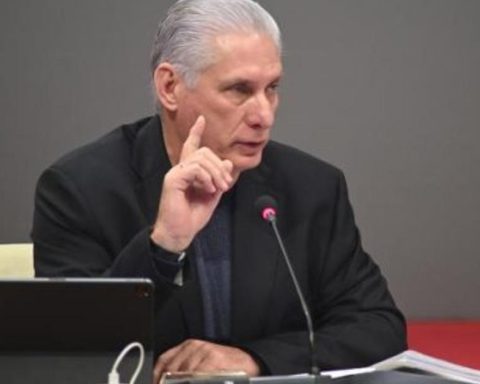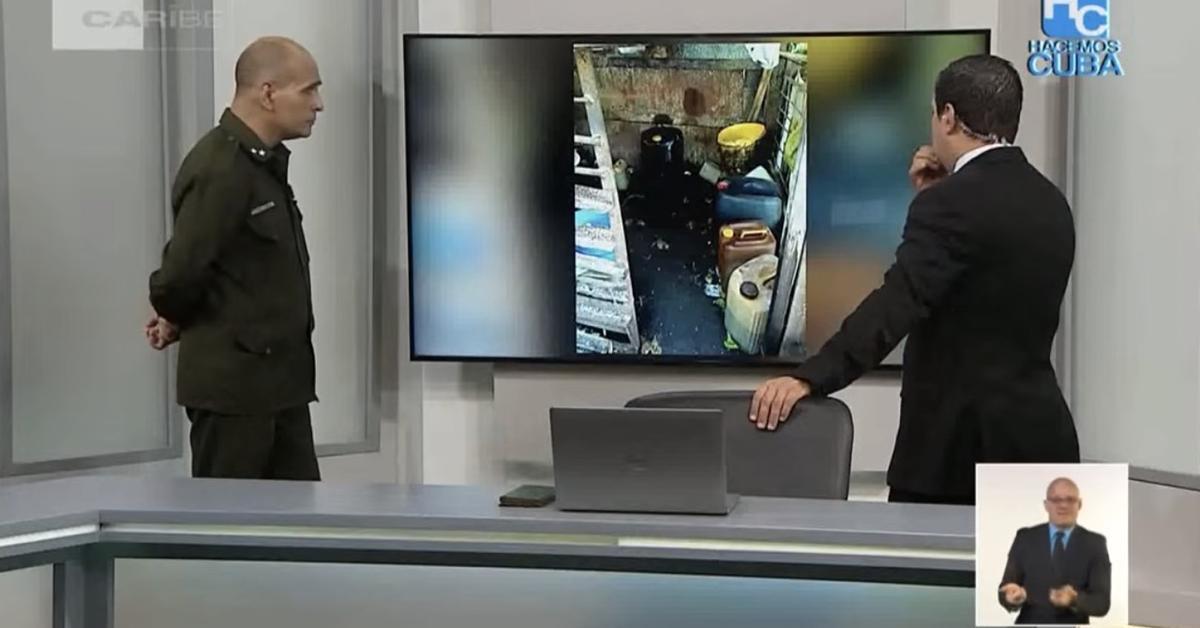
Madrid/The workers of state companies are responsible for most of the stolen fuel in Cuba. This is what emerges from the rosary of examples presented this Wednesday in a special program of We make Cubaled by the regime’s spokesman Humberto López and intended to stop a bleeding that seems to not stop.
One of her guests, Yarianna Guerra González, general director of the fuel marketing company of Unión-Cuba Petróleo (Cupet), dependent on the Ministry of Energy and Mines, explained that in that entity, oil is mostly stolen from deposits with “large storage capacities” that are then transported in tanker trucks to all corners of the country.
“There are several flaws in the processes,” acknowledged the official, who detailed how the theft is carried out. The tanks, he explained, must maintain a temperature, and when this is higher, the fuel evaporates. Guerra González said that “people knowledgeable about this activity” manipulate the temperature on paper, indicating that it is higher and therefore there is evaporated fuel, when in reality they appropriate it.
With this system, “up to 20,000 or 30,000 liters of fuel could be lost” per day, stated the official, who said that the procedure is not simple and that it “fundamentally” involves the operators, but also brigade leaders and managers and, necessarily, the custodians present at the site.
17 defendants received up to 10 years in prison for stealing and reselling more than 800,000 liters of jet fuel
This is what happened in one of the exemplary trials that they mentioned in Hacemos Cuba, held in Havana earlier this year. 17 defendants received up to 10 years in prison for stealing and reselling more than 800,000 liters of jet fuel that the Hydrocarbon Transportation Company had stored on a farm dependent on the Habana Agroforestry Company, in the municipality of Guanabacoa. The events involved directors of the entity, as well as custodians, residents in the vicinity of the place and drivers from other state companies and the private sector.
Accused of “robbery with force in things of a continuous nature”, “embezzlement”, “bribery” and “reception”, those involved caused an economic gap of almost 18 million pesos, which the sentence obliged them to “repair.”
Fuel thefts from the Berroa generating set, also in Havana, or in a similar facility in Güines, Mayabeque, also presented in the program, reveal a modus operandi similar: state workers, including bosses, act “in collusion” with residents in the vicinity to commit the crime. For all this, there are “four or five” processes open that have not yet concluded.
The crime they face is not minor, López and his guests were responsible for repeating, but very serious, and can carry prison sentences of up to 30 years: sabotage. In this regard, they recalled that “confronting fuel crimes” is a “priority” due to the “energy crisis situation.” Last May, the People’s Supreme Court already endorsed that the “vandalism of strategic infrastructure” in the country was considered sabotage “even when they don’t do it intentionally.”
However, once again, the threats They don’t seem to be of much use. Authorities did not provide global figures, but the amount of stolen fuel recovered between January and August 2025, 350,000 liters, gives a measure of what was actually lost. That figure, they said, would be enough to “provide electrical service to 5,500 homes for a month.”
“We must establish control of the technical means, it is a vulnerability that we have today”
Much of what was stolen cannot be recovered, said the lieutenant colonel present in the program, Asmel Rojas Águila, “because there are some who steal it and spend it quickly, selling it.”
“What are we going to do to prevent it from happening?” López asked those present. “We must establish control of the technical means, it is a vulnerability that we have today,” Guerra González responded, referring to the reinforcement of cameras and other surveillance equipment. The announcer insisted that “the main problem here is not the equipment, but the people.” To this they replied: “We are also working on people prophylactically, we try to talk to them and explain to their families everything that can happen from everything they are failing to comply with.”
In addition, said Mario Pedroso Caballero, general director of the Generating Groups and Electrical Services Company of the Electrical Union of Cuba, “the selection of personnel is being deepened,” but not only focusing on the selection, “because at that moment it can be very good, but over time it can deviate.”
In fact, the official explained, these types of organizations are governed by Decree 200, which does not allow employees with criminal records. “We have not had people who have entered with a criminal record, the key lies in the afterwards,” he said, referring to those possible “deviations.”
Before calling for a new installment of the program on the same topic next week, they stated: “What must be clear is that this all-out war will not go unpunished.”