In recent years, the number of people who receive recurring income of the Dominican state It has grown in a sustained way, reaching in the quarter April-June a total of 5.3 million people, which represents 49.2 % of the population.
In the graph that accompanies this text, it is possible to appreciate that the number of people who are benefited from a recurring income from the public resources represented 36.8 % in the Year 2019.
The increase reflects the expansion of social assistance and public employment; reflecting a structural change in the economy The country, since a greater portion of the population depends directly on the State for subsistence.
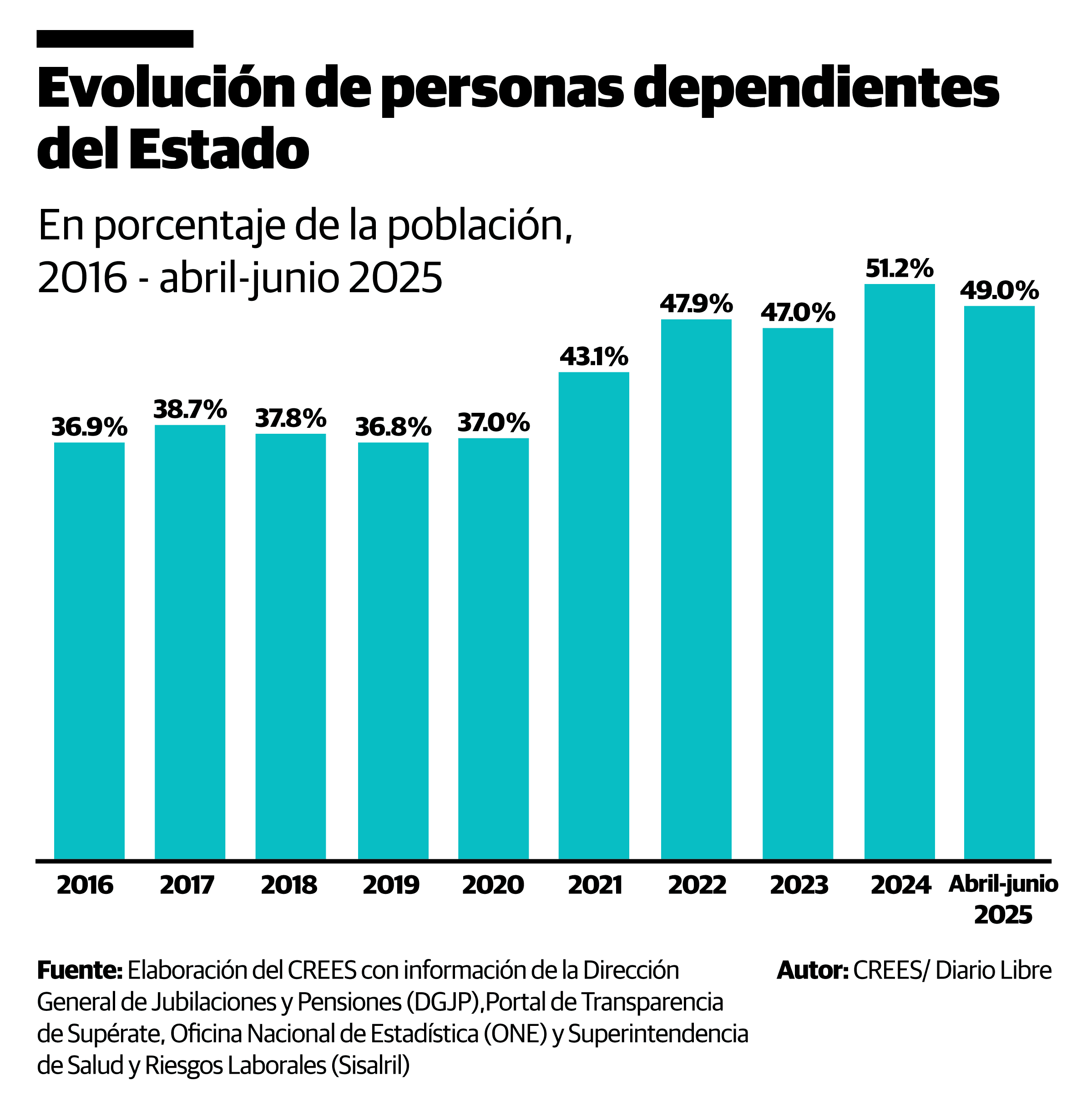
The Covid-19 pandemic crisis marked a turning point In this trend. During the phase in which the economy It began to dismantle mobility restrictions and return to normal, no reforms were implemented to promote a favorable environment for investment and generation of productive jobs; Instead, there was an expansion policy of subsidies and transfers, while increasing employment in the public sector.
He State growth It raises a important challenge For the fiscal sustainability. The central government expenditure would end close to 20 % of GDP in 2025, and the intention is to expand expenditure even more from 2026.
How the new expense is financed could have an effect on individuals and their decisions to invest and their consumption level, and on the economy Like a whole.
__________
A collaboration of the Regional Center for Sustainable Economic Strategies (CREES).