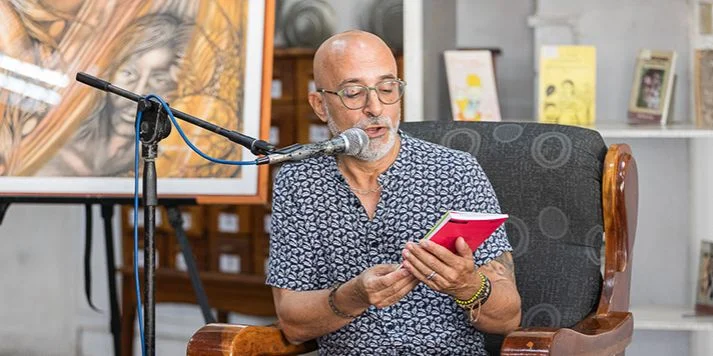
The Pinareño writer Nelson Simón launched a hard criticism against the social, economic and political situation of Cuba.
Miami, United States. – Cuban poet, narrator and playwright Nelson Simon denounced on Tuesday the abandonment of the people by the authorities and reflected on the limited options that a common citizen has, which reduced only three: “Silence, resistance or exile.”
On your Facebook wallSimon wrote: “Empty information. Dead letter. Distraction strategies. Promises that will not be fulfilled. Silences and quieter. It seems that this is what we have left. That and resist. Adapt to a change that we do not think, that we do not foresee. A change that nobody consulted us and that we have to assimilate.”
For the Pinar writer, who holds the distinction by national culture and is editor of the magazine Channelthe Cuban “on foot”, the one who “is not part of assemblies or elites”, who “does not hold a card or know how to operate in a medium that accepts corruption and illegality as a survival tool,” faces a scenario of drastic and inescapable options: shut up, resist or leave the country.
The first of those options, silence, is for Simon a form of forced self -censorship. “Mechanism that you impose or impose you because ‘say’ condemns you. He exposes you. He points to you. He feels on the bench of the suspects and from there to the bench of the defendants and the label of ‘dissident’, there is only one step.”
The writer also pointed to the hypocrisy of those who exercise power or benefit from the system while criminalizing those who think differently. “There are tens, thousands of opportunists, who will push you, point you, will use you to divert attention. Many of them are inept, corrupt, double standards, and at least they have a child who left or have taken out and they send online remittances and purchases.”
The second route, the resistance, describes it as a synonym for resignation: “To fix them as you can. Coal. Hunger. Non -covered needs. Walks. Sweat. Mosquitoes. Blacks. Collapse.”
From its perspective, this resistance develops in the midst of an institutional abandonment logic: “Resistance implies that you accept that nothing of what they have will be beneficial for you. That nothing will be thinking of you. It is anarchy and save who can.”
The author also highlights the contradiction between the official discourse and reality: “It is the speech that on the one hand puts you in the center and on the other ignores you, as well as ignoring that in you the consequences of all the mistakes for which no one responds and of which you will never know the consequences will fall.”
Through a chess metaphor, he warns that the citizen always loses: “Some pieces fall and others are raised. A pawn, a lady or an alfil is sacrificed and continues the game knowing beforehand that you have lost it.”
Simon also rejects the normalization of exile as an exhaust valve. “No exile is voluntary. Push into exile and then load with the weight of the country, it is unworthy. The country should generate decent opportunities and jobs. Save the ‘economy’ with production and not with the fruit of your uprooting.”
The writer also criticized the political use of remittances and economic contributions of emigrants, instead of generating effective public policies within the country.
“Where was the promise of summer?”
In the immediate context, Simon refers to the blackouts that affect the Cubans during the summer of 2025. “Today, July 29, we are still turned on. Yesterday Energas came out and today the UNE announces the departure of the Central Guiteras for another 96 hours. Last week it came out by 72. He leaves but enters. They are almost always appropriate inputs that suffocate and relieve tensions and prepare us for a new exit”.
Faced with these energy interruptions, the writer wonders: “Where was the promise of summer? Which summer did they talk?
Simon also firmly questioned the lack of austerity of the Government by pointing out the contrast between the sacrifice discourse that is required to the people and the lack of adjustment in the structures of power: “I hear again and again to talk about the complex situation that we are going through but I do not see the administration and the ideology to adjust to the extent that the people have had to be adjusted.”
In addition, he said that citizens would appreciate cuts in “acts, celebrations, trips, campaigns, job schedules, activities that are not essential, bankruptcy companies that we continue loading among all.”
On the pandemic, he said he did not leave institutional lessons: “Pandemia had to be a teaching but it was not. It must have been an exercise to learn to act in new and adverse conditions. With new and modern ways. But it was not.”
According to Simón, after the health emergency the country returned to “the old propaganda and mobilization mechanisms as if we do not lack fuel, energy, transport. As if the costs had not multiplied by 100”.
He also criticized the use of public resources: “We stop subsidizing some things (almost all of a material nature) but others are still subsidized (almost all of a political and symbolic nature).”
In the final part of his message, the writer called for ethical responsibility and the tune between those who govern and the people. “Let’s never forget that we are public servants and we are here to fulfill what the sovereign dictates.”
He asked the officials to adopt the same austerity that is required to citizens: “Value is needed to tighten their belts and march next to the people with the same austerity and creativity that is required. They have a finger. They can already raise it.”
Nelson Simón, born in South Consolation, in 1965, is an outstanding figure of contemporary Cuban literature. Poet, narrator and playwright, has been editor of the magazine Channel and programs screenwriter on Radio Guama. He is a member of the editorial board of the Hermanos Loynaz Center, UNEAC and the Brothers Saíz association. His work has been translated into English, French and Italian.