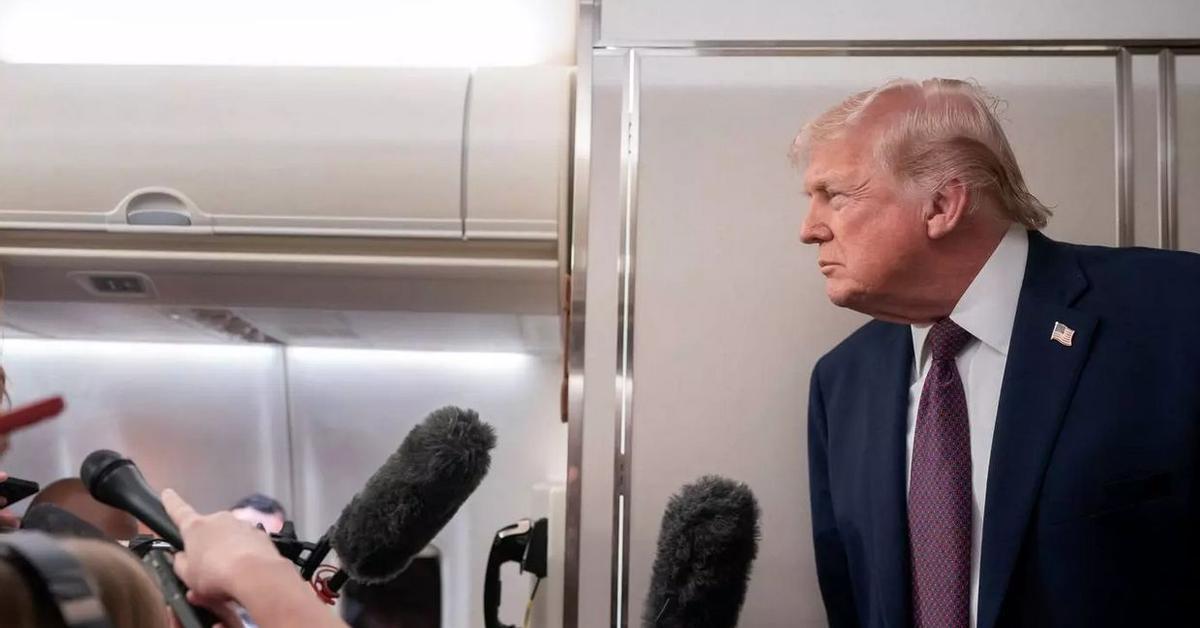
Madrid/Confusion reigns around the situation in Cuba hours after statements by US President Donald Trump, saying that the Island will no longer receive more money or oil from Venezuela. The president, in brief statements aboard Air Force One, stated that he was in contact with the Cuban authorities and maintained that there would be news soon.
“We are talking to Cuba and they will know very soon. One of the things that I want to take care of, one of the groups that I want to protect are the people who came from Cuba, who were forced to leave under duress and today are great citizens of the United States. We have many people expelled from Cuba unjustly, so we are going to preserve the most important thing right now, which are the people who came from Cuba, who are American citizens or are in our country,” he said.
Trump did not mention anything specific, neither dates, nor people involved in the alleged conversations, nor deadlines; but the official press of the Island has reported the news treating it as speculation. CubadebateFurthermore, it offers the information not as its own, but with Alma Plus TV – a channel linked to the Latin American left – as a source and does not provide a denial or another possible version of the regime, as one would expect from a state media.
Meanwhile, the mystery continues about what economic relations will be like from now on with the Government of Delcy Rodríguez, which this Sunday issued a statement of support for the Island but without commitments for practical purposes.
“The relationship between the Bolivarian Republic of Venezuela with the Caribbean and the Republic of Cuba has historically been founded on brotherhood, solidarity, cooperation and complementarity,” the text states.
Caracas ratifies its “historical position within the framework of relations with the Republic of Cuba, in accordance with the Charter of the United Nations and international law, to the free exercise of self-determination and national sovereignty.”
Furthermore, it concludes by saying: “Venezuela reaffirms that international relations must be governed by the principles of international law, non-intervention, the sovereign equality of States and the self-determination of peoples. We reiterate that political and diplomatic dialogue is the only way to peacefully resolve controversies of any nature.”
Beyond politics and diplomacy, the statement omits any type of reference to the closest link between both countries and which is at the center of the controversy: oil.
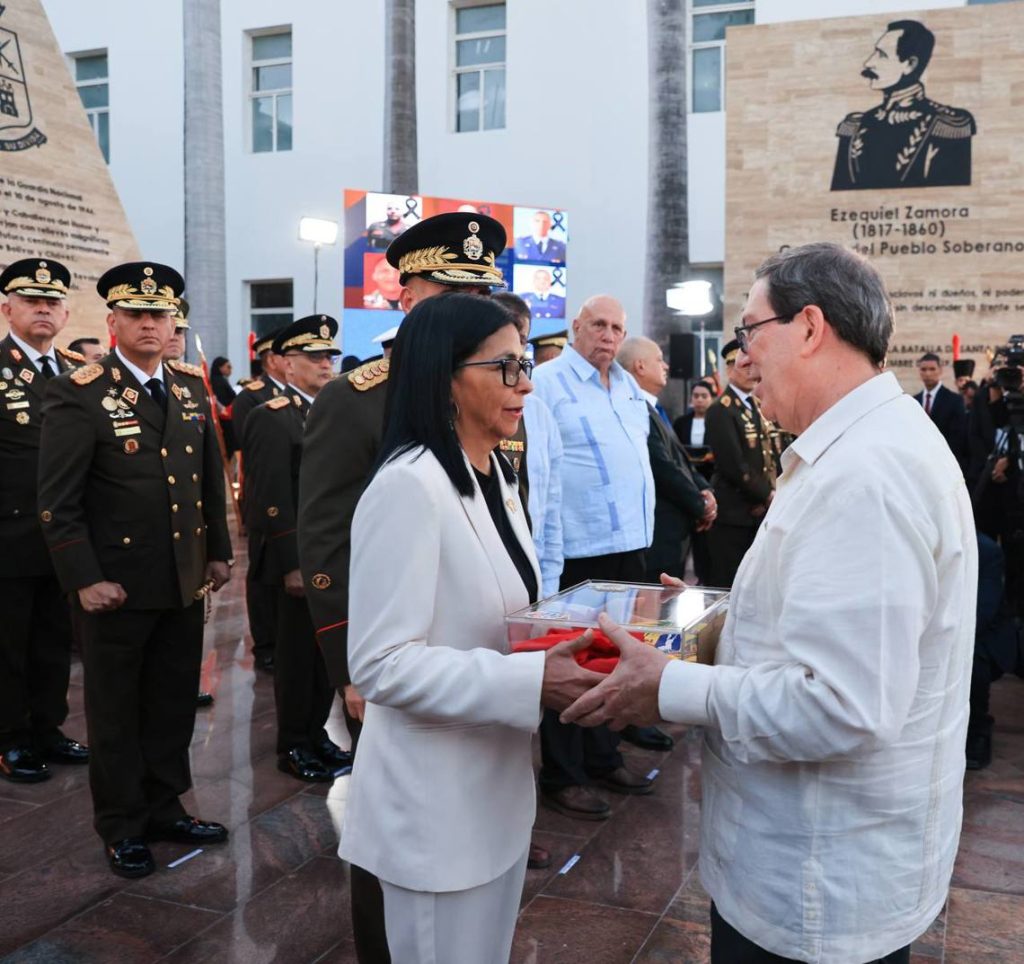
The Government of Delcy Rodríguez has been moving all week in an ambiguity that combines political gestures – from the demands for the release of what it publicly considers to be the legitimate ruler, Nicolás Maduro, to acts such as the presentation of medals to the Cubans killed defending Maduro– with facts, such as the meeting he will hold with Trump, as confirmed this Sunday by the president.
“We are working very well with the leadership, and we will see how it all turns out,” Trump told reporters aboard Air Force One, also stating that Rodríguez offered the United States “50 million barrels of oil” that are on their way to the country.
At the moment, it is unknown if there will be any type of agreement between the three parties for oil to reach Cuba, after Trump said that the Island has been “living for years” thanks to Venezuelan money and crude oil in exchange for “security services” for the “last two dictators (Hugo Chávez and Nicolás Maduro).”
“BUT NOT ANYMORE!” Trump snapped on his Truth Social network, where he stressed that “the majority of those Cubans are DEAD from the latest US attack” and Venezuela now has the “most powerful” army in the world, that of the United States, to protect itself.
The Cuban authorities responded by assuring that they “do not receive nor have they ever received” monetary or material compensation for security services provided to any country and insisted on demanding that Washington put an end to the “brutal kidnapping” of Maduro and Flores, which they called “illegal” and a “judicial and media farce.”
The Cuban authorities responded by stating that “they do not receive and have never received” monetary or material compensation for security services provided to any country.
In addition, Foreign Minister Bruno Rodríguez vindicated Cuba’s right to import fuel from markets “willing to export it”, in addition to exercising its right to develop its commercial relations “without interference or subordination to the unilateral coercive measures of the United States.” “Law and justice are on the side of Cuba,” he stated.
What is known is that the American oil companies Chevron and Shell, the Spanish Repsol and the Italian ENI will “immediately increase” their investment in Venezuela, according to the United States Secretary of Energy, Chris Wright.
“We had Chevron, Shell, Repsol and ENI, four of the largest oil companies in the world, saying: ‘Immediately, we will begin to increase our investments and grow our production.’ I have a team of American oil prospectors who say they will go there this week,” he told Fox News.
Wright’s statements come after Friday’s meeting between Trump and oil executives at the White House, where the president asserted that there will be an investment of “at least $100 billion of his own capital, not the government’s money,” to revitalize Venezuela’s infrastructure.
However, the director of Exxon, Darren Woods, said that the South American country “today is uninvestable”, something that has cost him Trump’s threats.
“I didn’t like Exxon’s response. We have a lot of people who want it. I would probably be inclined to leave Exxon out. I didn’t like their response. They are being smart,” said the US president.
Wright, for his part, asserted that Exxon’s opinion is the “atypical,” stating that there are “at least a dozen” companies ready to return to Venezuela. That includes “five large” companies that are already “there and rapidly ramping up production and probably another six to a dozen” that are “ready to move in.”
“I didn’t like Exxon’s response. We have a lot of people who want it. I’d probably lean toward leaving Exxon out. I didn’t like their response. They’re getting smart.”
“So the speed at which we will see investment and the change in the trajectory of Venezuela’s production is impressive,” said the secretary.
Energy analysts have shown skepticism about Trump’s plan for Venezuela, which apparently has the largest reserves in the world, the equivalent of 364 billion barrels or 17% of the total, but a production that only represents 1% globally, according to data from Standard & Poor’s (S&P).
Among the reservations they have stated the obsolescence of Venezuelan infrastructure and political uncertainty. In this context, Trump declared a “national emergency” this Saturday to protect income from Venezuelan oil sales in United States Treasury accounts, which would prevent creditors of Venezuela’s foreign debt from claiming the funds.
Following the oil expropriation, there have been nearly 60 arbitrations since 2000 against Venezuela for a total estimated value of $30 billion, almost 15% of its international debt, according to data from the Center on Global Energy Policy (CGEP) at Columbia University.