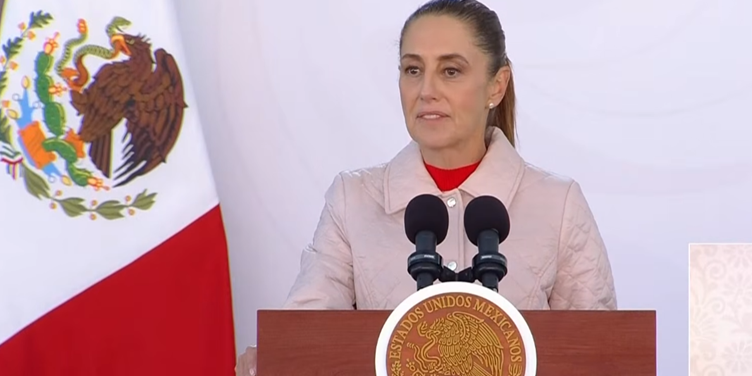
CDMX, Mexico. – The president of Mexico, Claudia Sheinbaum, assured this Wednesday that there are conversations to explore whether her Government can facilitate a dialogue between the United States and Cuba, while reiterating that Mexico will continue sending humanitarian aid to the Island in the midst of the serious economic and supply crisis that it is going through.
The president stressed that this eventual mediation “depends on the two governments” and framed it in Mexico’s foreign policy principles, such as non-intervention and self-determination.
“There are talks to see if it is feasible, but it depends on the two governments. That is, not only on the will of the Government of Mexico, but on the will of the Government of Cuba and the will of the Government of the United States and on the conditions that the Government of Cuba could be establishing within the framework of its self-determination,” declared Sheinbaum during his morning conferencewithout offering details about the type of contacts, the format of the eventual approach or the schedule of those conversations.
In that same exchange, the president called for other countries to join in supporting Cuba and confirmed that Mexico will continue with assistance. “Hopefully more countries will join. We are going to continue sending help and support,” he said. He also insisted that cooperation is not limited to State action: “Not only the Government [está] supporting Cuba, the people of Cuba, but there are also many citizen initiatives. “Mexico has always been supportive, always, and it will not be the exception,” he added.
Sheinbaum linked this position with Mexican constitutional doctrine on international matters. “I believe that it has always been a position of Mexico and that must be defended. Number one, the self-determination of the people. Non-intervention, the peaceful solution of conflicts,” he said. Along these lines, he remarked: “The only ones who can decide the government of Cuba are the Cubans. The only ones who can decide the government of Mexico are the Mexicans. No one else. There should be neither interference nor invasions.”
Mexico, which had become the largest supplier of crude oil and derivatives to the Island, stopped “for now” fuel shipments to the Island, despite criticizing the sanctions announced by the United States.
Last week, two Mexican ships entered the port of Havana with more than 814 tons of humanitarian aid, consisting of food and hygiene products, among other supplies.
A week ago, Sheinbaum assured that his government was carrying out “all necessary diplomatic actions” to recover the shipment of oil to Cuba.
“We are going to continue supporting and continue doing all the necessary diplomatic actions to be able to recover the oil shipment, because you cannot hang a people like that, in that way,” the president also declared during your daily press conferencein which he also described these sanctions as “very unfair.”
Sheinbaum reiterated that Mexico will maintain its support for the “people of Cuba”: “One can agree or not with the Cuban government regime, but the people should never be affected,” he said.
In early February, US President Donald Trump signed an executive order in which declared “national emergency” with respect to Cuba, considering that “the policies, practices and actions” of Havana constitute “an unusual and extraordinary threat” to the national security and foreign policy of the United States.
Said order establishes a “tariff system” that would allow the imposition of an additional tax on imports from countries that “sell” or “provide” oil to Cuba, directly or indirectly.
The document indicates that, as of the date of entry into force, this additional rate may be imposed on imported goods that are products of any country that supplies oil to the Island.