He explained that with this credential the population will know which clinic, health center or hospital to go to and will have an electronic medical record shared between institutions.
Sheinbaum explained that the objective is to move towards a single interoperable medical records system between the IMSS, the ISSSTE and the IMSS-Bienestar.
“In such a way that, even if they are here in Zaragoza or go on vacation and have an illness, the file is shared,” he stated.
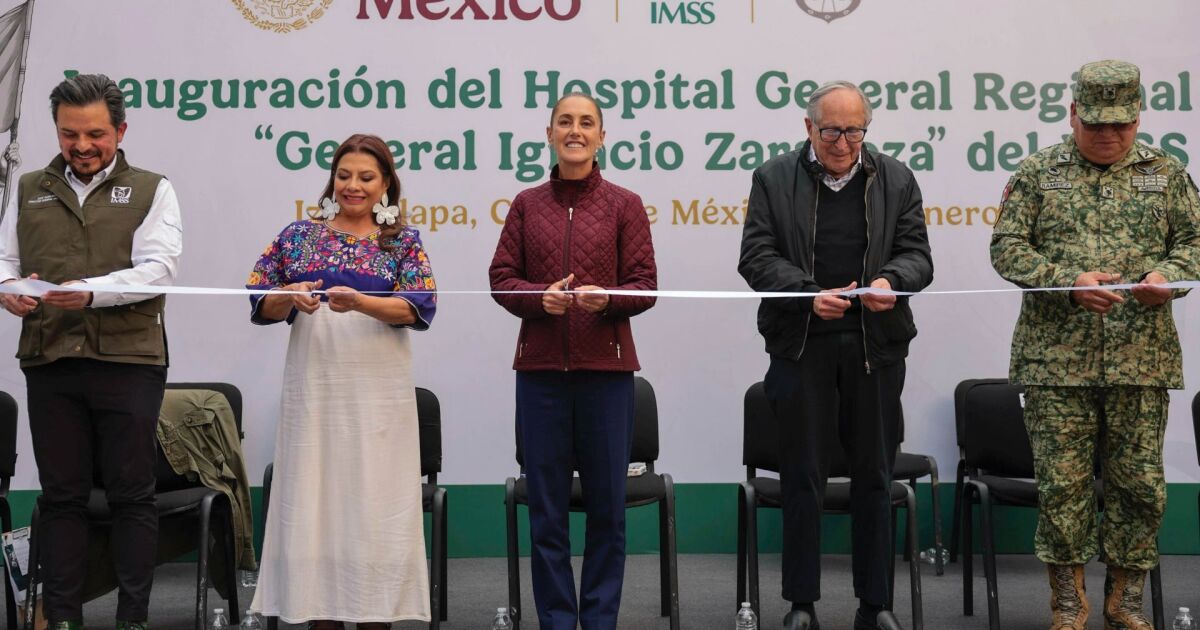
In Iztapalapa we inaugurated the “Ignacio Zaragoza” General Hospital of the IMSS, affected during the 2017 earthquake. It now has 35 specialties and state-of-the-art equipment. pic.twitter.com/lzFFqgAFpx
— Claudia Sheinbaum Pardo (@Claudiashein)
January 17, 2026
The president added that this process will allow laying the foundations for a unified national health system, with gradual implementation.
“In 2027 we are going to start with some services; in 2028 others; in 2029 more, and in 2030 a universal health service in our country,” he said.
Likewise, he announced complementary actions such as the rehabilitation of the Darío Fernández hospital and the strengthening of health centers, including the installation of laboratories to avoid unnecessary transfers of patients.
During his speech, Sheinbaum contrasted this model with the policies of previous governments. “Previous governments saw access to health as a commodity. We believe that it is not a privilege nor something that must be paid to be valued; it is a right of the people of Mexico,” the president stressed, recalling that the right to health is enshrined in the fourth constitutional article.