As part of the actions of the Electricity Sector Development Plan (Pladese) and the Mexico Plan, the Ministry of Energy (Sener) this Monday invited the private sector to invest in new renewable electricity generation projects, in accordance with a new binding planning scheme of the Mexican State.
The invitation came after this Friday, October 17, Sener published in the Official Gazette of the Federation the Call for Priority Attention to Applications for Electricity Generation Permits, which establishes the route for individuals to develop power plants under the binding planning of the electricity sector to 2030.
The issuance of the Call represents a milestone in the energy policy of the governments of the so-called Fourth Transformation, since during the six-year term of former president Andrés Manuel López Obrador, few generation permits were issued to private companies.
A climate of tension also prevailed in the sector, given the criticism from Obrador that in the government of its predecessor, generation permits – mainly those for solar and wind sources – were granted in a chaotic manner, without taking into account aspects such as the reliability of the electrical system or the interconnection of the plants.
The Call from President Sheinbaum’s government once again extends its hand to private generators, but under new rules, since the authority will grant permits only if the projects conform to the binding planning of the State.
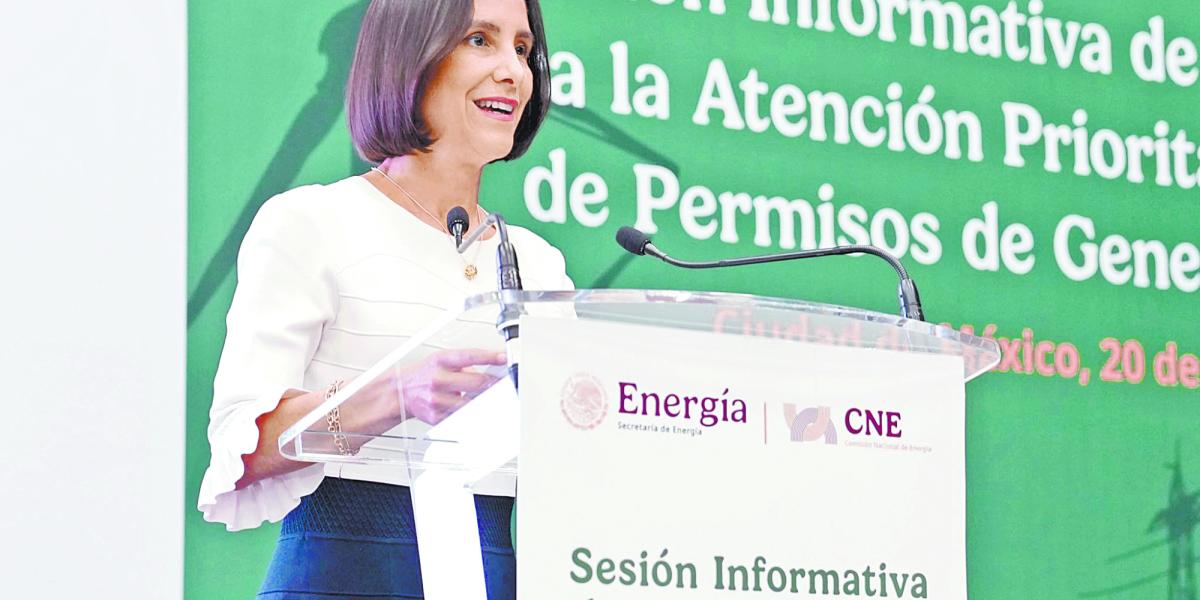
“As a result of this binding planning, the need arises to identify the electricity generation projects that best contribute to the country’s energy needs in the coming years and the identification in which regions and with what technologies these projects should be carried out to guarantee reliability and energy security,” Luz Elena González, head of Sener, said this Monday in an information session of the Call.
The Call proposes a series of key dates starting this October 20 for interested parties to express which generation projects they are interested in and present all the required documentation.
It will be on December 10 when the National Energy Commission (CNE) determines which permits it approved and the list will be announced on December 11. To conduct all the procedures, the CNE enabled the Single Window for Strategic Projects in the Energy Sector (VUPE).
According to Pladese, the projects will provide a capacity of 6,000 megawatts, which represents an approximate investment of 7.14 billion dollars. Of this capacity, 3,790 megawatts correspond to photovoltaic energy generation and 2,100 megawatts to wind energy.
The new goal of the Mexican government is to reach a 38% participation of clean energy in consumption by 2030, after the last administration failed to meet the goal that Mexico committed to in the Paris Agreements, of reaching 35% in 2024 (it fell 13 points below).
“It is a call that represents a challenge for the State and for private companies; as a State we are committing to having the resolutions and evaluation (of the permits) in record time,” said González.