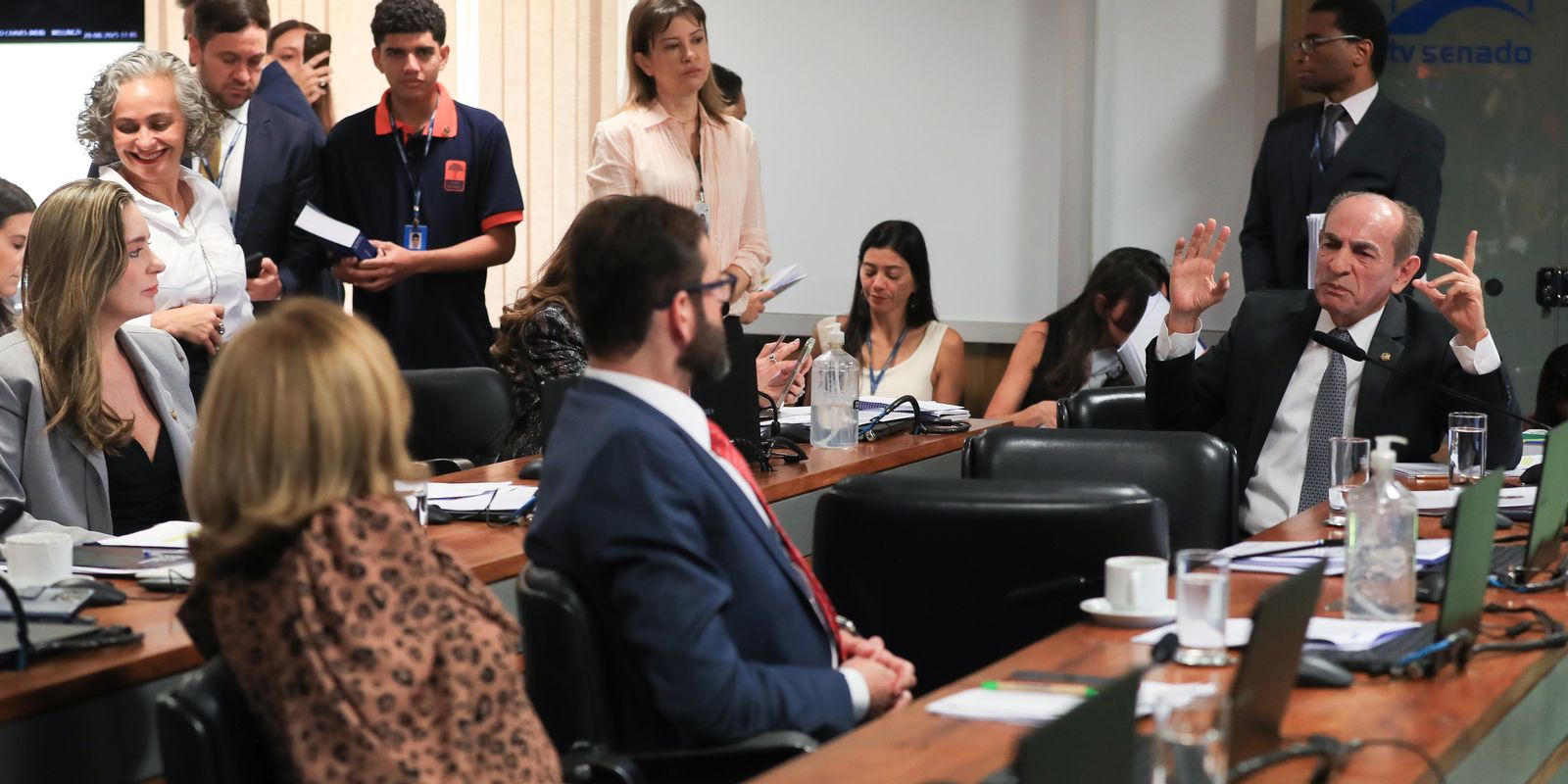
After several POSTS THROUGH THE YEARwas approved by the Senate Constitution and Justice Commission (CCJ), on Wednesday (20), the Complementary Bill (PLP) that creates a new Electoral Code in Brazil with almost 900 articles.
THE PLP 112/2021 It unifies seven legislations and was changed at various points last week to meet parliamentarians’ requests.
At the CCJ meeting, three highlights were approved with new changes involving female participation in policy, use of the candidate’s own resources to play campaigns and Printed vote institution.
The female bench managed to approve of 18 votes against 5 to maintain the obligation of 30% of women for each party, just as it is today. The proposed text ended this obligation.
In addition, the project sets a 20% quota for women in the Federal Chamber of Deputies, as well as state and municipal assemblies.
Now PLP 112/2021 must follow the Senate Plenary. As there were changes, the article will be analyzed again by the House.
To apply in the next elections, the new rules need to be sanctioned until a year before the 2026 election.
Fake news
PLP 112/2021 was approved after the rapporteur, Senator Marcelo Castro (MDB-PI), reduce the penalties for those who disclose fake news To damage the electoral dispute, as well as exclude the penalty for those who promote lies to delegitimize the electoral system.
The opinion approved at the CCJ provides for a prison sentence from two months to one year, or a fine, for those who disclose “known facts in relation to parties or candidates and able to influence the electorate”. In the previous text, the penalty was one to four years of detention.
Measures to combat fraudulent news was target of criticism of parliamentarians of the opposition. Castro argued that, in the face of such divergence, he decided to change the text.
“We took everything that criminalized the question of fake news That came from the House and we put what already exists today in the legislation that we approved in 2021, even unanimously here in the Federal Senate, ”explained the rapporteur.
Electoral system
The rapporteur also removed from the text the punishment for those who disclose known news to delegitimize the electoral process. “The mere criticism of the electoral service and the voting process is not a crime,” said the rapporteur.
In a previous session, Marcelo Castro stated, in response to opposition criticism, that attacking the electoral system was different from criticizing the electoral system.
“It is a discrediting movement of the electoral result to promote a rode and discredit the elected. It is totally different from criticism,” said Senator Marcelo Castro in June.
In the last election, supporters and former President Jair Bolsonaro denounced, without evidence, that the electoral system would not be safe.
The practice has been understood as part of the strategy to create a mood for coup in case of defeat, according to the investigation that is processed in the Federal Supreme Court (STF) about the coup plot.
Female participation
The proposal approved by the CCJ reserves 20% of vacancies in the federal, state and municipal parliaments for women. The rule is valid for 20 years.
According to the proposal, only 20% could enter the candidate who had at least 10% of the electoral quotient defined in each election.
The electoral quotient is an average calculated based on the number of valid votes and vacancies disputed and used to prevent people with few votes from taking a chain in the legislature.
On the other hand, the rapporteur’s opinion overthrew a 30% quota for female candidates per party, maintaining the current requirement of the 30% funds from the Electoral Fund for women’s candidacies, regardless of the number of candidates per caption.
Senators Zenaide Maia (PSD-RN), Dorinha Seabra (União-TO) and Soraya Thronicke (Somos) criticized this change. For Zenaide Maia, the change is a setback regarding women’s participation in politics.
“Brazilian women, what will be voted here today is to take a right of us with a lot of struggle, given by the judiciary, it was not from this house. And know what will happen?
The rapporteur argued that the 30% vacancies for women do not guarantee female participation, but the resources, which were maintained.
“Obligation of women’s candidacies does not elect women, does not increase women’s female participation in politics. It is a fight in vain. It is money that is important in women’s candidacies,” he said.
The rapporteur’s position was won by prominence presented by the female bench and approved by 18 votes against five. With this, the current rule that reserves 30% of vacancies for women candidates is maintained.
Quarantine
Another change made by the rapporteur to fulfill requests from senators, in particular, of the opposition, was the reduction of quarantine for judges, prosecutors, police and military personnel to apply to elective position from two to one year.
This period of one year, however, would only be valid for the 2028 elections. Police officers in administrative functions would not have this quarantine, and could leave their duties only six months from the election, as with occupants of other public office.
The argument was that these functions – from military, prosecutors, police and judges, can be instrumentalized to pursue opponents and unbalance the electoral process.
“We credit that the period of a year before the election, although shorter than the previously proposed, is the minimum necessary to rule out the influence that these public agents may have in an election and ensure equality between candidates, without injuring the passive electoral law of these categories,” the rapporteur wrote in the opinion.
Printed vote
The opposition justified that the printed vote would pacify Brazil in a context of accusations, without evidence, against the electronic ballot box made by the supporters of former President Jair Bolsonaro.
“We have to pacify the country. For God’s sake! The question is not wanting to be right, it is being happy. So, to pacify the country and be happy, it is the printed vote,” said Senator Carlos Portinho (PL-RJ).
The CCJ approved of highlighting the obligation of the printed vote in the text, a measure already considered unconstitutional by the Federal Supreme Court (STF). The text was approved by 14 votes against 12.
According to the approved text, “the ballot box will print the registration of each vote, which will be deposited automatically and without manual contact of the voter, in a previously sealed place; III – the voting process will not be completed until the voter confirms the correspondence between the content of his vote and the printed registration and displayed by the electronic ballot box”.
The amendment also states that the new model must be implemented in the following election the approval of the project.
Own campaign resources
The third highlight approved by the CCJ was that of Senator Jaime Bagattoli that allows a candidate to use his own resources until the stipulated ceiling of spending for the campaign that disputes.
“It is impossible for us to accept that one citizen gets $ 3 million from the party fund, and the other, who wants to put his money, can only put 10% of this value, $ 300 thousand. We have to equalize, and this is not abuse of economic power of the candidate who has the money. He can put the 100% to the maximum ceiling,” said the senator.
For the rapporteur Marcelo Castro, the possibility of rich candidates playing until the ceiling of the campaign itself unbalances the electoral process.
“We have increased self -financing to 20%. Now, increasing to 100% is good for those who are rich, but who is poor? It loses equality of conditions among candidates, it is completely unequal,” he said.
Other topics
PLP 112/2021 that creates the new Electoral Code unifies seven legislations in force and deals with the most diverse topics involving elections in Brazil.
The project sets ineligibility for convicted under the Clean Record Law; stipulates rules for inspection of electronic ballot boxes; prohibits mass messaging on social networks; Regulates the use of Artificial Intelligence (AI) prohibiting technology manipulation to artificial images or voices.
In addition, it creates more rigid rules for the dissemination of voting intentions, despite releasing research dissemination on the previous day of the election, which is prohibited today.
PLP 112 also establishes new rules for campaign accountability: Electoral Propaganda on the Internet, among other topics.