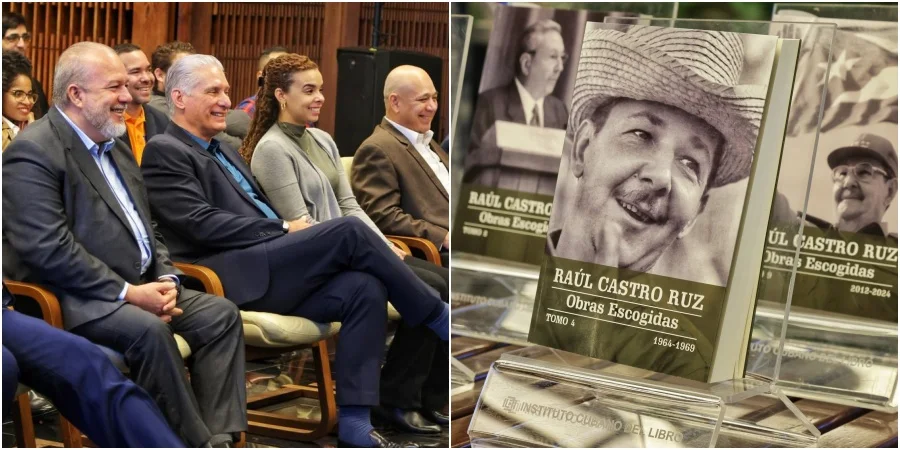
MIAMI, United States. – Miguel Díaz-Canel led this February 24, at the Palace of the Revolution, a new public presentation of the Selected works of Raúl Castro Ruz before 100 young people, in a ceremony that the Presidency of Cuba framed as “a historic day” for the anniversary of the restart of the wars of independence.
On social networks, the Cuban Presidency specific that the collection consists of nine volumes and brings together “more than 500 documents” in about 5,000 pages, prepared after “a meticulous and constant work of four years.” The Selected works, which consist of a prologue by Díaz-Canel himself, were presented to the Cuban rulers by the historian Elier Ramírez and the intellectual Abel Prieto.
The event is not a new editorial launch, but rather a political relaunch of a collection that had already been publicly presented on October 3, 2025 at the José Martí Memorial, also with Díaz-Canel at the helm.
A key element of the background is financing and logistics in a country with chronic paper shortages. In October 2025, 14ymedio He stressed that, “if this editorial feat was possible on an island without paper and with few functional polygraphs, it is because China financed 3,000 printings,” and maintained that the collection was privileged “among the few Cuban publications” in the midst of an “editorial blackout.”
🇨🇺| Along with a hundred young people, the President @DiazCanelB attended the presentation at the Palace of the Revolution of the Selected Works of the Army General, Raúl Castro Ruz, on a historic day for #Cuba: February 24, restart of the struggles for the nation’s independence. pic.twitter.com/6WIlsViMiw
— Presidency Cuba 🇨🇺 (@PresidenciaCuba) February 24, 2026
Official rhetoric has been consistent and explicitly laudatory. In October 2025, a text published by Cuba in Summary —presented as “notes for presentation”— described the collection as a way to approach Raúl Castro’s personality “in a new way.” “They are summarized here (…) 70 years of an exemplary and heroic life, which we now have as a formidable guide to ethical behavior in revolutionary action,” wrote Díaz-Canel in the prologue of the Selected works.
The staging of this February 24 at the Palace of the Revolution—with young people as the central audience and with a discourse of “ethical compass” and “arsenal of ideas”—reinforces the logic of political canonization that had already been exhibited in 2025: editorial production, distribution and public narrative appear subordinated to a legitimation operation, even in the midst of an unprecedented economic and material crisis.
Along with the official narrative of exaltation, questions have circulated from critical spaces. In an opinion article published by CubaNet in October 2025a journalist close to the edition of the Selected works ―whose identity was protected to avoid reprisals― maintains that the compilation responds more to a symbolic operation than to a social demand in the midst of the economic crisis.
The text states that, given the “impossibility of seeing at least one of the volumes completed, due to the lack of content”, the team in charge would have had to “invent more than one letter that he never wrote, more than one speech that he never gave, and extend (like soy mince) other writings that barely had the size of a memorandum.”
He also assures that Raúl Castro himself “had to, personally, amend and delete ‘sensitive content’” and that, after multiple corrections, certain documents “ended up being ‘something else’ far removed from their original meaning.”
The columnist adds that the first version delivered “only managed to reach four volumes,” and that they insisted on completing nine volumes, “one for each decade of life,” despite warnings about the brevity of the available material. In his opinion, the decision to call them “selected” and not “complete” would obey a symbolic strategy to project the image of a thinker.
The text also questions budget priorities amid blackouts and shortages. He points out that, “according to sources within the Council of State and the Armed Forces,” “more than five million dollars would have been allocated to import the paper from China,” while editorial production financed by the Ministry of Culture continues to be paralyzed.
Likewise, it mentions that the future publication of the 23 volumes of the “complete works” of Fidel Castro would have “a cost of more than 10 million dollars.”
In his conclusion, the columnist states that the authorities “do not have solutions to the problems that overwhelm us,” but they do offer “nine volumes of Raúl Castro (…) like bricks clanged against our heads,” in critical reference to the contrast between the promotion of these collections and the material difficulties faced by the population.