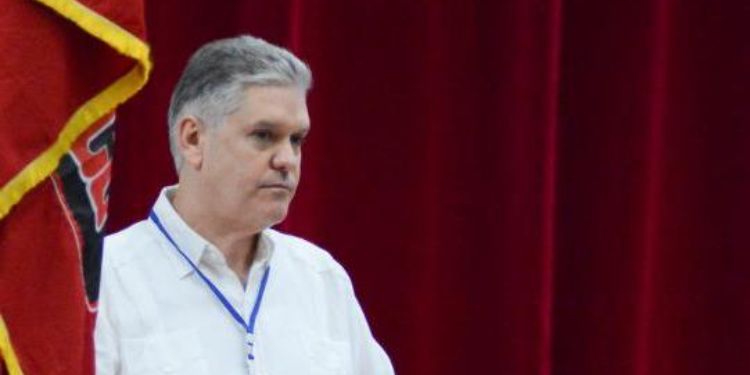
A source close to the case of the former Minister of Economy leaked information that until now the Castro regime had kept secret.
LIMA, Peru – The trials against the former Minister of Economy and Planning of Cuba, Alejandro Gil Fernández, concluded days ago on the Island, leaving more questions than answers.
This Saturday the journalist Mario J. Pentón from Martí News He offered new details about one of the questions that surrounded the process since the regime made the accusations public: the charge of espionage accused of Gil Fernández.
In conversations with the former minister’s sister, María Victoria Gil Fernández, the Cuban revealed that the regime accuses him of spying for the United States Central Intelligence Agency, popularly known as the CIA (for its acronym in English).
A source close to the case that María Victoria describes as “reliable” leaked the information that until now the Castro regime had kept secret.
“Alejandro Miguel Gil Fernández categorically denies each and every one of the facts linked to espionage (…) He has flatly denied it point by point since the beginning of the investigations,” stressed the former television host.
Likewise, the Cuban resident in Spain acknowledged in the interview the conflicts between Gil Fernández and the current Cuban Prime Minister, Manuel Marrero Cruz, whom she recognized as one of the main figures in her brother’s fall from grace.
“Marrero is the person who has been in front of and behind this entire process against Alejandro Gil. In some ways I think it has also been cruelty. The economic crimes that are attributed to my brother (…) Marrero has committed five more times,” María Victoria highlighted.
The Cuban regime advertisement In March 2024, the start of an investigation against the former Minister of Economy for “serious errors committed” during his administration.
At the end of October, the Attorney General’s Office (FGR) reported having presented the criminal action and the case file to the Supreme People’s Court (TSP). The FGR then stated: “Responsibility was requested for the crimes of espionage, acts detrimental to economic activity or contracting, embezzlement, bribery, falsification of public documents, tax evasion, influence peddling, money laundering, violation of the rules for the protection of classified documents and theft and damage of documents or other objects in official custody,” the entity indicated.
For its part, the TSP assured that “in compliance with due process,” the lawyers and the accused would have had “access to the file and the provisional conclusions of the Prosecutor’s Office.” However, by invoking “reasons of national security,” the judicial authority restricted access to “the parties and persons authorized by the Court,” which excludes citizens and the press unless expressly authorized.
The position of the former minister’s family has been to ask for maximum transparency. Before the trials began, Alejandro Gil’s daughter demanded an open process: “I join the popular call for the trial to be public, televised, with free access to the international and independent press.” And he announced that his father would not plead guilty: “He will not recognize ‘under any circumstances’ any crime; he will defend each of his actions, and with evidence.”