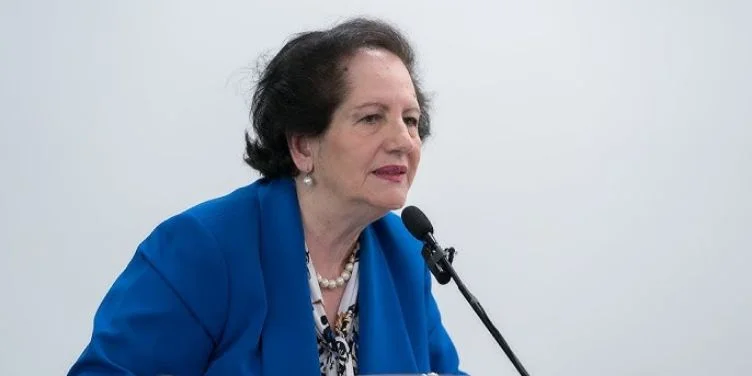
Sara Martínez Castro was born predestined to be a poet and fighter for the sensitivity and impetus of justice that emanates from her lyrical creation.
Exile is the nostalgia that Gatea
For memory. It is reading
interrupted from a novel that
It is the story of a life.
Nedda G. de Anhalt
Miami, United States. – I dare to state that Sara Martínez Castro was born predestined to be a poet and fighter. And I say it for the enormous sensitivity and impetus of justice that emanates from his person and lyrical creation.
Sara opened the eyes to the world in Cueto, small town of the then province of Oriente, Cuba. It grew near sugarcane plantations, sugar plants that smelled of molasses and fertile tillage lands, cut out of fruit and grassland trees that fed cattle, sheep, etc. And in that environment – from roosters that sing in the early morning, in which they distill perfumes of homemade gardens, wild flowers and also from which, not far, it runs, like that of José Martí, a murmur stream – Sara studied the primary and superiors. At that stage of existence he wrote poems, the first, children and youth. Then the pre -university (baccalaureate) took in the nearby city of Holguín.
And, in full apogee of Castro-Communism, at the end of adolescence, Sara and immediate family, after passing vicissitudes and humiliations, they start, as political exiles, heading to the United States.
Already in lands of freedom and settled in the city of Miami, while doing poetry obtains a degree of associate in Miami Dade Community College. It also takes courses of Spanish and Spanish -American literature in St. Thomas University and receives a certificate of journalism from the Koubek Memorial Center from the University of Miami.
Since then, work, among other activities, as a translator, and militates in the anti -Castro struggle organization Alpha 66where he exercises, until now, as a Cultural Affairs Coordinator. It is associated with literary groups and clubs of exile and soon its valuable versification, in which the sonnet predominates, is disseminated in newspapers, specialized magazines and are collected in prestigious anthologies and shared works, with other authors. And, as she understands that the Enlightenment is a formidable instrument of struggle, against totalitarian tyrannies, in the current directive of the Cuban writers Pen Club in exile, presides over the prison writers committee.
In 1986, under the Seal of Hermes Editions, he publishes the poems entitled The loneliness stoppedwho begins with a brief dedication to her husband and fellow fight in Alpha 66: “To Diego, guest of this loneliness”. Years later (in 1999), suddenly, the spouse, Diego Medina, Doctor of Medicine, and the father of the, then, little target, the fruit of the love of a couple dies. Then, in the timelessness in which Anida pain speaks to Diego:
I keep silent and silence can
Ask my pain like a grill.
You are present, love, that’s why it happens
The anguish without touching me.
Sara Martínez Castro has written; He continues by writing poetry, but, a woman linked to the native land, human and Christian beliefs, has never clusted in her principles. That is why I take the work as a starting point The loneliness stoppedwhose 45 poems are grouped into four parts or chapters. But, also, I add others, in this review, belonging to its wide creative production.
Guiating for personal feeling, I share some verses of the author, in which the hunger of nostalgia vibrates, product of unwanted remoteness and uprooting; All imbued with love, patriotic feelings and thirst for justice, not yet realized:
And who says I want to be brave
When I can’t be what I was:
The girl who loved spring
And he wanted to flourish among the people.
In the poet’s pupils, he was forever recorded, the breakup that the gloomy Castro-Communist entertainment imposed on the Cuban family. And at the moment of the farewell; Obliged game that, in memory, never expires, she expressed with bleeding pain:
Uncle Manuel was at the crossroads,
closer to us – but sullen.
He did not want to say goodbye; A year ago
that carries our absence in the look.
However, hope, that does not give up arbitrariness, is projected in the valid desire and says:
I dreamed of returning to my town,
with being again in my landscapes,
waking up my colored yesterday
Again by the park.
Fully convinced of the coat and love that the family, with national taste, provides taxes to those who gave the being:
My father was very child
Sometimes I feel a little orphan,
Despite the big hands of his hands,
Despite Carrero’s shoulders …
And thinking about the mother exclaims:
I was the first of your tree
And the first star of your sky,
The one that adorned your belly of songs
And of astonishment your chest.
Sara Martínez Castro, consistent with her status as an exiled politics, committed to freedom to know, in 1970, the infamous news of the fall in unequal combat, in the province of the East, of Vicente Méndez, member of Alpha 66, writes:
Vicente Méndez, courage
of a dreamy guajiro,
Faithful soldier, with pain
From homeland you started the trip …
AND, Approximately two years after death, in captivity, during heroic hunger strike of the leader Pedro Luis Boitel (1931-1972), proclamated, convinced of the immortality of the righteous:
His heart went early
To tell God our martyrdom …
Nor is Sara’s poetics alien to the tragedies that occur in the sea, because of the exit of Cubans, in precarious vessels, struggling for escaping the “Castro Paradise that builds new men.” Therefore, aware that two mothers were rescued from a rabid Caribbean Sea, hugging the small bodies, already lifeless, of the fruit of their entrails, the creator’s pen, with tears of lucrative pain, asks and pray for Cuba:
Today I ask for buried blood …
By the bottom of the hallucinated sea,
Therefore sudden broken child
And the stubborn lonely hope …
The loneliness stopped And the rest of Sara Martínez Castro’s creative firmament, with deep footprints in the before and now that demands future justice, make up a necessary work that is inserted in the best of Cuban literature and forces to quote the English poet John Donne: “No person is an island; the death of anyone affects me, because I find it together with all humanity; for that reason, you never ask who you double the bells.