“I don’t want to go back,” author Denis Imanov wrote in a Russian media after a 16-day trip to the island.
MIAMI, United States. – Denis Imanov, author of an article published last Sunday on the Russian portal Bryansk He assures that he spent 16 days in Cuba and that he does not wish to return, after alluding to a combination of high prices for visitors, deterioration of hotel services and constant pressure on tourists to spend or pay commissions.
The text presents the experience as a direct criticism of what it describes as an economic model that “extracts” resources from the visitor without offering equivalent quality standards.
The axis of the story is the contrast between the money that circulates in tourist areas and the income of the Cuban state sector. Imanov writes that “when you pay 40 dollars” for a taxi from the “José Martí” International Airport to the center of Havana “you commit an act of economic aggression,” and concludes with a comparison: that sum would be equivalent to the “monthly salary of a surgeon or an engineer of the highest category.”
Indeed, the average state salary in 2025 on the Island was 6,685.3 Cuban pesos, around 16 dollars per month at the informal exchange rate.
The article of Bryansk insists that tourism in Cuba does not operate as a “normal” market exchange, but as a forced contribution. “In Cuba you are not a guest; you are a donor in a system (…)”, says the author of the article. Along the same lines, he maintains that a $10 meal—“dry rice with chicken,” according to his description—functions as a reminder that certain spaces are inaccessible to “the locals.”
Another central part is criticism of the hotel industry. The text introduces the section “Five-star mold: the illusion of luxury” and questions that facilities that charge “200 dollars per night” do not meet international standards. “It’s Cuba!” concludes the text. The author attributes the normalization of failures in hygiene, lingerie, and food to the same idea.
Imanov also dedicates a segment to what he calls “the ‘tomorrow’ philosophy,” comparing it to the Thai culture of “sabai-sabai.” There he describes a logic of tipping as a requirement to receive attention. The text speaks of “hostage service,” and maintains that staff “wait” for extra payment before performing basic tasks.
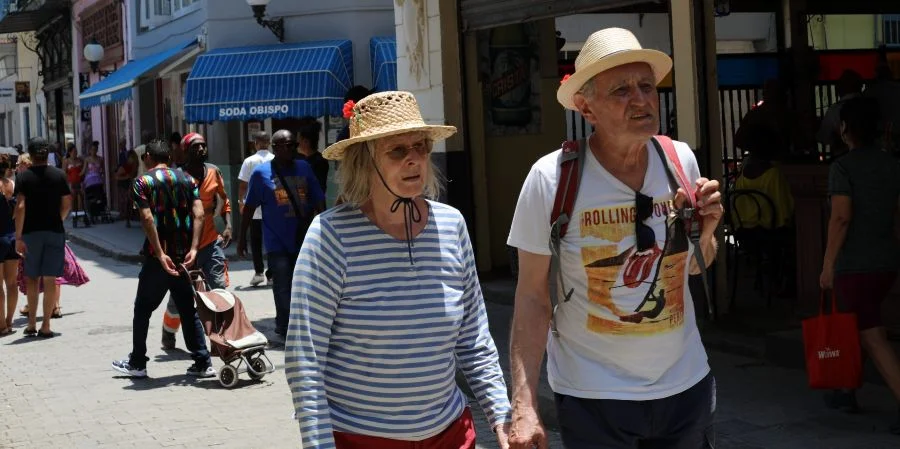
In the street shot, the author portrays Havana as a photogenic but exhausting place to walk due to commercial pressure. “Everyone sees you as an ATM” and mentions guides that lead to “the best stores” with inflated commission prices, sellers of counterfeit tobacco and constant “buy, give, help” offers.
The closing of the Russian text is a verdict: Cuba “is worth seeing once” for old cars, the Malecón or Trinidad, but traveling for “rest, gastronomy or service” would be “an expensive mistake.” The author also concludes that “financing” an economy that offers “nothing” at the price of “everything” does not pay off.