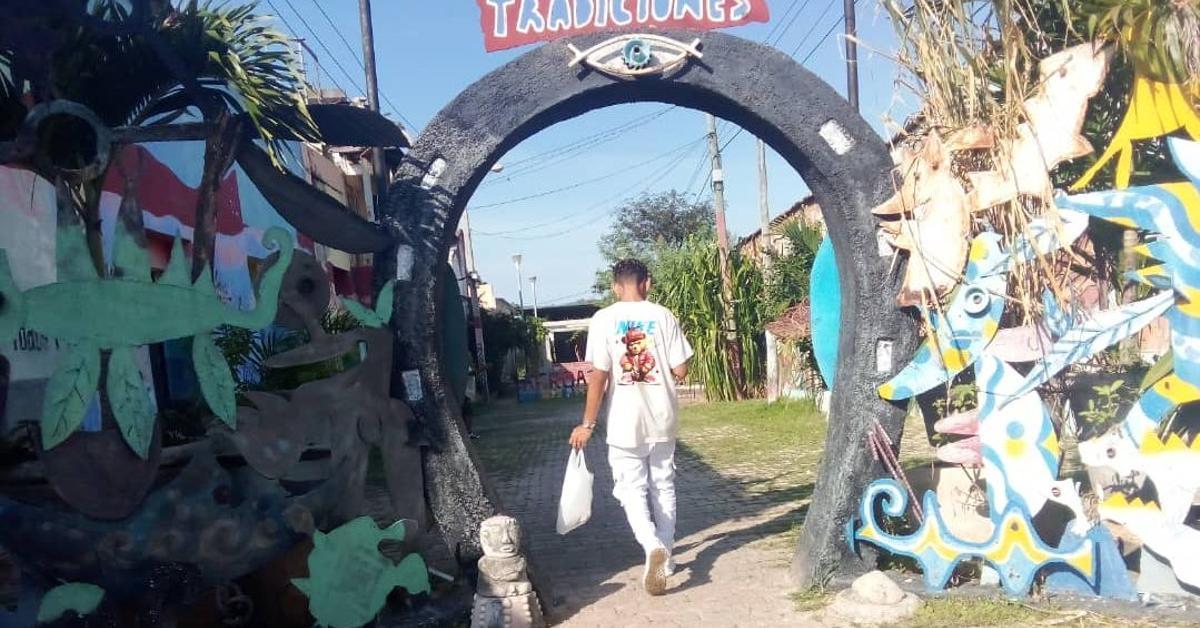
Matanzas/When the music turns off, when the tourists leave and the officials put their speeches in the drawers, the Callejón de las Tradiciones returns to being what it has always been for its inhabitants of Pueblo Nuevo, in Matanzas: a place where survival begins right where cultural statistics end. The murals full of colors and Afro-Cuban symbols barely manage to conceal the poverty that is hidden behind the facades, built – many of them – in the 19th century and in a dilapidated state.
“On the outside it’s full of graffiti, but one of these days the roof will fall on me,” he tells 14ymedio a neighbor sitting at the entrance to her house, on the same staircase where amateur artists once posed for official photos. The woman prefers not to say her name. Maybe out of fear, maybe because she is tired of speaking without being heard. “It hurts to see how the leaders come, put their hand on my shoulder and then hide in their offices so as not to attend to me.”
The alley, located between San Juan Bautista and San Francisco streets, very close to the old Matanzas railway line, has been growing as a community space since 2009, when the AfroAtenas project decided to “rescue” the area. The official press then presented it as a cultural corridor inspired by diversity, a tribute to rumba, masks, and deities. But it is enough to stop in front of the walls to notice that the paint is peeling, that humidity is creeping up again on the colors and that daily life is seeping through the cracks.
/ 14ymedio
“At that time they cleaned the garbage dump and painted the facades. But the walls continue to rot. Everything is designed to save appearances,” says the woman, who lights a candle every night for her saint to intercede for the construction materials that she was promised two years ago. On the same block, another neighbor is waiting for a subsidy to repair the pipes in his house. “Every now and then we collect for a pipe with water,” she explains. The water arrives, curiously, when there are official visits or cultural events. “When they announce the visit of someone important, they immediately begin to enter. That lasts as long as the show“.
A boy sits on the porch of his house, focused on a cell phone, a short distance from the crumbling mural; an older man dozes on a cement bench decorated with mythological figures; A lady drags a wicker chair over the uneven pavement, in front of a façade where a text promises “House of Blessings”, although inside the leaks, when it rains, keep the family in check.
According to the historical chronicles of the neighborhood itself, published a few years ago in the local press, the Callejón de las Tradiciones was once a center of spontaneous cultural exchange, where rumba and popular dances emerged without microphones or institutional agendas. The neighbors still remember the improvised batey, the religious meetings, the parties that lasted until dawn. Today, that spirit coexists with accentuated precariousness and the need for state institutions to exhibit “community impact.”

/ 14ymedio
Neither the entrance arch nor the presentation platform have managed to return the promised good living to the neighborhood. A poster announces the concert of a singer from Matanzas, canceled several times due to blackouts. “What no one says is that this neighborhood was considered conflictive,” says a man who refuses to play the drum with people not initiated into the Yoruba religion. “So the solution they found was to put this cultural surveillance on us.”
Next to it, murals of giant eyes, printed hands and symbolic creatures share space with worm-eaten doors, broken windows and walls that require more than a coat of paint. In the immediate surroundings, it is not unusual to find a neighbor selling rum, cigarettes or soap to complete the day’s meal. The domestic economy is improvised with what is at hand, with what appears.
“They say they want to rescue traditions, but why don’t they bring a construction brigade to repair the houses?” asks one of the area’s most respected residents. For him, there are two realities: the one that is shown to the visitor who comes to consume the cultural product and that of those who live with minimal pensions, with mattresses replaced by sacks and with roofs about to collapse. “Rumba alone does not take away hunger.”
The Alley of Traditions, despite the welcome doll and the metal sculptures, has continued to be a neighborhood forced to “invent itself every day,” as confirmed by a neighbor who teaches the neighborhood children the fundamentals of Abakuá culture. The true tradition – that of resisting, that of surviving – occurs behind the walls, where the paint falls off and the officials no longer arrive.