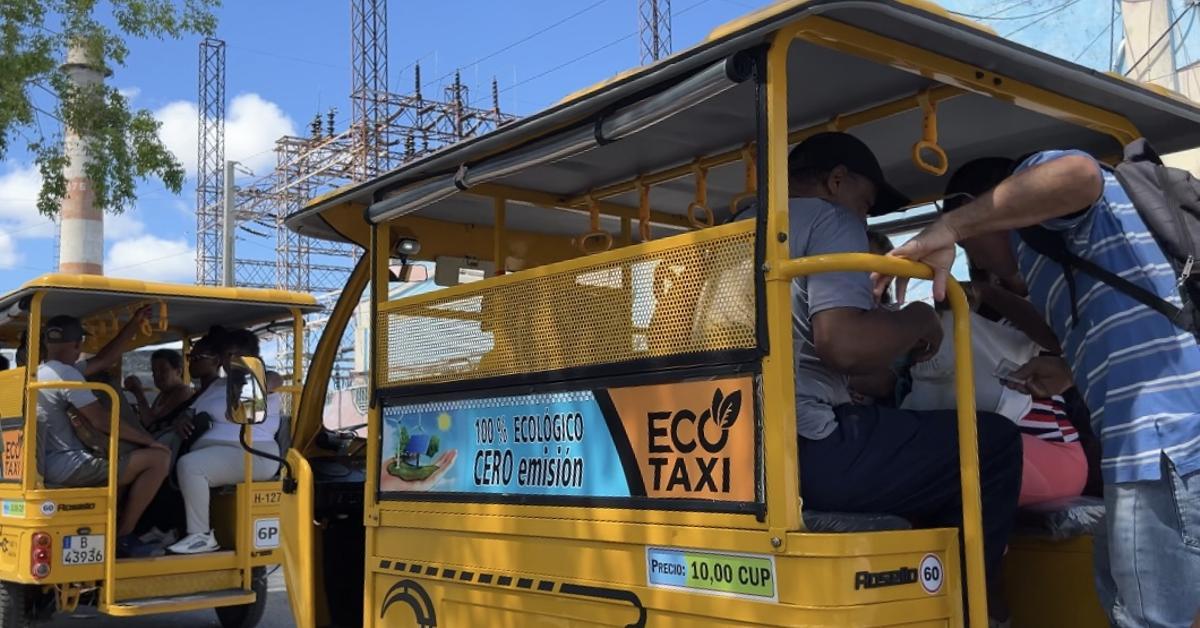
Havana/The expansion of the electric tricycles service in Havana has reached the municipality of Rule, where in recent days several units were launched in a short section that connects the boat of La Lanchita with the old oil refinery of the Shell company, on the outskirts of the town. With a rate of 10 pesos, vehicles seek to relieve the strong urban transport pressure, but the first trips have shown more deficiencies than solutions.
“They started three days ago,” says a resident who has closely followed the premiere of the service. “They arrive fast, but they are far from satisfying the demand there.”
Electric tricycles appeared in the capital in 2020 as part of a “neomobility” project supported by international cooperation, and in 2021 they began to join regular routes. The declared objective was to cover short journeys with more sustainable and accessible vehicles, offering a complement to collective buses and taxis. However, From the beginning Technical limitations – especially batteries and maintenance – have restricted their impact.
/ 14ymedio
In August 2024, the Government raised the price of trips of 4 to 10 pesos, a rate that is now in order. At the end of that year, the number of tricycles that circulated in the capital was around 118 units, distributed in 15 routes throughout eight municipalities, according to official data. Despite the incorporation of 35 new teams, the authorities recognized problems of technical availability and frequent failures, and the increase in The blackouts Multiply doubts about the effectiveness of this strategy.
The town is a point of high demand, especially since there lands the little boat that crosses the bay from old Havana. As soon as passengers arrive by sea, state tricycles are surrounded by the competition of private vehicles, which offer longer and expensive tours.
“There comes the little boat, and the private tricycles are planted there and reach Guanabacoa and Havana, at 150 and 200 prices, but much further than the Shell,” says the neighbor. The difference in rates and distances shows the contrast between the official service, restricted to a short section, and the private supply, capable of adapting to the demand although at a much higher cost.
The confusion of the first days has also been noticed. “There are normal confusion, because they are the first days, and the drivers reach the little boat, when they should not. The first stop is in the Parque de las Mothers,” he adds. The testimony points to a lack of organization in the design of the stops and the improvisation of the drivers to approach the flow of passengers that leaves the jetty.
A few meters from that point, a microbuses where they link with different destinations from the capital works. “Next to gazelles For Havana, but that is delayed more, in addition to having greater demand. That crowded stop is, among others, for the A29, towards Guanabacoa, ”he says.
“These tricycles are a patch, far from solving a real problem,” summarizes the rule neighbor. His trial coincides with what other capitalists have already expressed in neighborhoods where the service has been operating for months.