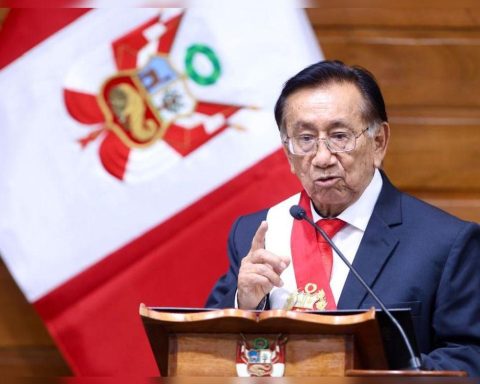
The congressman Fernando Rospigliosi intensified pressure on the Judiciary to apply Law 32107, that opens the door for crimes against humanity to expire, despite questions from the Public Ministry, Bar Association and human rights organizations due to the impact that this norm would have in emblematic cases of serious violations.
listen to the newsText converted to audio
Artificial intelligence
Through a letter addressed to the head of the National Authority for Control of the Judiciary, Roberto Palacios, Rospigliosi urged that ex officio action be taken against judges who do not apply the rule and that this could even create functional responsibilities. “The Constitutional Court in the exercise of its functions has issued an express statement through which it has declared the constitutionality of Law 32107, urging that said rule must be applied by all jurisdictional bodies,” reads its letter.
WE RECOMMEND YOU
JOSÉ JERÍ “FULL MACHINE” AND ELECTIONS IN THE JNE | WITHOUT SCRIPT WITH ROSA MARÍA PALACIOS
Besides, Rospigliosi points out that there are jurisdictional bodies that issue resolutions that ignore, contradict or do not apply the law despite the ruling of the TC. However, Peru is subscribed to the Inter-American Human Rights System and has ratified the American Convention on Human Rights (Pact of San José), which obliges judges to interpret and apply internal regulations in accordance with international standards on human rights.
“Notwithstanding this, it has been learned that some jurisdictional bodies could be issuing, or eventually issuing, pronouncements or resolutions that ignore, contradict or do not apply the aforementioned law, despite the existence of a clear, express and binding pronouncement from the highest interpreter of the Constitution, without a reinforced constitutional motivation that validly justifies the exercise of diffuse control, which could compromise the proper functioning of the justice system and the principle of legal certainty,” he added.
It is worth remembering that in March of last year, a judge of the Second National Preparatory Investigation Court refused to apply this law in the case of the leader of the MRTA Victor Polay Campos and other defendants.
The judge argued that The norm contravenes the imprescriptibility of serious crimes and may imply impunity. Polay’s defense had invoked the law to prescribe crimes against humanity, but finally the judge determined that the regulations of the Constitutional Court allow diffuse control to be exercised over its inapplicability in specific cases.
Law 32107, which was approved in August 2024 by Congress, specifies that crimes against humanity and war crimes are only applicable to acts committed after July 1, 2002, when the Rome Statute came into force in the country, and for previous acts it refers to the prescription periods in force in the 1991 Penal Code, which raises questions about its compatibility with the principle of imprescriptibility of crimes against humanity recognized in international human rights treaties to which Peru is a party.