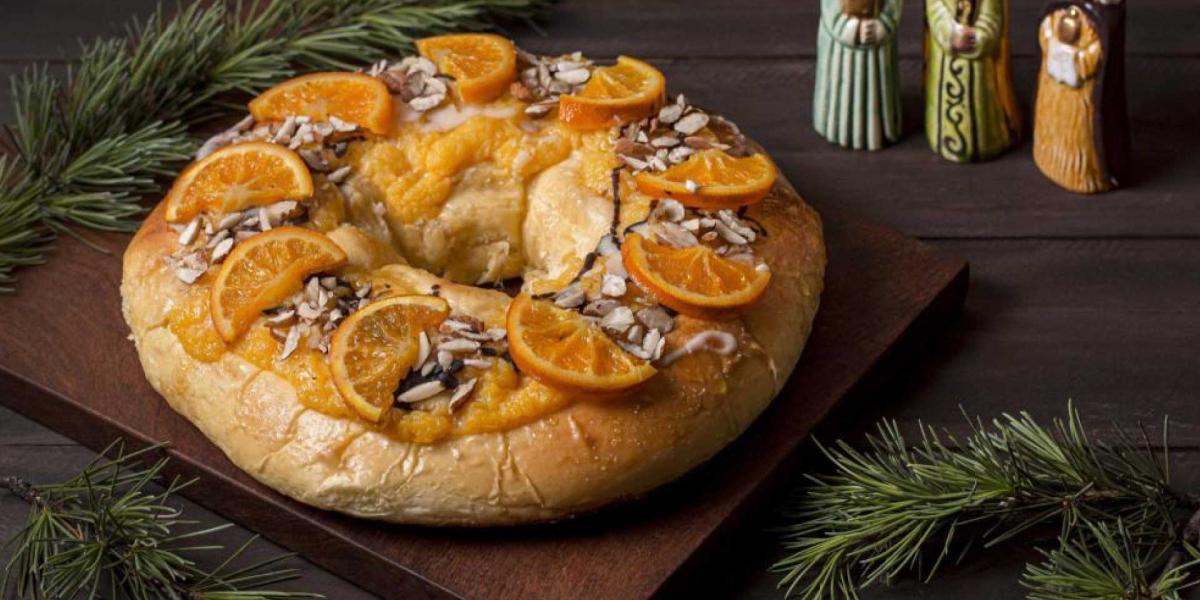
Every year, the Rosca de Reyes It appears punctually in bakeries and family tables to mark the symbolic beginning of the festive calendar. It is not just any bread: its presence activates a collective ceremony made of repeated gestures, nervous laughter and future promises. Breaking a bagel is, above all, sharing a story that has been told for centuries through bread..
The tradition of the thread dates back to the Christian celebration of Epiphanywhich commemorates the visit of the Three Wise Men to the baby Jesus. In Europe, since the Middle Ages, special breads were made for this date, designed to be divided as a community. With the arrival of the custom to New Spain, the recipe was transformed: local ingredients, mestizo baking techniques and a new sense of party made the thread its own symbol within Mexican gastronomic culture.
The form as a message
The circular or oval silhouette of the bread does not respond only to an aesthetic decision. It represents eternity, endless love and the continuity of time. In Mexico, this symbolism acquires a social reading: the thread is not eaten alone. Its shape forces you to distribute, sit together and accept the portion you get, reinforcing the idea of equality around the table.
The best Roscas de Reyes.
The crystallized fruits that decorate the surface of the thread function as a visual language. They symbolize the jewels in the crowns of Melchior, Gaspar and Baltasar. For decades, citron was the protagonist of this iconography; Today, its use has been replaced by alternative fruits due to the protection of the biznaga, without the meaning being lost. Bright colors evoke abundance, celebration and offering.
The doll and its deep meaning
The small doll hidden inside the bread is the symbolic heart of the tradition. It represents the hidden baby Jesus to protect him from the persecution of King Herod. Finding it is not a joke or a punishment: it is assuming a community commitment. Whoever discovers the doll becomes the host of the next meeting, inviting the tamales on February 2, Candlemas Day, extending the celebration beyond January 6.
In different regions of the country, several dolls are placed inside the thread to distribute responsibility.. The filled versions—with cream, cream, chocolate or cajeta—respond to contemporary tastes, but they do not alter the symbolic structure of the ritual. Even the act of breaking the bagel has unwritten rules: you don’t choose the slice, you accept it; You don’t look for the doll, you find it.
The Rosca de Reyes is one of the clearest examples of how Mexican gastronomy functions as a social fabric. It’s not just about flavor or technique, but about belonging. Around this bread, generations cross, ties are strengthened, and the year is inaugurated with a simple but profound gesture: sharing.