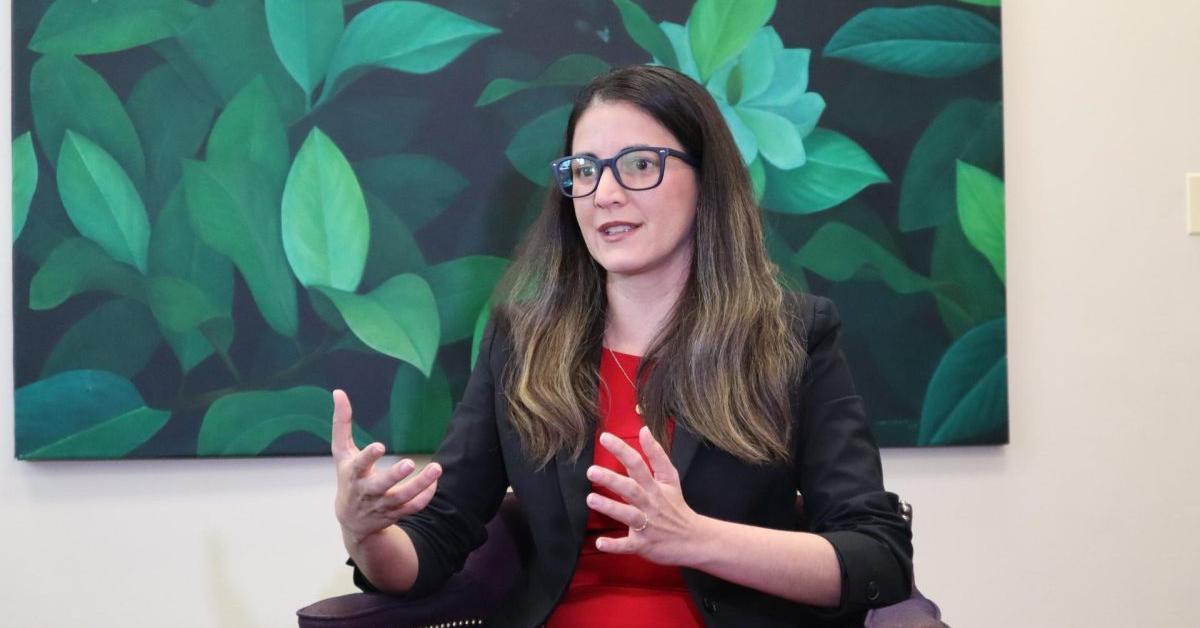
Washington/United States candidate for the Inter -American Commission on Human Rights (IACHR), Rosa María Payádaughter of the Cuban dissident Oswaldo Payáproposes to improve the functioning of the organism from its own experience as a victim of human rights violations.
“I have been a victim. I have seen my family suffer and die, my compatriots and friends live in anxiety just for not having basic rights,” says the 36 -year -old activist with Efe.
Payá took to the IACHR the case of his father’s death in a suspicious car accident in 2012 in Cuba, for which the body held the Cuban state After ten years of process.
“I have seen my family suffer and die, my compatriots and friends live in anxiety just for not having basic rights.”
“The only instance of accountability that my family has obtained is precisely the report of the commission,” he recalls. “I want the same and something better for each citizen of the Americas who have seen their repressed rights,” says Payá, who says he has been able to know first hand both the lights and the shadows of the commission.
Rosa María Payá was nominated by the administration of Donald Trump as a member of the IACHR and received the commission from the Secretary of State, Marco Rubio, of Cuban origin.
Founder of the Cuba initiative decides, which advocates the democratization of the island, Payá argues that it is marked by “an adult life dedicated to the defense of human rights” and that has worked with civil society organizations from Canada to Chile.
That experience, he says, has allowed him to clearly identify the challenges faced by victims, as well as the limits of the current system.
Ensures that the IACHR can and should be more accessible, faster and more relevant to the victims
It ensures that the IACHR can and should be more accessible, faster and more relevant to victims. It is an autonomous body of the Organization of American States (OAS) in charge of ensuring the protection of human rights in America.
“I think I can contribute a lot to the commission’s work by bringing those voices, the voices of the defenders and the victims, to the commission,” he says.
Payá identifies four especially serious human rights crises in the region: Haiti, Cuba, Venezuela and Nicaragua.
Although those last three countries do not participate in the Inter -American System, Payá emphasizes that the IACHR maintains jurisdiction over its cases and that the commission must continue to make those violations with their recommendations.
On the situation in his native Cuba, he denounces a deep energy, health and food crisis “while the Cuban military maintain millions of euros in foreign banks.”
As a Cuban and American citizen, he cannot participate in the decisions made by the commission on those two countries
As a Cuban and American citizen, he cannot participate in the decisions made by the commission on those two countries, but states that “of course” will continue to fight for the “recovery of democracy” on the island.
“I think it is clear that the exit of the crisis goes through the exit of the dictatorship and in that direction the states should support,” he says.
Asked about the hardening of Trump’s migratory policies and the sending of migrants, accused of criminals, to the Megacárcel of El Salvador, Payá replies that each State is sovereign to define its rules.
However, he argues that the function of the IACHR is to ensure respect for human rights in all contexts.
“I am also a migrant in this country (USA) and my role in the commission will be to ensure that the human rights of migrants are fulfilled,” he says.
The OAS General Assembly will choose in June, in Antigua and Barbuda, to the three vacancies of the IACHR from among seven candidates presented by the Member States.