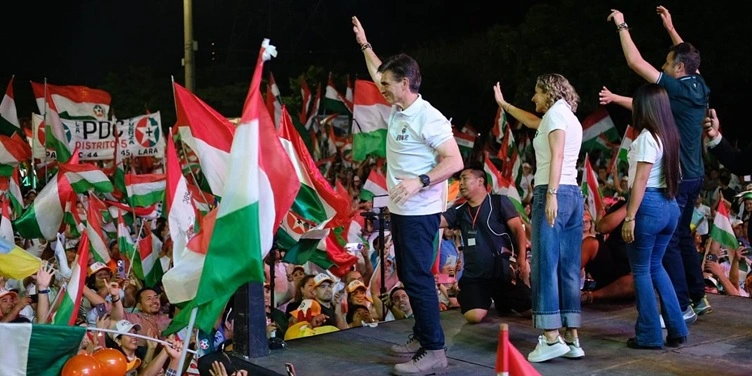
The triumph of the centrist candidate in the Bolivian runoff specifies the political possibilities that are open to the country.
HAVANA, Cuba.- This Sunday the second round of the presidential elections was held in fraternal Bolivia. The centrist Rodrigo Paz, winner of the first round, and the right-wing former president Jorge (Tutorial) Quiroga, a very sharp man, whom I had the honor of meeting in person when the Castro-communist regime still allowed me to travel abroad.
According to data from the electoral body, the victory belonged to Paz, who obtained more than 54.5% of the valid votes. The defeated Quiroga recognized his opponent’s victory and ruled out fraud. The information published about it right here on CubaNet puts – I think – the finger on the sore point: “For the first time in two decades the Movement towards Socialism (MAS) did not participate in the electoral contest.”
One can only boast of that reality: To the great luck of our Bolivian brothers, there the “socialism of the 21st century” did not reach the levels of bossiness and virulence that have been enthroned in Nicaragua and Venezuela. (And note that I mention these two countries because in them, in principle, the participation of opposition candidates is still admitted; even if the dictators put them in prison or declare them losers after having obtained more than two-thirds of the votes… I do not even mention Cuba, because here the control has reached the extreme of only admitting the presentation of government candidates and, to make matters worse, in a number equal to the number of positions to be filled, so that they are all! “elected”!…).
But since I’m talking about bossing around, I can’t help but allude to the audacity exhibited in these elections by the unpresentable former president Evo Morales. A fugitive from justice, the founder of the MAS remains a refuge among his coca growing partners from El Chapare, who support and protect him.
In the first round, Morales, prevented from running himself or supporting any of his supporters, called for the vote to be annulled. On that occasion, Rodrigo Paz obtained some 1.7 million votes; Quiroga, just over 1.4; and the voided ballots were just under 1.2 million. To begin with, we must point out the obvious: even if someone (in this case, Evo) has called for the ballots to be invalidated, there are always ignorant or clumsy voters who, if they annul their ballot, do so out of ignorance; not in response to a slogan. Despite this, Morales had the audacity to claim victory, stating that, supposedly, he had won the null vote!
The position that this man has now assumed represents a total disrespect for the intelligence of others. Despite having insisted that the vote be annulled, he now affirms in a tweet: “Paz and Lara won with the evista vote”; boasts: “1.3 million of the null vote defined the second round”, and makes an insane statement: “It is clear that the vote was more against Tutorial”…If any reader can explain to me how a null vote can express support for a candidacy!, I would appreciate it if you could clarify it for me.
But enough of paying attention to this fugitive from justice, who, without a doubt, among the coca plantations of El Chapare is in a more appropriate place for him than the Presidential Palace of La Paz. With the very important decision that the Bolivian voters have just made, new promising perspectives open up for the fraternal Andean country.
Logic indicates that, to begin with, the new President Paz, once he takes office on November 8, takes concrete steps to put an end to the deep economic crisis in which his country is mired. This is, of course, not an accidental fact, but rather the inevitable consequence after decades of applying the counterproductive measures of bureaucratic socialism.
From this concept alone it is reasonable to expect that a notable change will occur in the economy of the Altiplano country. I think that, on a political level, we should be a little more restrained. Mr. Paz does not have a majority in the so-called Plurinational Legislative Assembly. But it is to be expected that he will obtain certain support from those political forces that are hostile to Bolivian socialism.
Colleague Gabriela Moreno has published in PanamPost an article with an ambivalent title: “Bolivia the day after; a weakened left and continuation of the status quo.” The text begins with a hopeful statement: “Changes are coming for Bolivia. That is not up for discussion.” But a little later, he clarifies. “However, everything indicates that the current panorama will be maintained in some scenarios.”
I believe that this more nuanced approach reflects the perspectives that are now opening up for the Altiplano country more objectively than the optimistic headline of DW (Deutsche Welle): “End of the socialist era in Bolivia.” I hope I’m wrong for having those precautions! But I do trust that, even if it is not with the desirable speed, under the presidency of Paz Pereira steps will be taken in that desirable direction.
For now, there has already been information that predicts a normalization of the Andean country’s foreign ties. The most important democracy on the Continent and in the world has already expressed its satisfaction. The State Department reported: “After two decades of mismanagement, the election of President-elect Paz represents an opportunity for transformation for both nations.” At the same time, Infobae inform: “Rodrigo Paz announced that Bolivia will reestablish diplomatic relations with the United States after 17 years of rupture.” Let us hope that, at the same time, the new president establishes a policy of principles towards Cuba, Venezuela and Nicaragua.
All that remains is to wish our Bolivian brothers that, under the new president they have just elected in democracy, they begin to emerge from the crisis that bureaucratic socialism put them in and strengthen the rule of law and respect for citizen freedoms.