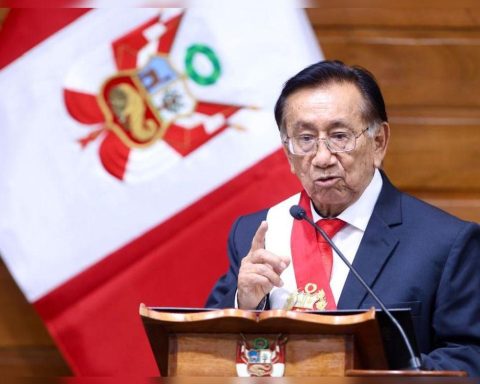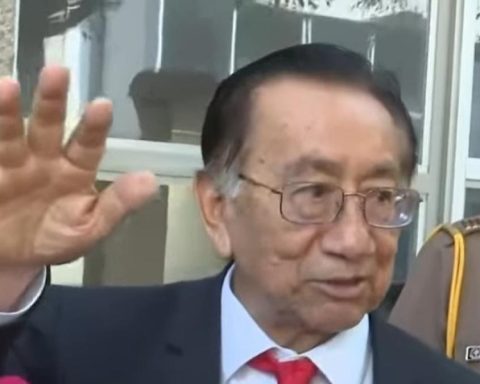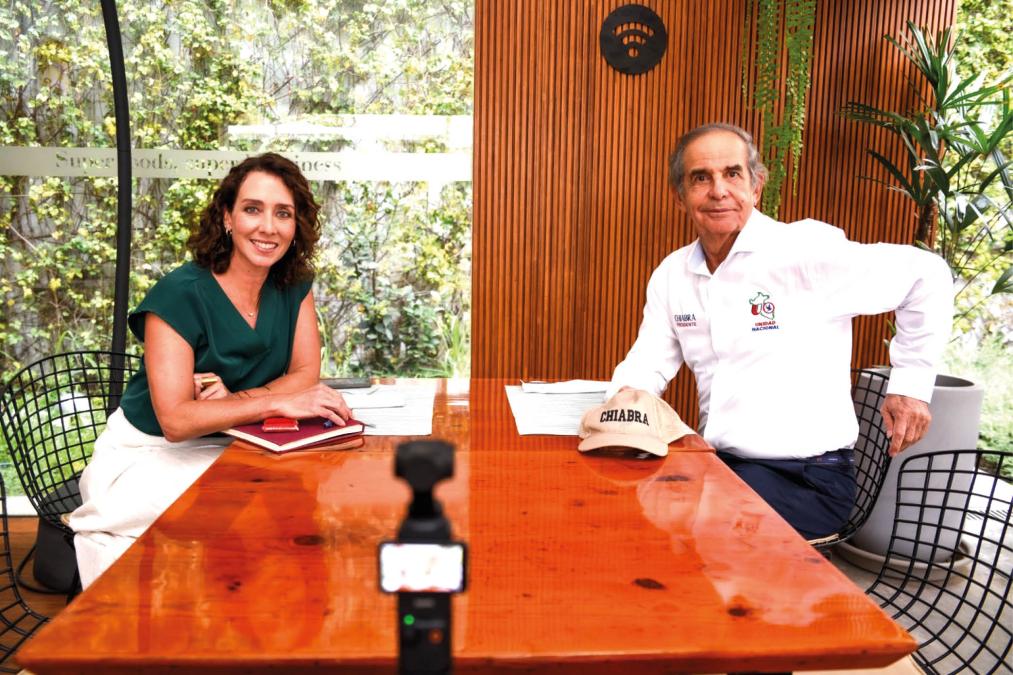
A military man by training, Roberto Chiabra had to experience Fujimorism from the inside, when disagreeing had a cost and he paid it. His critical stance left him out of the Army after a military inspection against him when he was a brigadier general, although years later the balance turned again in his favor. With Alejandro Toledo he returned to the institution, became General Commander of the Army and then Minister of Defense, in the midst of the task of rebuilding the relationship between the Armed Forces and democracy.
Today Chiabra no longer wears a uniform, but he has not let his guard down either. From civil politics he is currently a congressman – he arrived with the Alliance for Progress and then became independent – and now he also heads a presidential formula of a party alliance with the intention not only of competing, but, as he says, of seeking with strategy and conviction a pass to the second electoral round.
The most recommended way to avoid having a list of candidates was to form alliances, but few were achieved.
This shows that in Peru we are difficult to unite, even in difficult situations. The three of us feel proud because we have registered without cheating, also because we have made the effort to leave personal and party issues for a national issue. And because we believe that Peru needs to add strengths to be able to manage a moment like the one we are experiencing.
Although the PPC was also part of an alliance with APRA, but it did not work out. Why would it work with Roberto Chiabra?
I believe that they have learned lessons from that experience and there is also a renewal.
Although there are old people, of great value and great prestige who have held positions in the ministries, which helps a lot, especially for the formulation of the government plan, there is also a renewal of young people. I believe that every negative experience always comes out with something positive.
What lessons do you have from this Congress, where you ended up independent and therefore with difficulty presenting bills of law?
The ideal is that the benches that enter finish. What cannot happen again is that we enter 6 and finish 13 with some who have been on different benches. That harms democracy, it harms the functioning of Congress as well. I have a very good relationship with the bench and I had the possibility of presenting projects where they supported me.
What is the greatest parliamentary achievement you have had?
I have different projects, mostly related to people’s rights and I also have projects that have to do with education. But I think that my greatest parliamentary achievement has been the issue of oversight, of representation. There are many Peruvians who need to be represented by authority. There is a distrust in the authorities and congressmen, in addition to legislating and supervising, have to represent where you generate trust in those who ask you for a service that is not a favor, that is part of your job.
Has it been very difficult to work in this Congress?
As you say, it’s difficult. There are 130 of us and in Peru we have the bad habit of generalizing, we have disqualified and generalized. All congressmen are bad, all police officers are bad, all lawyers are bad and that’s not the case. Because we are not all the same. The idea was for it to be a government that turns on the engines of the economy that were turned off for two years by Covid.
How did that idea break down?
When you find a president who starts talking about the rich and the poor, the people of Lima and provincial projects. That he went to the secret cabinets, where he incited violence. So that ruined the whole relationship.
But there was no longer a good relationship after so many changes of president.
We are all responsible, although the Executive is more responsible. I believe that neither Castillo, nor Dina, nor now Jerí have realized what an honor it means to be president of the Republic. The office of president has been devalued.
Since when has the presidential figure been devalued?
I believe it has been devalued since President Belaúnde left in his second government. I was dean of President Belaúnde in 1983. A decent and cultured person and in those times not even flies entered the Government Palace. Only those who had an appointment and with the authorization of the aide-de-camp entered. Today at least 80% of the staff who are working have to leave there.
Would that be the first step to return to having national dignity?
Look, the first step would be to reduce bureaucracy. And bureaucracy is related to corruption. We have high bureaucracy, low efficiency, great corruption. The more hands a procedure passes, the more corruption. So, what you have to do is give the country a strong, agile and efficient State. Strong with the presence of the State throughout the territory. The State is not present in the entire territory.
Are we talking about military or police presence?
Presence and development. When we talk about the borders, it is not just the soldiers, it is the comprehensive border development. There are towns on the border that are not physically united, where teachers or doctors do not go, because not even the bonus they give is enough for them. What future do these young people have? What opportunity? None! And since they have no education, they have no health and are dedicated to the illegal economy. You have to physically integrate the territory. Moral poverty must be overcome. What is moral poverty? 41% of Peruvians spend days eating little and poorly, 43.7% of children under 5 years of age suffer from anemia and 12.1% with chronic malnutrition, eight million Peruvians who have not finished school education. There is no state policy.
How would Roberto Chiabra do it and in how much time?
Look, it takes time, but get things done. The project that I present is an articulated work and I relate it to the following. There is a lot of talk about the failure of regionalization. Regionalization has not failed, we are the ones who have failed. If in 2002 the politicians, the professional associations, the universities and the Chamber of Commerce, the governors, the mayors had come together, in the four years of his tenure there would have been progress along that axis. But there is no articulation and no one enters with objectives. Candidates make a laundry list. But for what? What is the main objective?
The issue is whether they would let him, because as things are, the vice presidents govern.
Look, if during the campaign you insult and disqualify your rival, you have to be very hypocritical to ask for help later. We do not disqualify anyone because we are going to need everyone, left, right, center. All. When there are specific objectives, who on the left cannot want their district, their province to grow? We have to leave chance, move on to planning and change the way of thinking and working. We must think long and big and work from the bottom up, from the districts, setting measurable goals.
What happens if your vice president stays? Would you work the same with him?
I’m going to stay for five years. I am an older person, I am an experienced person, I am a person who makes decisions and I am a person who meets with teams that know how to work. I’m not going in to learn. What mistake would I make to be removed at this point, having the honor of being president? I’m not going to let others get fat at my side.
But there will be those who want to get it out.
Leadership is what you exercise because of who you are and what people consider you to be. I’m going to work well. Reduce the amount of bureaucracy, facilities so that investors do not have the need to corrupt. That’s the first point. And then there are points such as those that concern the entire population, which is security, informal or illegal mining, the economies that are now active. I’m not talking about citizen security. Talking about citizen security would be talking about cell phone thieves, national security, even regional security. Here we have three enemies, common criminals, the criminal gang and transnational organized crime. Corruption, illegal mining and drug trafficking and related crimes, human trafficking, which is no longer a social problem, but a criminal economic problem, illegal logging, arms trafficking and smuggling. That is the enemy you have to defeat. But you are not going to defeat that because with populist proposals, the death penalty, that I am going to go to the pampas with blood and fire with the army, that I am going to put them all in military justice, things that you are not going to be able to carry out and you are going to blame the other. Then there must be a comprehensive, national, medium and long-term strategy to be executed permanently and simultaneously that has to do with prevention, intervention and resocialization. But you have to apply an immediate application strategy. And the big mistake is trying to apply a strategy for all of Peru. We are 25 different regions, a unitary country with 25 different regions. We were wrong, just like with Covid, by applying a single strategy.
What would you do with the police?
The question is, are organized crime the strong ones? Or are we the weak ones? We are the weak and the police, you have to strengthen the police, the police have to reform. You cannot have 27 training schools, you have to have 7 with infrastructure, equipment, organic plant and the forms with esprit de corps. I don’t need more police officers, I need police quality.
Let’s say you are given the chance to be president. How long will it take for Peruvians to feel a change?
From the moment you start taking measurable actions. Look, I’m too old to do TikTok. The difference between me and others is that I am the one who gives the guiding ideas, I am the one who gives the strategy and the others comply with them.
It seems like you were the one-man band.
No. I am the one who gives the guiding ideas, but I do not go into development, that is, the candidate gives the ideas in a general way: this is how I want health, this is how I want education, this is how I want security, but development is done by the people. I have Carlos Neuhaus leading the government plan. I pitch him the idea and he takes it, he has experience and he has people.
How is the campaign going?
I started a few weeks ago. I went north warming up, how do you say? Tumbes, Piura, Lambayeque, first nothing about the campaign. First of all, because we are not the big four that have everything. We have to do with each one’s resources. Unlike other parties, we have not charged anything to the candidates.
Unidad Nacional has not charged for its lists. That also differentiates us.
How do you think the polls are going to change?
There is a behavior of Peruvian voters that is permanent. They don’t decide in advance. There is the famous hidden vote and then there are the undecided, 40%, with the difference that today there is more knowledge and if the problem that Peru has is one of insecurity, who are you looking for? To a strategist, not an apprentice or one who says he has a team. I would bet on a strategist and that is my forte.
With a heavy hand?
With a firm hand. A firm hand means that you have to enforce the laws. We all talk about rights, no one talks about duties. That everyone’s rights are respected and that everyone fulfills their duties. We have come out worse. And the Peruvian has to choose. Why does he have to choose me? Because I’m not going to let him down. I am a person whose motto is that Peru respects and defends itself. And I am the general who is going to defend Peru. I have a background.