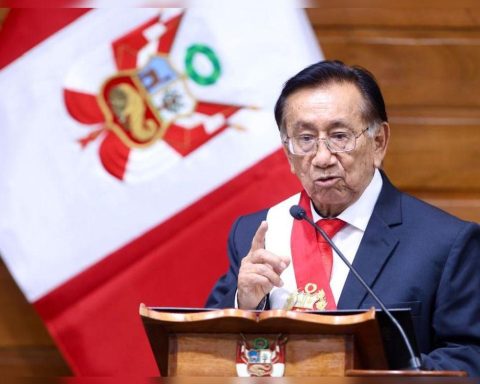
Recently, the Fiscal Council warned about the time bomb that Congress had activated on fiscal accounts by approving laws without identified financing. Robert ChangPeruvian economist, distinguished professor at Rutgers University, reflected on the seriousness of the problem.
The Fiscal Council has warned that the current Congress has approved laws with an identified unfinanced spending initiative for almost S/36,000 million. Why is this a problem?
Because this can cause public debt to begin to grow unsustainably. Historically, in Latin America debt problems have led to episodes of high inflation or even hyperinflation. If one looks at the history of Peru, the hyperinflationary process that culminated in 1990 with an inflation of 7,500% arose because persistent fiscal deficits increased the debt. Eventually, this became unsustainable and led the Central Bank to finance it through the issuance of currency, which ended up unleashing hyperinflation. Ultimately, that is the big problem that we are trying to avoid today.
Can the fact that laws are approved that promise benefits without financing, and then are not fulfilled, also generate social conflicts?
Yes, although that is not the issue on which the Fiscal Council has ruled. In essence, I think the biggest concern that the Fiscal Council points to is that, eventually, debt financing could destabilize the economy and destroy Peru’s great macroeconomic performance over the last 30 years. That is the great fear that economists have.
Looking back, what consequences has the country faced when it has had high levels of debt?
The most dramatic case ended in the hyperinflation of 1990. This problem gradually developed and began during the dictatorship government in the 1970s. Basically, since there was an oil crisis, the country began to increase its debt. At that time, for example, in the second half of the seventies, international interest rates were relatively low, and Peru began to go deeper and deeper into debt. Other Latin American countries did it too, not just ours. This was common practice until the early 1980s. Between 1982 and 1983, the United States began to raise interest rates, and Latin American countries entered the so-called debt crisis. Peru was no exception, but the way it ended up paying the cost of that debt was, effectively, through hyperinflation. The situation worsened when Alan García took office. Peru decided to limit debt payment and incurred an international default. García took advantage of the fiscal space he gained by restricting debt payments to around 10% of the value of the country’s exports, which was very little. He used that margin to implement a series of populist policies, including a fixed exchange rate and price controls, which generated large deficits in state-owned companies. Peru’s debt skyrocketed. Eventually, García’s strategy failed and he resorted to what is known in the country as “the little machine.” Around 1988, financing from the Central Bank to the Executive began to increase more evidently to cover the debt, and in 1989 and 1990 the situation exploded. Of course, there were other factors occurring at the same time. All this happened in a context of economic, but also increasing social and political degradation during García’s first government.
Another concern of the Fiscal Council is the high financial expenses. How relevant does this become?
Indeed, that is the big problem because budget resources must be sacrificed to pay interest. Additionally, the cost of financing debt also increases. That is, the effective interest rate rises when the debt grows, because the risk of default increases. Then, international markets start demanding a higher interest rate and that is also a big risk. At the moment, Peru is one of the countries in Latin America, or even the emerging world, with a lower country risk, but that can be lost. Everything that has been earned with effort and fiscal discipline in the last 30 years can be quickly lost if the country does not control its fiscal accounts. That is the great fear. And if that happens, not only the fiscal balance, but also the monetary balance, becomes much more fragile.
To what you already mentioned, how does it affect us as citizens that the Government lacks fiscal discipline?
When the government borrows too much, it eventually faces a series of options that are all bad. That is, it has to increase taxes to cover the debt burden; reduce spending, which means, for example, offering fewer services or laying off workers; borrow again, which only postpones the problem; or resort to dangerous financing from the Central Bank, which ends up generating inflation. Those are, basically, the alternatives. And with this I do not mean that having a deficit or going into debt is necessarily bad. For example, during the pandemic I think it was necessary for the government to spend what was required, but we are not talking about that type of context. We are talking about a situation in which, on a recurring basis, the Fiscal Council has warned that Congress approves laws that increase public spending without considering financing. Eventually, all that spending will have to be covered in one way or another: with more taxes or with more inflation. Inflation is a way to “make a dead dog” of debt.
Julio Velarde has repeatedly pointed out that the autonomy of the BCR has not only been preserved thanks to the 1993 Constitution, but also due to the fiscal discipline that has avoided resorting to the Central Bank to finance the deficit. Could the extent of high deficits and fiscal debt put the autonomy of the BCR at risk?
Yes, high deficits put the autonomy of the Central Bank at risk. What Velarde has emphasized is that the autonomy of the Central Bank is also a matter of institutional culture: the culture of maintaining both monetary and fiscal discipline. The recent positions of the Ministry of Economy and Finance have been disappointing because, in my opinion, they have been deviating from that culture. If we think about what happened in Peru after 1990, the country was devastated economically, socially and politically. Economic reconstruction convinced the vast majority of Peruvian economists with influence in macroeconomic management that it was essential to adopt strict fiscal and monetary discipline. Thus, many people of my generation consider the 2% inflation target, debt limits and fiscal rules as part of their professional “bible.” This discipline has allowed us to maintain the remarkable stability that Peru has experienced in the last 30 years. Recently, for example, Peru celebrated becoming the Latin American country with the longest period of single-digit inflation, and it is still building on that achievement. If we look at what happened in Peru in political terms and in the face of external shocks, this stability is, in a way, surprising. Another indicator is the exchange rate. Today it is around 3.40 soles per dollar. How much was it in the year 2000? Basically the same or greater. In that sense, Peru is the envy of many emerging countries. And all of this has been built on the basis of this economic culture that has guided macroeconomic policy in recent decades. That, precisely, is what could be lost little by little. The recent positions of the Ministry of Economy and Finance have been disappointing because, in my opinion, they have been deviating from that culture.
So do you agree with the Fiscal Council that there is also responsibility of the Executive in all this?
I think so. I believe that the Executive, and in particular the Ministry of Economy and Finance, as well as the president who has just left, Dina Boluarte, and President Castillo before her, could have been much firmer in enforcing the Constitution with regard to the limitations it establishes on the spending initiative.
It seems to me that what the Fiscal Council is suggesting is that it could be argued that many of the measures approved by Congress violate the Constitution, to the extent that they imply a spending initiative. And, according to the constitutional text, Congress should not do it.
Some media outlets are calling the Fiscal Council “neoliberal” because these spending laws are supposedly fair. What can we say?
That argument is fallacious. To begin with, the laws that the Fiscal Council has identified benefit, if at all, very small and specific groups of people, not the general population. That’s the first point. Secondly, could such measures be defended? Yes, but Congress should also be required to identify how they will be funded. That is, why not propose, for example: “we are going to increase the salaries of this or that group, but at the same time we will reduce inefficiencies in other areas”? And there are many. Parts of the budget could be reallocated or subsidies that do not serve their purpose could be eliminated. An obvious case is Petroperú. Why not say: “we are going to eliminate financial support for Petroperú to allocate those resources to other more necessary expenses”? In other words, many of the population’s demands are legitimate, but this does not mean that the fiscal deficit or debt should increase. There is a lot of inefficiency in public spending, a lot of bad design. And I think the effort should start by correcting that, rather than adding more and more spending, probably with the same or even worse level of inefficiency than today.
The Fiscal Council’s exercises have even been conservative by not considering natural phenomena such as El Niño or an earthquake. What measures should be implemented to help reverse the problem generated by Congress?
Well, these are rather legal issues in which I do not have a major comparative advantage. However, it seems to me that one possibility would be to require that proposals that imply increases in fiscal spending can only be considered if they are accompanied by a study or financing plan. That is, if it is proposed to increase, for example, the salaries of teachers in a certain region, as is the case with some of the laws mentioned by the Council, the fundamental question is: how would this be financed? Where would the funds come from?
I have a proposal: we should ban the phrase “we must.” Everyone constantly says “you have to do this, you have to do that.” There is already too much of the “must” without the “how.”
Receive your Perú21 by email or WhatsApp. Subscribe to our enriched digital newspaper. Take advantage of the discounts here.
RECOMMENDED VIDEO