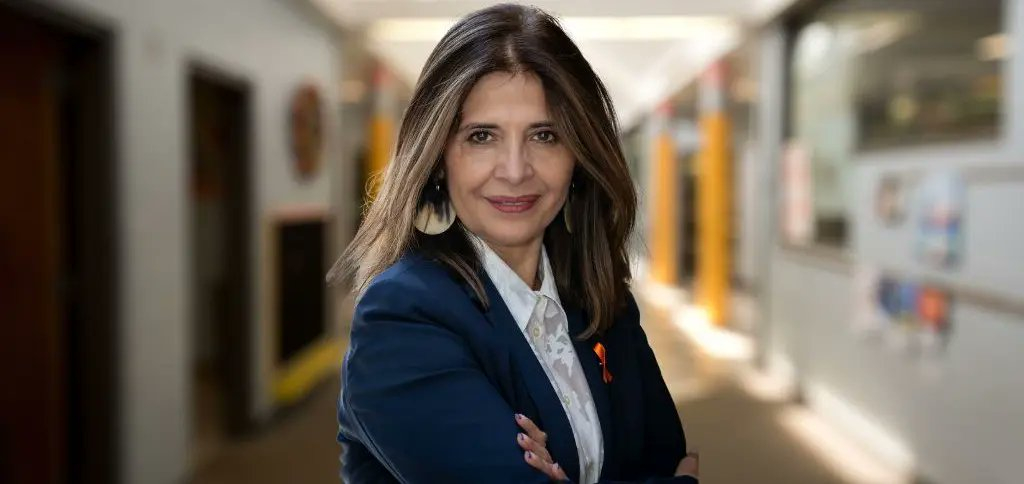
Within the framework of the thirtieth anniversary of international idea, the Republic spoke with the doctor Marcela RíosRegional Director for Latin America and the Caribbean of this Intergovernmental Agency created in 1995 by 15 countries. Although it is often confused with an NGO, an idea is actually an institution founded by states, with a trajectory closely linked to our region. Three of their founding countries – Chile, Costa Rica and Barbados – are Latin American, and today others such as Peru, Mexico, Brazil, Uruguay, Dominican Republic and Panama are added. Precisely, the idea office in Peru has a unique relevance: it is the oldest in Latin America and the second longest worldwide, with 25 years of work accompanying democratic strengthening in the country.
Céspedes: What do you think are the main challenges of democracy in Latin America?
Rivers: I think that Latin American democracies have always been challenged. The positive part is that Latin America remains the southern region of the planet with the greatest number of democracies. In spite of the IRES and going, it is a region that has embraced democracy as a preferred form of government. Although there are many times lack of trust or some disappointment from citizens, they continue to think that democracy is the best form of government.
It is also true that there are high levels of discontent with their democracies and with the way they work. We have a complex history in Latin America and today, globally, we are in a context of tensions and setbacks. Today we see more setbacks than advances: 54% of the countries have some type of deterioration in some of the more than 160 indicators that we monitor on democratic quality in four large dimensions. Only 32% show improvements. In Latin America these stagnations have been practically eight years, so they are not conjunctural, but rather structural. We are concerned to see how certain dimensions of democracy deteriorate in many countries and how, in our region, today we have more authoritarian regimes than 20 years ago. Today Nicaragua and Venezuela join Cuba and, unfortunately, also El Salvador to the regimes that are no longer classified as full democracies.
You can see: Editorial | The international community supports Peruvians in front of the regime
Céspedes: In the Peruvian case, the self -criticization processes for many have accelerated. How do these processes perceive international idea?
Rivers: First, it is important to verify that there is a global tendency of democratic deterioration, not only in a country or in a region. We see it even in advanced democracies such as the United States, or in Europe, with setbacks in countries such as Poland or Hungary.
In Latin America, in addition, the route of deterioration is different from that of past decades. Our history records numerous coup d’etat, but today that is not the tonic. The main threat is no longer the taking of power by weapons or by external actors, but internal deterioration: slow, progressive, using the rules of democracy to subvert its spirit. We see indefinite reelections, persecution of the press, manipulations in the appointment of supreme judges. They can formally be legal, but in practice they break the counterweights.
Reforms that seem harmless, seen in isolation, accumulated generate a deterioration of free competition, counterweights and the exercise of rights. Those are the main challenges and we see them with enormous concern.
Our call is to take care of democracies. Once they are lost, we do not know how or when they recover. Preventing setbacks is much easier than reversing them, as we see in Nicaragua and Venezuela. These internal, gradual processes are a tracing of the regimes already considered dictatorships.
Céspedes: What should be the priorities of citizens to prevent these processes from growing up to become uncontrollable?
Rivers: There are multiple tasks, which compete with different actors: politicians, elites, media, academics, universities. It is crucial to protect the autonomy of the autonomous organs in a rule of law. That means taking care of the nomination processes of authorities so that they do not distort themselves based on private interests. If autonomy and technical capacity with state vision are lost, democracy undergoes severe deterioration.
We need referees, controls and counterweights. On the part of citizens, easy solutions are sought to complex problems. But democracy is not fast. A dictator can make immediate decisions, because he does not consult or deliberate. Democracy, on the other hand, requires time and respect for minorities.
In addition, the main current problems – socio -economic, insecurity, climate crisis – are complex and require science, data and learning of international experiences. The shortcuts do not ensure success. We must encourage civic pedagogy and broad dialogues.
An enormous additional challenge is the misinformation and use of artificial intelligence in politics. We have seen its impact in Argentina, Chile and other electoral processes. The proportion of false news against true can be 5 to 1. that generates toxic public debates, based on lies, instead of programmatic discussions. For idea, this is a priority issue.
Céspedes: Politics is changing, society too. You mentioned science, data and innovation.
Rivers: The new generations demand other things: speed, solutions to problems that did not exist before. Our studies show that young people in Peru are particularly critical and are dissatisfied with institutional functioning. They expect much more from politics and are disenchanted.
Céspedes: Young people have other ways to communicate.
Rivers: And other ways of interacting. Institutions and the State must adapt to these new realities, look for new communication and interaction channels.
In spite of everything, we remain convinced that democracies are resilient. In critical moments, citizenship and institutions have managed to save democratic processes. We saw it in Brazil, in Guatemala, with mobilizations of young people and indigenous peoples who stopped attempts for democratic interruption.
Céspedes: Peru suffers a similar inmine.
Rivers: We have faith that Peruvian, critical and active society, with a mobilization tradition, can resist. We have seen it in communities, small cities, with students, women, indigenous peoples and entrepreneurs willing to dialogue if the conditions are generated. We need more spaces for genuine consultation and participation.
But there are strong threats, such as illegal economies, which not only replace the State in some areas, but also penetrate politics through corruption and illicit financing. They are a direct enemy of democracy.
Céspedes: How does these threats observe idea?
Rivers: Criminality and illegal economies are one of the great challenges. Security is a basic human right and cannot be negotiated in exchange for democracy. States must guarantee security respecting the rule of law, due process and human rights. Hard hand discourse cannot serve as an excuse to weaken democracy, as in El Salvador with persecuted and exiled journalists.
International experience shows that when it is allowed to violate the rights of some, nothing protects the rest. That is a path of no return to authoritarianism.
Céspedes: Idea turns 30, coinciding with three decades of democracy in many countries in the region. What does this anniversary mean in this context?
Rivers: It is not just an institutional celebration. It is an opportunity to reflect on the current and future challenges of democracy. We want to attract more people to the debate, recognize the achievements and also the pending tasks. You have to defend the achieved, update democracy and put it in tune with the 21st century.
Céspedes: Lately some rulers consider supranational cuts, such as the Inter -American Court of Human Rights, an affront to sovereignty. How do you evaluate that?
Rivers: Multilateral and rights protection systems were built after World War II to avoid new horrors and protect people. The inter -American system, driven by Latin America, is the result of agreements between states, not external impositions. This system strengthens democracy and has allowed us to expand rights: health, education, indigenous rights, women, environment and fight against corruption. It is a democratic conquest that we must defend as an additional pillar of