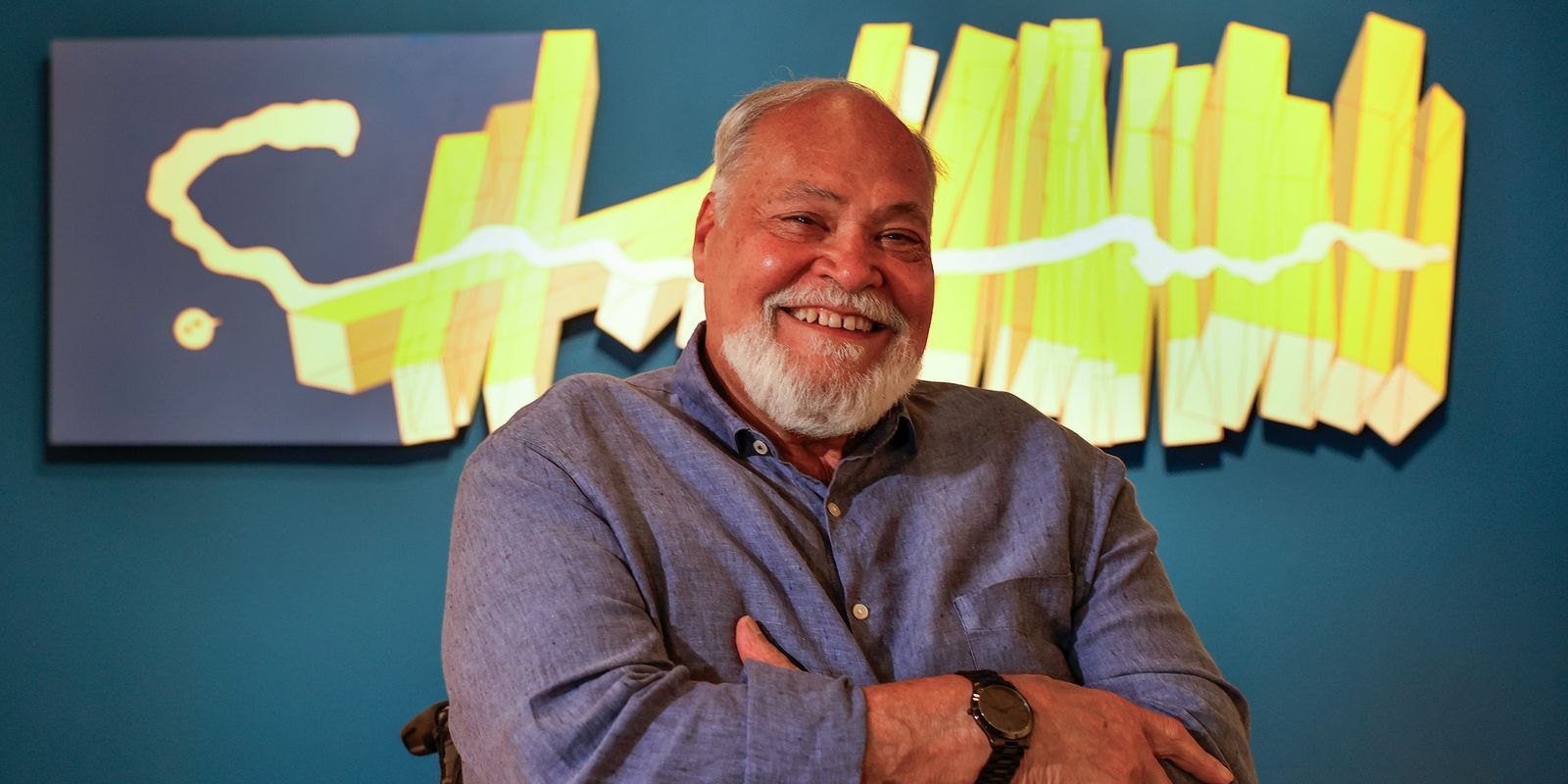
The works of artist Gilberto Salvador go through several phases of the author, all representative of his moment in life. The Visceral Geometry exhibition, installed in the three rooms on the second floor of the Paço Imperial building, in the center of Rio, is available to the public until March 1st of next year.
The exhibition represents Gilberto Salvador’s return to Rio, 17 years after his last local exhibition. Around 40 works are on display, including paintings, sculptures and videos, developed over more than 60 years of experience.

Colors entered the artist’s work in a characteristic way. Photo: Tânia Rêgo/Agência Brasil
The artist was 18 years old when he had his first exhibition. Although it largely refers to the most recent production, the exhibition features works that were highlighted in the 1960s and 1970s. The rejection of the military dictatorship is present in the work in It saw…! 1968, a relevant period in his career.
“My work ended up gaining a very political identity, because we were living under a military dictatorship with coercion of all kinds and major limitations on action”, he stated, in an interview with Brazil Agency,
Salvador recalled his participation in the São Paulo Biennale with controversial works in the 60s, highlighting that he and his family were always anti-fascists.
As resistance, in his work he used the form of movie posters and comic books to send messages.
“It was the moment that I used my plastic language as an affirmation of some ideas”, he said.
In the 70s, he changed direction towards a discourse more linked to ecology, becoming friends with landscaper Roberto Burle Marx and architect Oscar Niemeyer. “There is an important factor which is Brazilian nature, diffuse, wonderful and multiple, where the colors are vibrant”.

The exhibition represents Gilberto Salvador’s return to Rio, 17 years after the last local exhibition. Photo: Tânia Rêgo/Agência Brasil
Thus, colors entered the artist’s work in a characteristic way.
“We are tropicalists not for a conceptual reason, but for an existential reason. The choice of a tropicalist palette was much more existential than conceptual.”
“On the other hand, for 60 years I have been interested in various aspects of my work. There were times when I even used tapestries, produced several engravings along with painting, ceramics, bronze sculpture. I did a lot of things, because fortunately I am still alive”, he described.
The exhibition represents Gilberto Salvador’s return to Rio, 17 years after his last local exhibition, which he likes to portray in his works.
As an architect and urban planner, the artist admires the local landscape and is pleased to exhibit in the city again. “I’m in love with Rio de Janeiro because of the topography. I was sailing from Ubatuba to Rio and this topography is wonderful. Besides, my interaction with the locals has always been positive”, he stated, revealing that he has, among his works, one with the landscape of Pão de Açúcar and another with Morro Dois Irmãos.
Salvador considers that his training in architecture was fundamental to his work, ever since he started painting, making his own paints, which he learned to do from his grandfather.
“The faculty of architecture gives a very critical and constructive interpretation of space and I ended up taking advantage of it,” he said, adding that he worked as an architect and taught at the university until he dedicated himself specifically to art.
Life

If it were Gilberto’s will, all the works could be touched by visitors. Photo: Tânia Rêgo/Agência Brasil
Gilberto Salvador had infantile paralysis when he was 9 months old, which, however, never stopped him from doing what he wanted. “Then I had surgery, today I’m in a wheelchair. I swam a lot, dived a lot, sailed a lot, today I’m unable to do so,” he said. He added that it was not an impediment to developing his art, sharpened by the desire to be close to artistic practice in plastic language, painting, drawing and sculpture. “It was not a predisposition, but a disposition that happened and led me to a series of exhibitions, works and biennials here in Brazil and abroad”, he revealed.
“For a long time, I have used my artistic activity as a way of expressing myself sentimentally to others”, he pointed out.
Accessibility
The concern with accessibility is present in the exhibition. Upon learning from the curator that she needed to include works in the exhibition that could be touched by visitors, she immediately remembered two sculptures with this characteristic. “We brought two small sculptures so that people can pass their hand and get a certain feeling of what I think of three-dimensionality and space,” he said.
If it were Gilberto’s will, all the works could be touched by visitors. “I, deep down, between us, think that people could touch everything”, commented the artist, although he recognizes that there would be a risk of damage to the works, if it were allowed.
The curator is sure that the public will enjoy the experience. “It’s not a tactile reading of that work like we always do. In Gilberto’s case, it’s a work that he made available to be played”, he said.
Representation in art
“He is an admirable person. He has so many problems with his condition, but he is a person who never victimizes himself, who doesn’t even take it into consideration”, described the art critic and one of the most respected curators in the country, Denise Mattar, responsible for curating the exhibition in an interview with Brazil Agency.

Denise Mattar is the curator of the exhibition Visceral Geometry by São Paulo artist Gilberto Salvador, at Paço Imperial. Photo: Tânia Rêgo/Agência Brasil
For Denise, Gilberto Salvador’s work plays an important role in Brazilian art, originating from the 70s, part of a generation that formed the select group of artists of the period, including Rubens Gerchman, Carlos Vergara and Cildo Meireles.
“They are artists who opened up the possibilities of artistic work. They were the first to make objects, who began to make sculpture leave the wall and reach other paths”, he said. She highlighted that this generation is fundamental to Brazilian art.
“It’s an extraordinary group of artists. I think Gilberto fits well into this group”, he pointed out.
The curator highlighted that she has known the artist’s work for a long time and was very pleased with the invitation to curate it. “He gave me complete freedom to select the works, which I preferred to focus on contemporary production, but I made a small brushstroke, because it’s been a while since he exhibited in Rio.” The exhibition also features works with acrylic that are present in the artist’s most current phase.
The curator said that this is not an exhibition that has modules, but sought to establish conversations between sets of work. “Reviewing his works, I came to understand that his work always straddles the border between geometric and organic,” he said. She added that it was based on this observation that she chose the title of the exhibition.
“This is a constant in all of his work and, suddenly, the title hit me: Visceral Geometry. When I called him and said I was going to give him the name, he said ‘that’s not a title, it’s a summary of my work”, he commented.














