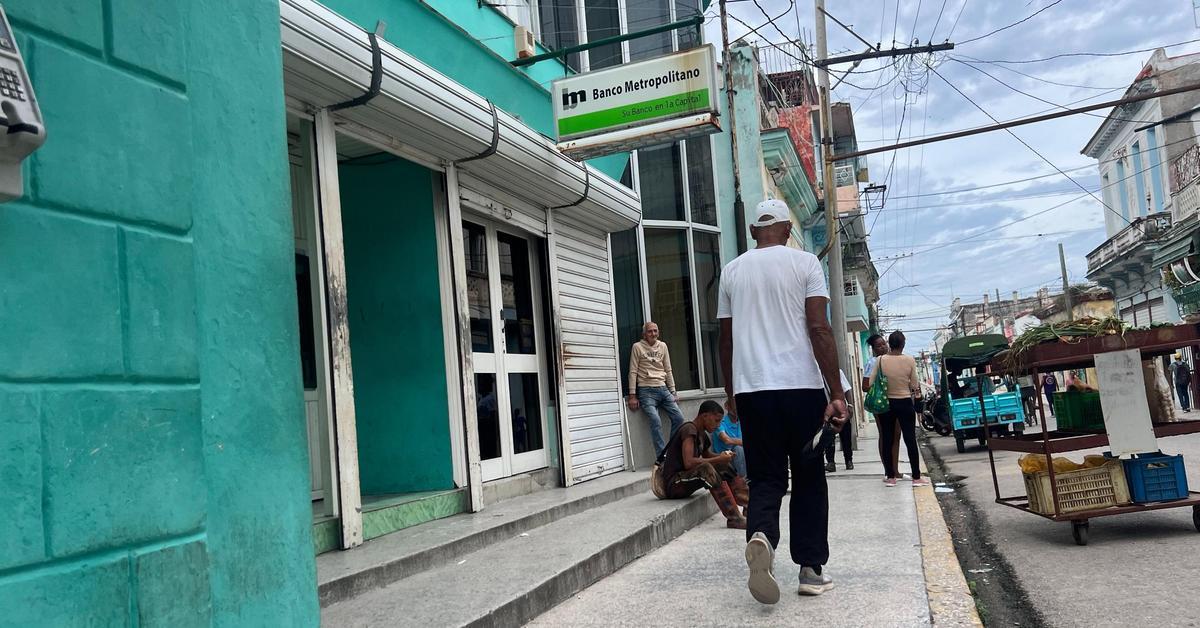
Havana/Holguín/“Do you want to change two legs?” asks a client at a MSME in Alamar. “Na,” responds the person who runs the business, “it’s for pleasure, the dollar is going down.” The scene, minimal and domestic, is repeated these days in various parts of the Island. It is the immediate reaction to the uncertainty created by the official floating rate, which this Saturday dropped to 408 pesos per dollar on the third day of its implementation (its starting price It was 410 on Thursday, December 18).
/ Cubadebate
In his crusade against the informal market and, in particular, against the daily publication of rates in the independent media The Touchthe Government seems determined to stop inflation like Cuban mothers lower their fever: with cold showers and “horse cures.” The paradox is that the rate announced by the Central Bank is too similar to what, until now, the street thermometer indicated, well above the official rate of 120 CUP supposedly in force in the banks, where it had become impossible to obtain dollars or any other currency.
The official bet has generated a tense silence in the market. “Right now no one is exchanging dollars, at least those who usually do that. I myself have problems exchanging. Some say they don’t have cash, others say they’re going to wait,” he tells 14ymedio a self-employed man from Havana. Another interlocutor confirms the same climate: “I have a colleague who wants to change and says that no one wants them in Havana. He has completely turned it around.” The response is almost unanimous: “Now is the time to sit back and wait.”
However, the effect threatens to be temporary. The official discourse itself recognizes, although in a much sweeter tone, the limitations of the measure. In an extensive analysis published by Cubadebateit is admitted that the implementation of a floating rate exchange market does not occur “at an ideal time” for the Cuban economy. Low levels of production, falling exports, severe restrictions on external financing and a still high fiscal deficit conspire against any attempt at rapid stabilization.
According to that text, the Central Bank of Cuba enter the market as “just another competitor”, but with the administrative capacity to publish the rate daily, which will float according to supply and demand. The official note itself recognizes that, at the beginning, the rate must remain “close to that currently in force in the informal market,” to avoid a greater inflationary shock.

/ 14ymedio
On the street, that admission translates into pragmatism and, in many cases, resignation. In a MSME near the Santa Fe bridge, in Guanabacoa, a woman tried to change 40 dollars. “But at 408,” the saleswoman told him. “I don’t care,” the client responded, “I don’t even have money to take a tricycle.” The scene illustrates well the dilemma between selling now, even if it is at a rate that may vary tomorrow, or keeping dollars that few want to buy today.
“In general, I think there are few who are selling their dollars at 408, but there are some, because right now it is the only option,” explains another interviewee. In Old Havana, a MSME where foreign currency was previously accepted decided to slam that door: “Yesterday I went to buy a couple of things and they were not accepting dollars, only national currency.” Nobody wants to be trapped with greenbacks in a market that is pure anxiety due to the official measure and the proximity of the Christmas celebrations.
In Holguín, the scene is different. Far from Havana – where most of the dollars available for the Central Bank’s operations are expected to be concentrated – the official floating rate has aroused more apathy than expectation. A self-employed worker who moves around the city every day assures 14ymedio that in the province “the measure has been ignored; here the dollar is still at 440.” Geographic distance translates, once again, into economic distance.
/ 14ymedio
The official story insists that this new system will allow greater fiscal control, a gradual reduction in inflation and more resources for sectors such as health, education and culture. It also promises to stimulate exports, offer a “safe” channel to exchange remittances and combat the distortions created by informality. That all sounds good on paper. The problem is that Cuba has already experienced too many reforms that, in their initial phase, promised order and ended up multiplying chaos.
The key is what is not said clearly enough: the market will sell only what it buys. That is, there is no foreign currency support that guarantees sufficient liquidity. The availability to buy dollars – and, therefore, the credibility of the system – will depend on a “gradual process” of strengthening that, in an exhausted economy, may take too long or never arrive. Meanwhile, informality retreats, observes and waits.
The floating rate may have caused a tactical pause in the purchase and sale of currencies, but it has not resolved the structural causes of the problem, consider the majority of economists, from the opposition and also from a critical sector close to the regimewho have spoken out about the new measures. Without a real increase in production, without sustained exports and without access to external financing, the Cuban peso will continue to be a weak currency, no matter how much a new official price is published every morning. The market, inside or outside the institutions, will end up adjusting the figure in its own way.