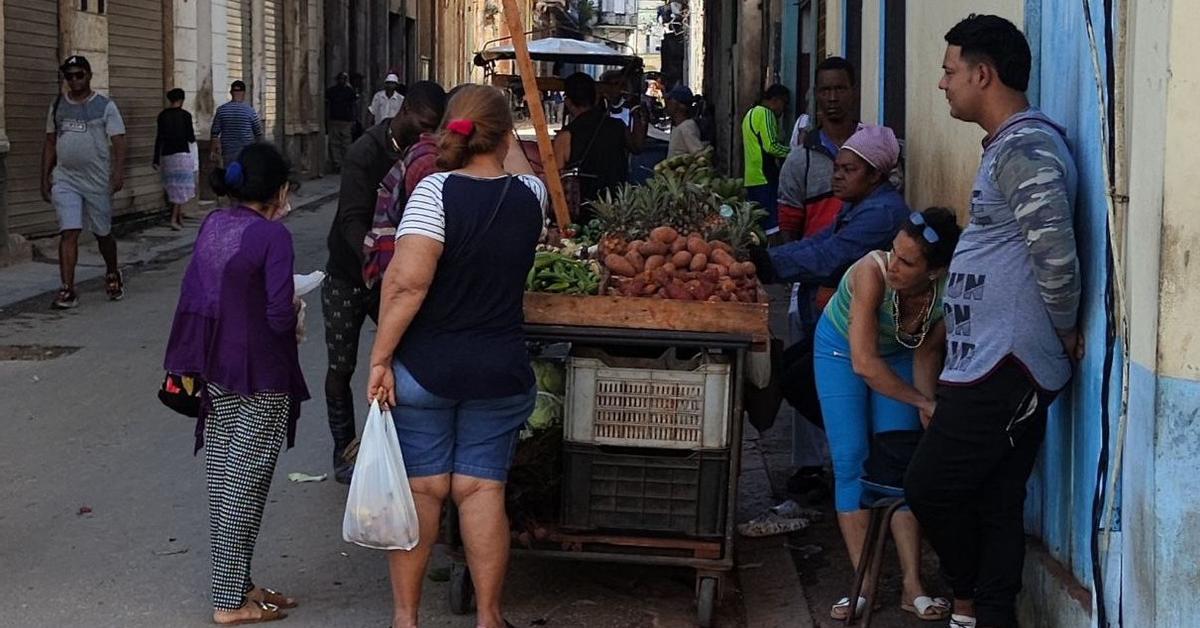
Havana/The controversy over potatoes and rice is hot and spreading in Cuba. Since the last broadcast of Squaring the Box Roberto Caballero, member of the National Executive Committee of Agricultural and Forestry Technicians, defended that the most appropriate thing to achieve food sovereignty would be to reduce the consumption of these two foods because their cultivation collides with the reality of the Cuban soils and climate. A storm has broken out on social networks in which everyone from the common Cuban to the host of the program herself, including the opinions of some experts, have been involved.
Marxlenin Pérez Valdés herself, host of the television program, jumped on the weekend and reproached the fact that there have been “worms” that have cut fragments of her program “with all intents and purposes.” The presenter assured on her social networks that you can disagree with what was said, but after listening to it in full. And it is very likely that Pérez Valdés feared how the population was going to accept what was said in her study, since she herself alarmedly sought collaboration from the other member of the audience: “Roberto wants to change even our rice! José Carlos, you will help me with this,” she said.
The matter has generated responses from some experts who have wanted to respond to Caballero by appealing to history. The Cuban climate is not conducive to the potato – which grows better in cool environments and suffers from diseases at temperatures above 30 degrees – but that has not prevented the tuber from being grown and eaten on the Island, he says. Carlos Martinez. The expert has recovered data that indicates that before 1958 the population consumed more than 10 pounds of rice per month, in addition to 2.20 pounds of meat per week. The information comes from a book by the historian Moreno Fraginals in which the regular consumption of taro, sweet potato and potatoes is mentioned, although the specific information is not provided.
Before 1958, the Cuban population consumed more than 10 pounds of rice per month, in addition to 2.20 pounds of meat per week.
“Now, the consumption of these products does not necessarily imply their local production: they could perfectly have been imported,” admits the expert, who rejects, in any case, that they are foreign to the culture. Martínez attaches a graph (with statistics from the Food and Agriculture Organization of the United Nations, FAO) in which he marks the production of the two foods in relation to tons per 1,000 inhabitants.
Although the figures are not huge, it can be seen that the best data for the tuber was achieved between the end of the 90s and the beginning of the 2000s, close to 33 tons per 1,000 inhabitants. Currently, the figure is about 10 tons per 1,000, and although there have been some specific moments that were worse, such as 1973 or 2013, the figures have remained low in general in the last 15 years. As for rice, the strength is much greater. Around 2003, the maximum peak of the last 80 years was reached, with more than 60 tons per 1,000 inhabitants and although there are also two abrupt drops – in 1965 more tons of potatoes were produced than grain -, since 2018 a slope has been observed that has not completely recovered, leaving the quantity at about 12 tons per 1,000 inhabitants.
Martínez considers that “both in Latin America and the Caribbean, rice, beans and potatoes were essential foods for workers to obtain the calories necessary for agricultural work,” because they are cheap sources of carbohydrates, which led to land being allocated for their production even since 1959.
Martínez also attaches at this point a table showing that a percentage of land has been dedicated to both crops at different times, from 1905 to 1959, although it is true that both rice and potatoes are not among the major beneficiaries, especially the second, which received barely 0.5 of the Island’s land just before the Revolution.
“The truly annoying thing about Dr. Caballero’s comment was not his meaningless speech about rice and potatoes, but what it represents: an attempt to blame the people’s habits for the failures of the system,” laments Martínez, who maintains that “the problem is the incompetence and inefficiency inherent in an economic model that stifles productive initiative.”
The economist has also recalled the data on national production, which has fallen “incessantly and in a significant amount starting in 2019.”
The Cuban economist Pedro Monreal has been much more abundant in rice. The expert presented on his social networks a graph of the consumption of this grain on the Island, which went from the peak of 874,266 tons in 2005 to only 511,548 tons in 2023, a collapse of 41.5%. “Of every 10 pounds of rice available for consumption 18 years ago, only six were available in 2023. What exaggerated consumption are you talking about?” he protested.
The economist has also recalled the data on national production, which has fallen “incessantly and in a significant amount from 2019”, although they were relatively stable without, therefore, completely compensating for the deficit. While in 2002 and 2003 the 300,000 domestic tons were widely exceeded, last year it closed with only 27,326. At the same time, the minimum imported (1989) was about 250,000 tons, compared to 484,222 in 2023.
Monreal considers that “the agricultural policy that is excessively controlled by the State” has been incapable of favoring private producers, who have been “the pillar of grain production” in Cuba. The land in the hands of these economic actors has fallen, leaving more and more surface areas in the hands of the State, which has not obtained very good returns. Recently, the Vietnamese authorities celebrated that their crops on the Island are achieving very notable results, up to more than 7.2 tons per hectare in some cases, compared to 2 or 2.5 for the Cubans.
“What must be changed is not the eating habits of Cubans, but the economic system and its political structure that generate permanent shortages of food for which there is evidence that it can be produced nationally,” Monreal emphasizes.