In this regard, activist Lucía Hernández assures that the problem is not that the UMAS exist, but that Nobody really knows what happens inside them due to the lack of public data, regular inspections and a monitoring system by the authorities.
The problem, he adds, is worsened by the lack of traceability. “Once Profepa delivers an animal to a UMA or a zoo, it stops knowing about it. There is no marking, there is no monitoring, there is no transparency,” he warns.
“It is impossible to know how many survive, how many are released or how many simply disappear from the system.
Lucía Hernández, activist.
The opacity, he says, “opens the door to a worrying scenario”: some animals could return to illegal trade under the protection of an official document.
“There are cases in which confiscated animals are delivered to individuals with exploitation permits, and once in their custody they can reproduce them or even sell the offspring without any control,” says the activist.
(Photos: AFP / Facebook)
Hernández also warns that the UMAS system has also resulted in an opaque network with potential conflicts of interest.
“There are UMAS registered to politicians, businessmen or former circus owners, some linked to the wildlife trade. We have found permits issued to non-existent addresses or to properties that are impossible to locate. There are even records of UMAS in departments or markets,” he denounces.
The information, furthermore, is practically inaccessible. “If you ask for data on a seizure for transparency, Profepa will tell you that a toucan was delivered to an UMA in Querétaro, but you will not know which of the 500 that exist in that state received it. Without public registration, there is no accountability,” he says.
Private sanctuaries to the rescue
Activist Lucía Hernández insists that, in cases like Mina’s, the chain of negligence begins from the rescue itself, since there is no public place or uniform national protocols for its protection.
“Profepa does not have its own facilities to house confiscated animals. In most cases it delivers them to zoos or UMAS, many of them saturated or without effective supervision,” he explains.
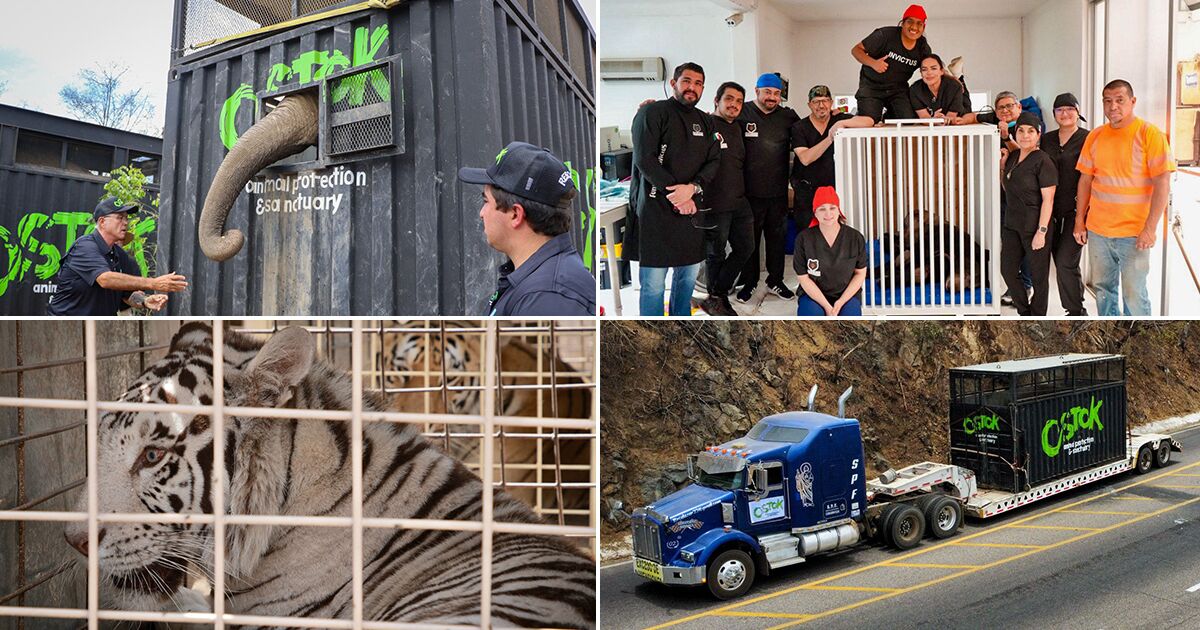
Faced with this institutional vacuum, private sanctuaries and zoos have become the main recipients of confiscated fauna. One of them is the Ostok Natural Sanctuary, in Sinaloa, directed by Ernesto Zazueta, president of the Association of Zoos, Hatcheries and Aquariums of Mexico (AZCARM).
In that entity, Ostok became one of the few spaces that responds when a federal operation ends with animals seized from properties linked to organized crime.
“The majority of rescues come through the FGR (Attorney General’s Office), Profepa or Civil Protection,” says Zazueta. “They call us when, for example, there is a search and tigers, lions or crocodiles appear. We go in with veterinarians, tranquilizers and cages, we stabilize the animal and take it to quarantine in our facilities,” he says.
This last weekend of September @OstokSanctuary1 Together with AZCARM specialists, they rescued 2 other Bengal tigers of approximately years old, a horse, a Spanish mare and five dogs. Feron found in a warehouse on the outskirts of Culiacán in undignified conditions. pic.twitter.com/683VgjE6m0
— AZCARM (@azcarmx)
September 29, 2025
The animals, he explains, arrive dehydrated, stressed and often injured. “We stabilize them for months, and they almost always stay here to live, because the legal processes are not concluded or because there is no other place they can go,” he comments.
Ostok is home to more than 250 animals, among them about 100 big cats, of which at least 16 were rescued from areas affected by violence in Sinaloa.
“We have tigers, lions, jaguars, monkeys… even several animals from the Black Jaguar-White Tiger case, which we continue to care for three years later because the process is not progressing.”
Ernesto Zazueta, president of AZCARM.
The animal rescuer explains that the sanctuary is supported by its own resources and that government agencies only provide support.
“We do what we can. We rescue, care for and give a dignified life to the animals. But if we continue without coordination, without a budget and with persecution, there will be no one to save them,” he laments.