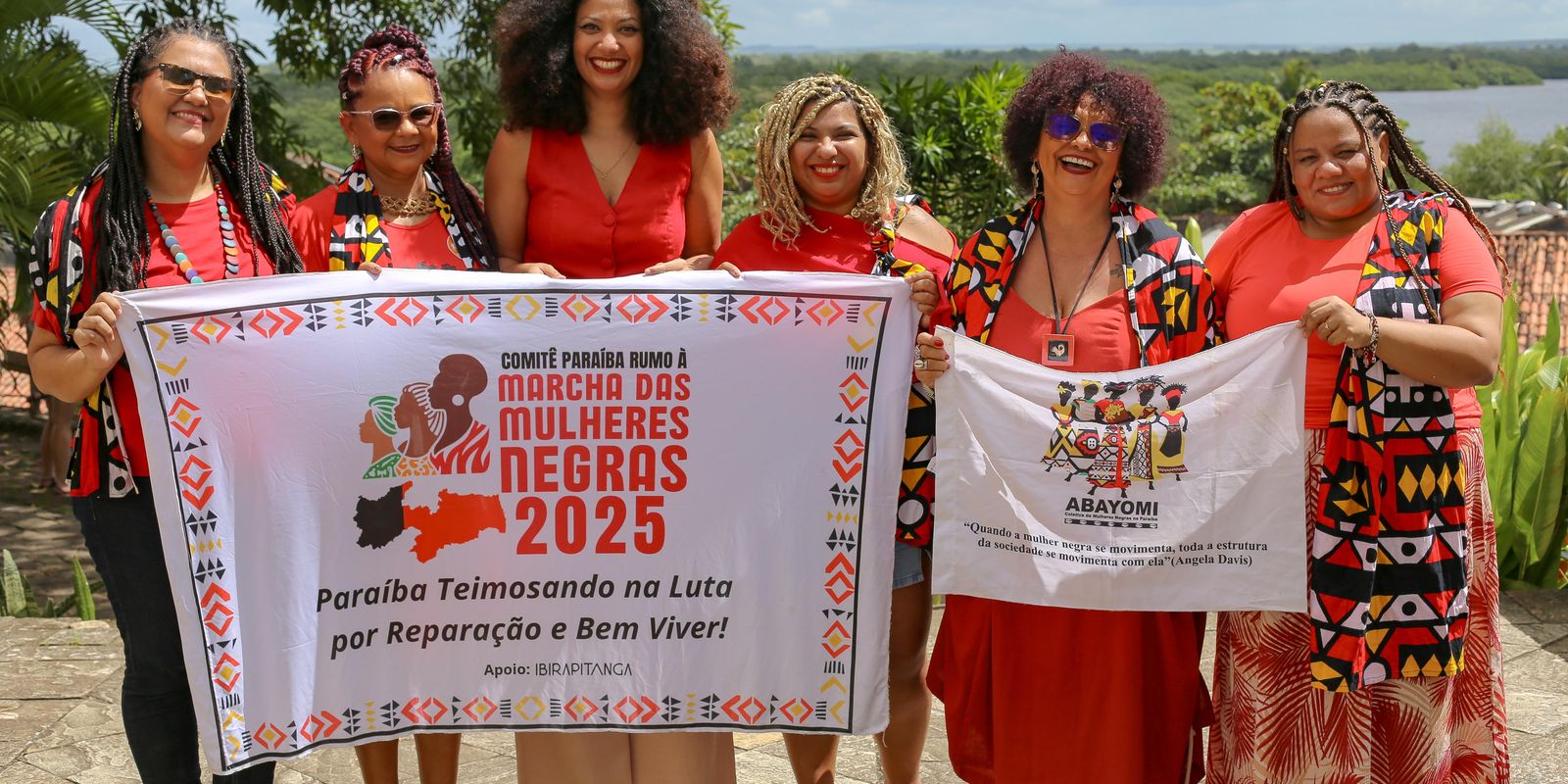
From the beginning, stubbornness, in Paraíba, has been a verb. He names the obstinacy of a contingent of black women who are on their way to the 2nd Black Women’s March for Reparation and Good Living, in Brasília. The delegation will travel almost two days to join 1 million women on November 25th.
They will march in defense of good living, which includes access to basic rights – such as housing, employment, security -, but also a dignified life, free from violence and reparation actions.
This agenda includes measures to promote social mobility, considering the damage left by slavery and the expropriation of the black population over centuries.
In Paraíba, the expression “stubbornness” was adapted by the black women’s movement from a speech by quilombola leader and nurse Elza Ursulino. The declaration channeled aspirations for the 2025 march, explained Durvalina Rodrigues, activist and coordinator of the Paraíba organization Abayomi.
“During a tribute, in 2024, Elza, from the Caiana dos Crioulos quilombo, in the interior of the state, told how she was repressed by her father for provoking discussions in the community, right?, [Por provocar] Reflections on the situation of the quilombo and that she, in her ‘stubbornness’, insisted on improving”.
The organization, whose name means “precious meeting” in Yoruba, which brings together and serves black women of different profiles, was born from the first black women’s march, in 2015.
“At that time, we knew that the march was going to be something big, but we had no idea that it would be historic,” recalled Durvalina.
Upon returning home, when taking stock, the activists decided to found Abayomi and expand the discussions that the march had proposed, with a focus on combating racism and violence.

Brasília – March of Black Women Against Racism, Violence and for Good Living in Brasília, 2015. Photo: Marcello Casal jr/Agência Brasil
Journey
Together with other black women’s organizations from Paraíba and the Northeast, the institution organized a series of activities throughout 2025, with the aim of discussing good living and reparation, themes of the march in Brasília this year.
The first was approached from the perspective of self-care as a political act, of resistance, but with collective impact, and the second, as a way of compensating for almost 400 years of slavery and the racist legacy that, to this day, determines the living conditions of black people.
From the perspective of good living, self-care, which goes beyond individual rituals, returns to be a theme of the march, ten years later.
“Stress at work, at home and in the community generally leaves little time for self-care, a path that causes chronic illnesses, psychological suffering and loneliness” with collective impacts, explained psychologist Hidelvânia Macedo, from Abayomi. From another perspective, when exercised, self-care has a positive impact on self-esteem and self-determination, he highlighted.
In this second edition, good living is treated alongside the search for reparation, that is, measures that allow the correction of distortions that reflect structural racism, which is the unequal treatment given to black people due to the structure of society.
Unlike contingents of immigrants, black people enslaved in Brazil did not have the right to compensation after abolition, nor access to land and education. Attending schools, for years, was prohibited.
These issues are at the basis of the inequalities that have survived to this day. In the Northeast region, for example, where the illiteracy rate is double the national rate (14%) and there is a greater proportion of people in extreme poverty and poverty, more black and brown people live*.

Rio de Janeiro (RJ), 10/29/2025 – Dozens of bodies are brought by residents to Praça São Lucas, in Penha, north of Rio de Janeiro. Operation Containment. Photo: Tomaz Silva/Agência Brasil
Necropolitics
According to Durvalina, from Abayomi, in the conversations organized by the institution, the discussion about reparation precedes that of good living. “It goes back to historical explanations, to colonialism, when they took everything from us, until perspective existed”, he explained.
From these preparatory activities, Durvalina revealed that discussions emerge about politics that determine who does or does not have the right to life, such as health and safety. For her, these reflections are part of the great legacy of the 2025 march.
“When women begin to realize that the politics of death, necropolitics, has a historical bias, based on racism, we see an awakening,” she added.
Necropolitics is a philosophical concept that explains how some people are more likely to be abandoned and killed due to omission or action of the State, with slavery itself being an example of necropolitics, as it subjected black people systematically and permanently to violence and death.

Rio de Janeiro (RJ), 07/27/2025 – XI March of Black Women, in Copacabana, mobilization against racism, for justice and good living. Photo: Fernando Frazão/Agência Brasil
Manifest
To address the issue of reparations, the Black Women’s March launched the Economic and Institutional Manifestowith proposals on seven axes, including the creation of an economic fund, the taxation of large fortunes and inheritances, policies to reduce interest rates, shielding the social budget, agrarian and urban reforms, in addition to credit lines and affirmative actions in companies that serve the public administration.
Stubborn like the quilombola Elza, from Caianas, Durvalina, believes that, for yet another edition, the march stimulates reflection and strengthens women’s organizations capable of leading and accelerating transformations in Brazilian society.
* The black and brown population groups, combined, are called black, as agreed by the Brazilian Institute of Geography and Statistics (IBGE) and black organizations.