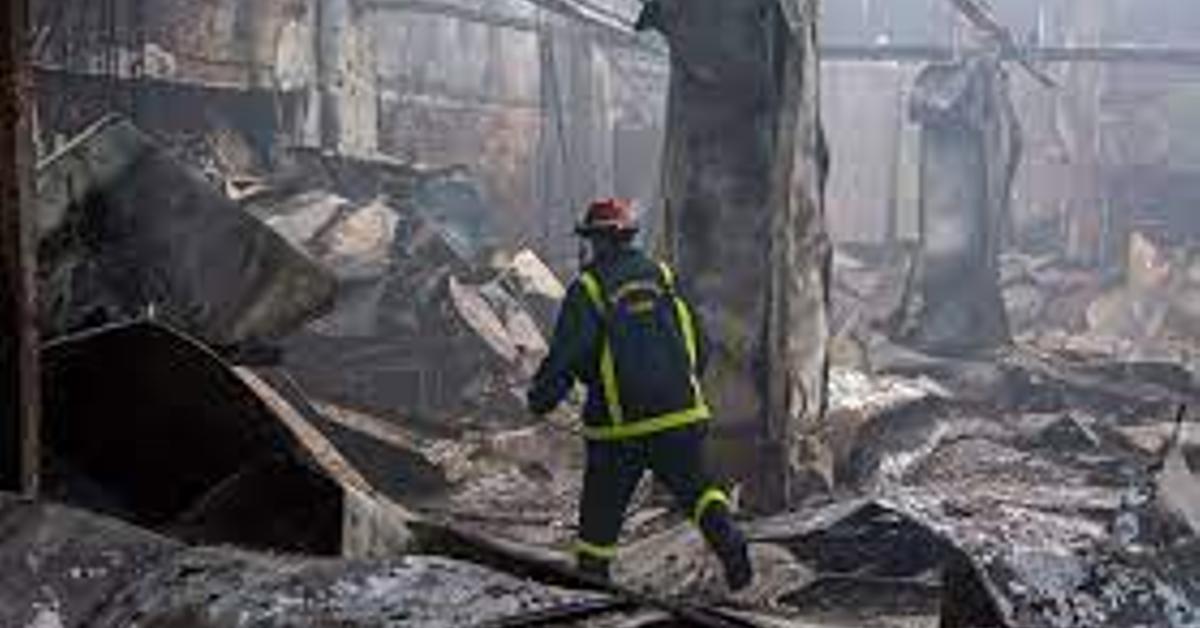
Madrid/Unrest spreads in La Coloma, Pinar del Río, after the fire that broke out last Saturday, October 11, in the facilities of the Industrial Fishing Company of the municipality, responsible for 45% of the lobster captured in Cuba and 80% of the bonito, both products of high value in the national and international market. Although at this time the majority of its staff cannot work, the entity has not lost its status as a prioritized circuit and receives light constantly, residents of the area report.
“I want to ask the director of the Electric Company in this way, since he does not show his face, what is the reason why they do not turn off the power in La Coloma if there is no longer any lobster,” asks an anonymous profile on the Ventas Pinar Facebook page. The author accuses the director of the entity, Yordan Nogueira Tapia, of corruption, although he does not provide more evidence than his surprise at the expense of electricity in a circuit that does not need it.
“Even to be corrupt you have to know and be intelligent. It’s already bad enough, begging for a few hours of power that belongs to us by right. (…). Power is not a luxury, it’s a necessity, it’s good now. Release the P961 circuit,” he claims, adding that this same Saturday the entire city was in blackout for 16 hours. “I’m not interested in your business, but don’t do it on our behalf, okay? Show your face, you ball of corruption. You’re carrying out an audit,” he claims.
“Current is not a luxury, it is a necessity, it is good now. Release circuit P961”
According to the official press, “dozens” of employees are working on the company’s administrative tasks to try to reorganize the reconstruction. Preliminary calculations indicate that about 110 million pesos – approximately $231,578 at the informal exchange rate – will be needed to fix the disaster, “a good part of it in foreign currency.” Nogueira Tapia, however, does not rule out that the sum could increase in the future, as the demolition and waste collection tasks progress.
At the moment, all lines are affected: from pre-selection, sorting, cooking and packaging, to pre-cooking. In the latter, as had already been advanced, were the “state-of-the-art machines”, acquired in 2022: one automatic sorter and three baggers with their respective heat tunnels. The list of damages is eternal, since not only the machines are affected. Also the tables, stainless steel shelves, climate equipment, walls and false ceilings, zinc covers and even a piece of the plate. None of this was saved and now efforts are directed at ensuring that the 44 working lobster boats fish without rest.
“That is the only way to overcome this situation, because most of the resources that have to be purchased are imported and today a considerable percentage of the foreign exchange generated by our business group and our Ministry comes from lobster,” the manager told Granma this weekend, who put the responsibility on the fishermen. “They will have to stay more days away from their homes, because the transfer of what they capture will be to other territories. But we have explained to them that recovery depends largely on what they are capable of doing,” he explained.
There are 175 workers whose jobs hang in the balance: part of them will go to another plant – not specified – that is responsible for the processing of fish, conch and sea cucumber, as well as the production of some products little appreciated by the Cuban palate, such as croquettes, medallions and hamburger dough. Another part will join the recovery tasks of the burned plant and the rest will become “interrupts”, earning 60% of their basic salary, which in practice leaves them in a very bad situation even though this plant paid salaries well above the company average, 20,000 pesos compared to 9,000 for Epicol.
According to a report published by the provincial newspaper Guerrilla, there is only one reason for optimism: “the freezing chambers did not suffer much damage, only in the joints and doors,” and three days after the fire they were already in operation, protecting part of the production.
“The freezing chambers did not suffer great deterioration, only in the joints and doors”, and three days after the fire they were already in operation”
The destroyed plant was about to receive a European inspection on-linethanks to the technology it had implemented for this, from Wi-Fi to whiteboards with ammonia detectors and temperature controllers monitored from the ice plant.
However, the capture was not going well at all. Of the 2,700 tons that should have been caught until the date of the disaster, at least 600 were missing, which the director attributed to causes as diverse as climate change and the lack of availability of fuel.
This weekend, workers They got involved in recovery tasks of materials, since some rubble could be reused, even if in other places. The director, despite the drama, remains optimistic: “It would be time to make a better plant design, the one we had was very good, but the new one would be more in line with the latest demands of the international market,” he explained.
Lobster production, one of the most profitable sectors for the State, is already in sharp decline. In 2019, fishermen on Isla de la Juventud obtained an average of 19 kilos of lobster per fishing gear, an amount that fell to 5.8 kilos in 2024.
As for the country, in the last five years production has fallen by 84%, from 6,900 tons in 2019 to 1,100 last year. Furthermore, in five years the production of glues also fell by 45% (248,600 tons compared to 136,000) and by 9.2% for whole frozen ones.