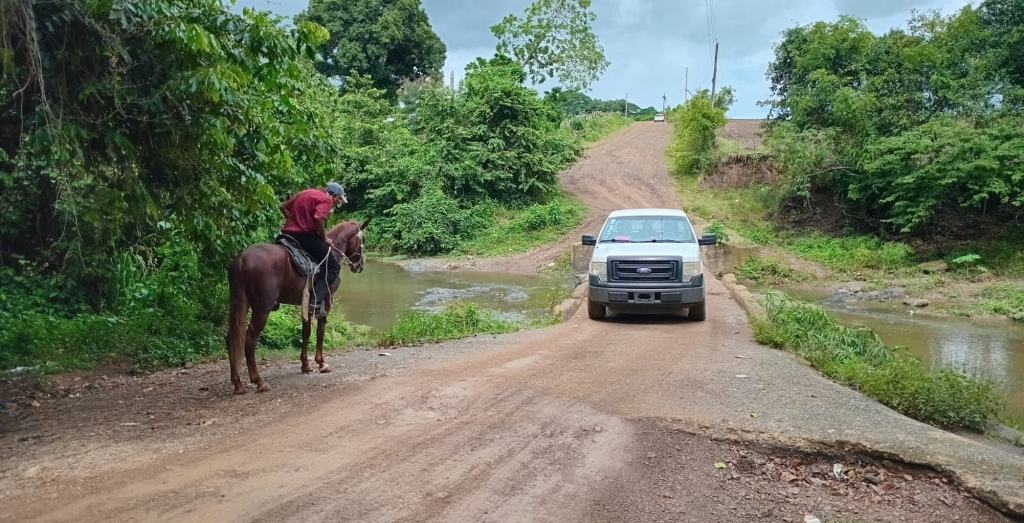
Savannah of El Cuey.-A walk to this community in search of some chicharrones, which according to one of the village priests are very good, brought me two pleasant surprises: the love they have given to the road and a Mocano enterprise in a community in El Seibo.
I had seen the road recently and the impression it left me then was that in a short time, to travel it, teams of donkeys and mules would be necessary; but something changed.
And it’s not that it has more life, or that it has undergone a major repair, but I was able to drive it with a little less risk of potholes and ditches destroying some parts of the vehicle.
On my previous visit I attributed the destruction of the road due to use and the effects of the rains to the carelessness of the Provincial Government of El Seibo, the ministries of Public Works and Agriculture, and perhaps even the Agricultural Bank.
At first I thought that the slight conditioning it was subjected to had been a collaboration between Public Works and El Cuey, but no.
An explanation
One of the heads of a neighborhood association in Sabana de El Cuey informed me that it was a collaboration of the mayor of the municipality of El Seibo, Leo Francis Chalas, some councilor and at least one ministry, that of Agriculture.
From this information I concluded that with a little from Public Works you can make a great collaboration with several communities, about thirty according to those of El Cuey, of which I personally know Cruce los Magueyes, Sesteadero, Sabana, La Cuevita, Los Rodríguez, Rodeo, Higuá and Los Mameyes.
There is, however, something to regret: the section from kilometer eight of the El Seibo-El Pintao highway to Alto de Jobo Dulce has not been touched again, a fact that puts at risk of losing an investment in gutters, pavement and rustic bearing layer on which an asphalt layer should have been spread or it will be lost work when the torrential rains of spring and summer arrive.
The bridge over the Quisibaní River, which some say made a vivid impression on President Luis Abinader when he visited Sabana after Hurricane Fiona, remains just as threatening as when I saw it in the middle of last year.
A little piece of Mocha
El Cuey is a name that includes dozens of communities dedicated to agriculture that for a typical Seibano begin counting from the Alto de Jobo Dulce – as far as the road arrangement applied by Public Works reaches – and end when from the top of the Sierra del Este it declines towards the Atlantic coast, to the north, or towards Higüey, through the Peñones de García.
Livestock farming in this part of El Seibo refers to cattle, horses and perhaps pigs. Hence why a poultry farm surprised me with a good boost in one of the Los Rodríguez laps.
It is run by an entrepreneur—Nelson Montilla—one of those that are not abundant at any time, who has gone to establish himself with his air of an “ingenious gentleman” and until now produces eggs and promotes coconut trees on a small adjacent property.
At the end of last year, this man had a slight shine in his eyes and anyone could think that the reason was in the superficial repair made to the road that serves as an artery and at the same time as a backbone to these communities from Alto de Jobo Dulce, where the worst begins, to Los Mameyes, where it ends next to the Chavón River.
When I questioned him I found optimism in his mood and then I realized the source of the light in his eyes. I also learned about his connection with the Mocano farmers, with whom he advises, from whom he buys thousands of baby chickens and with whom he has been learning about the care of birds to bring this economic adventure to fruition.
I could not hide my satisfaction when I gave the explanations, not only to this writer of stories, but also to a sister who accompanied me and who was greatly impressed by coming across a laying hen farm in El Cuey in which there must still be many things to do, but which in any case resembles those that thrive in Cibao, particularly in the vicinity of Moca.
and the road
The superficial repair directly benefits him, because he must transport chicks from Cibao, buy corn and soybeans in the ports of the capital to prepare the feed supplied to the chickens, and he suffers just thinking about what it means for the springs and axles of a small truck loaded and falling from a ditch into a pothole and going up a slope ditched by rainwater.
The entrepreneur
— A passionate
According to Nelson Montilla, when he started his project, about 4 years ago, he did not know the ins and outs of this business. Passion has saved him, because work has not allowed time to give up.
Those of El Cuey
—1— The road
They have been demanding for years that the Government take care of the state of a road that is the axis around which dozens of communities revolve.
—2— Superficial
The El Seibo City Council and Agriculture made a Christmas arrangement at the end of the year.
—3— They deserve more
If the section to Alto de Jobo Dulce has been possible, what prevents going a little further?