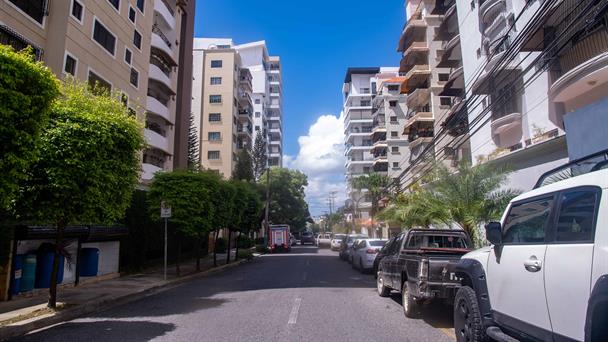
Desiring to live in a more welcoming space that went beyond a room in a closed residential complex, Mary Polanco took on the task of look for an apartment largest in the same sector in which he already resided, the kilometer 14 from the Duarte highway.
Finally, he managed moved two months agoafter a year and a half of meticulous searching to fit his budget: he went from paying 7,700 to 13,000 pesos in his new home, which is still small for what I expected: “There were times when, tired of searching, I took a break,” says Polanco.
Living rented in urbanized areas of the Greater Santo Domingo it turns increasingly uphill for many.
Although the Consumer Price Index – an indicator that measures the variation in the prices of a set of goods and services – fluctuates with an increase of just 2.86% in rent between November 2024 and November 2025, unions in the sector, such as the Association of Real Estate Agents and Companies (AEI)they observe increments what are they going from 10% to 25% in the last year.
The largest increases are observed in sectors such as Piantini, PopcornEvaristo Morales, Serrallés and other central areas of the National Districtassured its president, Alberto Bogaert.
He added that in other demarcations, such as the case of the eastern zone“you have to go practically to the outskirts of the city (Santo Domingo East)” to find affordable priceswhich vary depending on the building, the characteristics, the time of construction, the footage or the number of rooms, among other aspects.
Influencing factors
Both the AEI like the association Dominican of Builders and Promoters of the Dwelling (Acoprovi) agree that incomes rose in a context of increases in construction costs and land, interest rates that have made the financing of real estate projects more expensive and fundamentally greater dollarization of properties.
“The rent increases have absorbed both the increase in construction costssuch as the pressure of a greater preference to live close to work and service centers,” said the president of Acoprovi, Annerys Melendez.
The data of the CPI of the housing group They reflect increases in components that affect rent increases.
Between November 2024 and November 2025, the door repair recorded the largest increase in the CPI, with 9.48%followed by the maintenance serviceswhich increased 6.42%and of the common expenses in co-ownershipwith an increase of 6.08%according to figures from the Central Bank of the Dominican Republic (BCRD).
Added to this is the poor performance of the construction sector, which had a drop of -2.5% of its economic activity as of October of this year, according to the monetary entity.
“When the rental demand grows faster than available supplyprices tend to adjust upward“said Meléndez.
Economist Haivanjoe Ng Cortiñas ensures that the construction of housing decreased by 12% this year, which shows “a significant loss of dynamism in the sector”, at a time when rates for mortgage loans They were close to 13%, which increases the cost of monthly payments and restricts access to credit.

Rises that move
This leads many to move from places that are already familiar to sectors in which basic services or security may be compromised.
In his search, Polanco noticed two types of offers: apartments with older buildings, good distribution and several rooms for up to 30,000 pesos –something unsustainable with his salary of 50,000 pesos– and offers of one-bedroom apartments over the 12,000 pesos –poorly builtwith “disastrous” services and without clear maintenance, both in the kilometer 14as in Pantoja, another sector that pondered.
“The price has skyrocketed quite a bit. When I started living alone, I paid between 5,000 and 6,000 pesos for rent in 2019. Now to get a one-bedroom apartment, They want to charge you 10,000 pesos, even if they are poorly builtwith poor distribution, with disastrous services and without clear maintenance,” he deplored.
Francelys Veras decided move in with your partner for the first time, and it took him five months looking for a place. “I wanted to live in Los Ríos, a sector where I grew up, but the houses are expensive for what they offer,” explained the young woman, who moved to Christ the Kingin February, in a dwelling two-bedroom for which you pay 12,000 pesos.
In The Northern Gardensan apartment with just one room ranges between 18,000 and 22,000 pesosassures Mateo Herrerawho currently resides in a single-room room made for students, for which he pays 10,000.
With this same budget you can access larger homes, but in more remote areas. In areas like Villa Mella or close to the Jacobo Majluta Avenuethe rentals of three-bedroom apartments range from 12,000 and 20,000 pesos.
In The Alcarrizostwo-bedroom apartments range between 8,000 and 13,500 pesoswhile in Santo Domingo EastDepending on the sector, apartments two and three bedrooms between 15,000 and 16,000 pesos, according to advertisements on web portals such as Marketplace.
According to the AEIthere is a high offer of furnished one-bedroom apartments, but the greatest demand is in those of two and three bedroomswith or without furniture.


The dollarization of the real estate sector
However, in the National Districtget an income in dominican pesos begins to become scarce in the face of the proliferation of offers in dollars.
Cristian Trinidad Vicentewho has been working as a real estate agent for four years, says that more and more clients want rent apartments of a room –generally furnished– in dollars, with prices ranging between 400 and 750 dollars in areas such as Gazcue, Ciudad Nueva or Ciudad Colonial.
“If I compare the prices in Gazcue and Popcornthey are practically the same new apartments. I can tell you that in Gazcue there are already more expensive apartments than in Popcornalthough obviously in Popcorn There are apartments – in a penthouse or on a high floor – that can cost up to 4,000 dollarsalthough they last a long time to rent,” he analyzed.
The increasingly marked trend of dollarize the monthly payment of the properties responds, for Meléndez, to the search for inflation protection already exchange rate volatility.
Ng Cortiñas highlights that the homes are incorporating assumptions of peso depreciation of up to 5%, placing the reference rate around 65 pesos per dollarwhich increases the value of real estate in pesos without an equivalent adjustment in the buyers’ income.
“The dwelling starts to behave more as an indexed asset to exchange risk rather than as a commodity anchored to the domestic economy,” he emphasized.
In it Central Polygonan apartment a round room between 750 and 1,100 dollarswhile those with two bedrooms are between 1,000 and 1,600 dollars, and those with three bedrooms can reach ranges from 1,000 to 2,000 dollars on average, according to the AEI. Those who rent in dollars tend to be tenants high profile – such as businessmen, merchants or diplomats –, who make their payments in dollars or their equivalent in pesos, at the rate of the day.
Although in Dominican There is no specific regulation that directly prohibits or regulates rents in dollarscontracts must be governed by the principle of autonomy of will between the parties and comply with the Civil code and regulations regarding rentals.
For the economist, private agreements with implicit exchange references create a gap between the Rental Law 85-25 of Real Estate and Evictions, – which establishes that the offer and contracts must be expressed in dominican pesos– and what happens in reality. “This gap shows a de facto dollarization of the rentalswhich transfers the exchange risk to the tenant”stressed Ng Cortiñas.
From his work, Trinity agrees that many owners should have a fairer treatment with the tenants who, in addition to paying in dollars, are charged the annual increase in rent and other costs associated with renting the property, such as real estate commissionswhich should be assumed by the owners.
“I had a case of an apartment 800 dollars in which the customer I didn’t want to give the real estate commission; I also didn’t want to give a month in advance… nothing like that, but for a year you get a customer that will pay you almost 10,000 dollars. So, that doesn’t add up,” he observed.
Meanwhile, the tenants they continue to carry the heavier load from the place they want to call home.
Mary Polanco recognizes that he has had to move up to four times in the six years she lived alone, trying to be close to the jobs she has taken on, so she hopes to be more stable in the urbanization where you are now.
“The house is comfortable; he sector is quiet. Since I arrive and I open my door, no one can get in if I don’t open the door for them. It gives me a minimum of security that a populous neighborhood would not give me“he pondered.