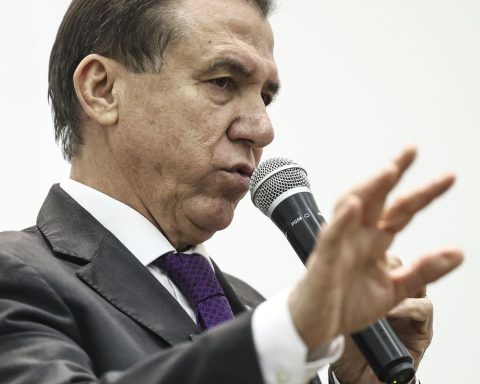
Sanctioned at the beginning of the yearthe States Debt Full Payment Program (Propag) will allow states to expand investment by about R $ 20 billion per year (in current values), said the National Treasury Secretary, Rogério Ceron. 
At a news conference to explain the program regulation, he stated that these investments should not impact the primary outcome of the states.
The secretary explained that, according to the program rules, andIn exchange of the value that states can invest more, the credit limits will be reduced that state governments will be able to borrow in the financial system. Thus, the final impact of the program on state coffers will be neutralized.
Propag regulation will be published on Tuesday (15) in the Federal Official Gazette. The state’s adhesion period starts this Tuesday and runs until December 31.
“So this means that it will be $ 20 billion more of tax expansion, primary spending, national investments? Not necessarily, because an important part of the investments that states are making today is with credit operations. And we are taking from the global limit,” said Ceron.
Every year, the National Monetary Council (CMN) stipulates the credit limit that states and municipalities can borrow. The reduction of credit limits needs to be approved by the Board.
Union accounts
The Union, said Ceron, It will no longer receive from R $ 20 billion to R $ 25 billion per year (in current amounts) in interest on state debt. The secretary, however, clarified that the impact on federal coffers will not affect the primary outcome, result of government accounts without public debt interest and used to investigate the fulfillment of fiscal goals.
According to Ceron, the money that the federal government does not receive will affect financial operations that impact net public debt (difference between what the Union must and has to receive), without being accounted for in the primary result of the Union.
Only in some cases, where states offer the Union to participate in actions of local state -owned companies to repay debt, there will be a residual impact on the primary result. This is because the federal government will inherit profits and losses of these companies, increasing or reducing the deficit.
In January, the Treasury had reported that Propag would increase federal public debt to up to R $ 105.9 billion from 2025 to 2029 in the worst scenariowhere states do not offer assets to the Union and do not repay debts. In the best scenario, the Union will raise up to R $ 5.5 billion in the same period, if states transfer R $ 160 billion in assets to the Union and amortize the debt in the first five years.
How it works
Propag provides discounts on interest and installment of state debt balance within 30 years. In return, states that adhere will contribute resources to the Federative Equalization Fund (FEF), that will distribute money to all states that adhere, even those who do not have debts with the Union, for investment in education, public safety, sanitation, housing, transport and other areas.
Administered by Banco do Brasil, FEF will have 20% of the resources shared according to the inverse of state debt (who should receive the least), with the remaining 80% distributed according to the criteria of the State Participation Fund (FPE), used to share the resources of income tax and tax on industrialized products.
According to Ceron, there are still no estimates of how much FEF will raise because the amount will depend on how many units of the Federation adhere to propag. The idea is that the low indebted states and good payers will be rewarded with more investments in education, safety and infrastructure.
Propag also allows states to amortize up to 20% of the outstanding balance by offering assets to the Union, such as local state companies, oil royalties, real estate, credits and state or district active debt among others. In return, states will have less counterpart in direct investments and may reduce FEF contributions.
Veto
Despite the dissatisfaction of several governors, who have pressured the state benches to vote for the overthrow of the vetoes to the Propag Complementary Law, Ceron said the economic team does not work with this possibility. According to him, the bill was widely negotiated between the Union and the Ministry of Finance.
The governors of Rio de Janeiro, Minas Gerais and Rio Grande do Sul have already made demonstrations favorable to the overthrow of the vetoes. One of the most controversial points is the withdrawal of the possibility that states use resources from the future National Regional Development Fund (FNDR) to deduct debts with the Union. Created by tax reform, FNDR will combat regional inequalities.