In previous articles I have presented manuscripts or publications that we find in the archives of the cultural center where I work. I have tried to integrate this column to the task that covers almost my entire life: to disseminate the universe contained in the Vitier García Marruz House—that sizeless universe whose name is Cuba, and that both everyday life and distance seem to strive to disfigure.
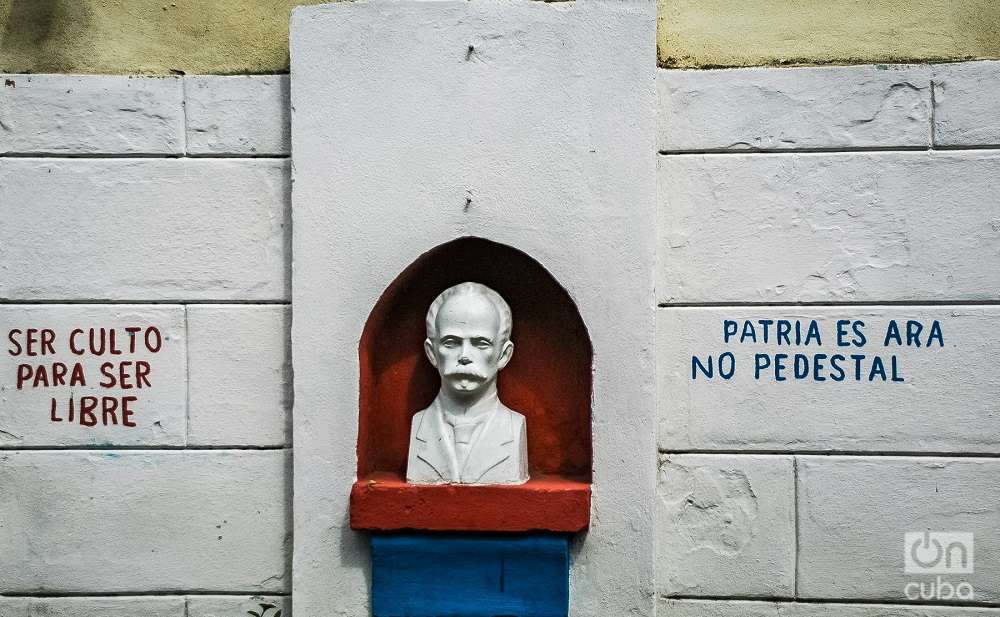
Today, January 28, I want to remember the clear teaching of Medardo Vitier with an evocation of Martí. Medardo was the first Cuban to write a book about Martí, titled Martí, his political and literary work (1911). The page we choose, however, belongs to his book Studies, notes, Cuban effigies (1944).
***
Jose Marti
The life of the Cuban Apostle was brief in time (1853-1895), but he filled it with human meaning, so much so that biographers and critics still study it.
He studied, suffered, traveled, preached the Revolution, gathered men, founded a party, prepared for the war, came to it and fell among the first in the fight.
Immense was his experience of the world because he was gifted to penetrate souls, in which he discovered chambers of light alongside evil powers.
Early on he decided to cast his lot “with the poor of the land.” He chose the path of sacrifice, that is, he renounced the enjoyment of existence, to give himself to a public cause. He did it all with perseverance, without fainting, without hatred.
He traveled around the world while his plan matured and he established himself in the methods with which he was going to influence History. It was a force that worked to build. He believed in the reality of good. He believed in the effectiveness of love to overcome the power of darkness.
He loved Spain with filial affection, “the Spain over there,” as he said; and so much so that it testifies:
I love the flowery land,
Muslim or Spanish,
Where it broke its corolla
The little flower of my life.
That is. Two words: “little flower”, tell us that he deprived himself of the joys of the world and that if anyone experienced it, it was there, in the land of his father, the good tough Valencian, Don Mariano.
In Madrid and Zaragoza he studied university. He came back graduated. He lived in Mexico, Central America, Venezuela, and the United States. He was in Santo Domingo, where he was attracted by Máximo Gómez, whose will he surrendered so that he would come for the second time to lead the Revolution. While passing through Haiti, on his way to death, as he was coming to Cuba, he wrote a travel diary, published recently, which exhibits the most refined and serene prose of his literary work.
He came tired, painful, with the strange lucidity that the proximity of the end gives to the superior man. The language, whose secrets he learned by reading in the library of the Ateneo de Madrid, from Cervantes, from Quevedo, from Calderón, opened its registers to him, soft and submissive, in those pages of twilight. I had never written them so beautifully, not even in the eulogy of Bolívar, or in the essay on Cecilio Acosta, or in that of Walt Whitman, or in the speech of “The New Pines.”
Rubén Darío, when he heard the news of Martí’s death, exclaimed: “Oh Master, what have you done!” The admirable page of the Nicaraguan poet is found in his book The rare ones.
Since then he began to live among us. Yes. There was the ineffable suggestion of his being. Those who approached him in Tampa, in Key West, in New York felt overwhelmed by the mystery of a pure and overwhelming man. But here, for us, the case was a legend and a long fame whose radiance illuminated Dos Ríos. The Cubans here had not seen him, at least the generation of ’95. Therefore, when his written work, which is copious, spread, a new life of the Apostle began. His ideology has been rolling (I’m not saying penetrating) into the consciences. In any case, and even if he does not prevail, an atmosphere has been created around his memory that is not generated by any other American hero. In some individuals it is a sign of behavior. It denotes something since it captures the wonder in few…
These men of spiritualized mission seduce only a few. Yes, they delight the most, but the difficult thing is to adhere, in everyday life, to the ethical modules of the founder. His ethicism makes him teach that “virtuous politics is the only useful and lasting one.”
These men are placed in the sphere that corresponds to their moral stature. Our vision encompasses the solemn set of these norms, but real, sacrificial adherence does not occur. Most men’s program is to succeed, to reach a goal of practical well-being, and often, without paying attention to the means used. So, Prophet looks strange up there in his heights…
However, we love him, we feel his divine make, because in everyone there are superior elements that sleep as long as instincts rule.
“Master, what have you done!” But Darío adds that the deep voice of the fallen man rebukes him…
Today Martí is where he one day contemplated the heroes, mute, at rest, with “eyes of stone, hands of stone”… His written work gains devotion in America. He is inciting us Cubans like the emigrants yesterday. It doesn’t matter, for now, that the founder’s austere ways do not prevail.
***
One would like to accumulate silence, rather than add something to the difficult brevity that illuminates the essential. “Blessed are we who have teachers.” All that remains is to continue.