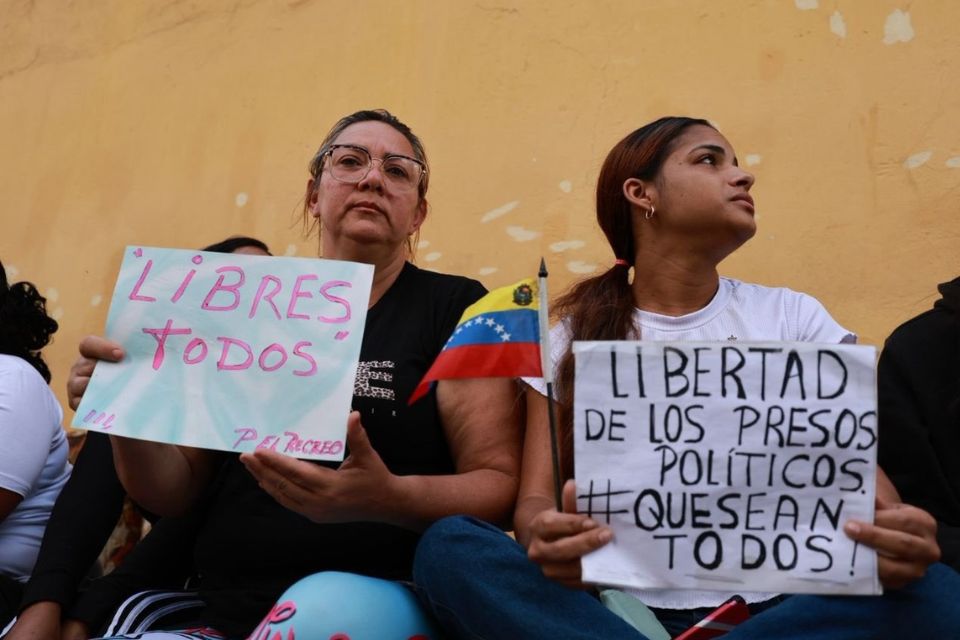
Since last January 8, dozens of mothers, fathers, wives or children have gathered every day in various prisons in the country waiting for a surprise, a call that tells them that their family member will actually be released from prison. Human rights organizations insist on a clear release process, which includes not only a list with detailed information on each political prisoner, but also information regarding the criteria used and the precautionary measures imposed.
12 days have passed since the first official announcement. A “large number” of releases of Venezuelans and foreigners was promised by the president of the National Assembly, Jorge Rodríguez, as part of a “unilateral gesture” by the Chavista administration. Since then, the process has been marked by institutional opacity, the wait, struggle and solidarity of hundreds of families in various prisons to be able to hug their loved one, the one who has the label of “political case.”
Since last January 8, dozens of mothers, fathers, wives or children have gathered every day in various prisons in the country waiting for a surprise, a call that tells them that their family member will actually be released from prison. They have held continuous vigils in prisons such as El Rodeo, Yare II, Sebin Helicoide, Tocorón or zone 7 to find out when the release tickets arrive.
*Read also: Between tents, vigils and threats, families of political prisoners do not abandon hope
As in other processes, some detainees have been delivered to places other than their detention center. Former deputies Enrique Márquez and Biagio Pilieri were left in the Altamira urbanizationdespite the fact that his detention center was Helicoide. Journalists Luis López and Roland Carreño were also taken to a shopping center in Guatire, where they had to wait for the arrival of their relatives who were outside Rodeo I.
Foreigners at liberty
At least 86 foreigners or Venezuelans with dual nationality were deprived of liberty until the end of 2025, according to human rights organizations. In this process, at least 19 have been released. The last to be released were the Panamanian Javier Olmedo, the Ukrainian Yvhenii Trush, imprisoned since October 2024, or the Hungarian citizen Zsuzsanna Bossanyi (detained June 2025), one of the crew members of the underwater exploration ship N35 intercepted 80 miles off the coast of Venezuela.
#15E Camilo Castro, former political prisoner of French nationality, shares emotional words from the United Nations headquarters in Geneva on the occasion of his recent release.#Venezuela pic.twitter.com/XUa0OyK4y4
— Penal Forum (@ForoPenal) January 15, 2026
The least considered
Although the organizations demand the “full and immediate” freedom of “all” political prisoners, it is not something that the authorities have announced as part of their “unilateral gesture.” In view of this, the NGO Justicia, Encuentro y Perdón has requested that the considerations for release include those detainees in a condition of greater vulnerability such as “adolescents, older adults, women and those who remain imprisoned for reasons prior to the electoral process.”
#ATTENTION To date, we have confirmed 150 releases of political prisoners since the official announcement was made on January 8, 2026. We insist that each release has been verified by our team.
We reiterate that the process must be broad,…
— Justice, Encounter and Forgiveness (@JEPvzla) January 17, 2026
There are currently two teenagers detained for political reasons: Gabriel Rodríguez, 17 years old and sentenced to 10 years in prison, and Samanta Hernández, arrested on November 19 for being the sister of exiled lieutenant Cristian Hernández.
*Read also: Lawyer pressures Lieutenant Hernández’s sister to admit crimes, Committee denounces
There are older adults like Aldo Rosso, an activist from Voluntad Popular, Mary Torres from Sequea, Yosida Vanegas or Nélida Sánchez, from the Súmate organization. The merchant Emirlendris Benítez, Colonel José Gámez, General Héctor Hernández da Costa, María Auxiliadora Delgado, Orlando Laufer and the activist Javier Tarazona suffer from serious health conditions that require specialized medical attention.
Juan Carlos Marrufo, Italian-Venezuelan, electrical engineer, and María Auxiliadora Delgado, Hispanic-Venezuelan, graduate in tourism, husbands and political prisoners, were detained for the first time on March 19, 2019 at their home in Valencia, Carabobo State, by officials of… pic.twitter.com/xVEdHptITV
— Penal Forum (@ForoPenal) January 16, 2026
There is also the case of the union members William Lizardo and José Elías Torres, who are in forced disappearance like the former deputy Fernando Orozco and his family, 31 convicted for Operation Gedeón (2020) or 16 soldiers with completed sentences who were taken from the Ramo Verde prison last November.
Likewise, engineer Darío Estrada, within the autism spectrum, has been detained since 2020 and is currently detained in the Yare II prison.
In Venezuela, two indigenous people also remain arbitrarily detained: Army Captain Rocío del Valle Fernández (Wayuu ethnic group), imprisoned since August 2024 and sentenced, and worker Alain José Linares (Puinave ethnic group), detained since October 2025.
– 𝗥𝗼𝗰í𝗼 𝗱𝗲𝗹 𝗩𝗮𝗹𝗹𝗲 𝗙𝗲𝗿𝗻á𝗻𝗱𝗲𝘇 𝗛𝗲𝗿𝗻á𝗻𝗱𝗲𝘇, Political Prisoner, 44 years old, Captain of the Bolivarian Army and belonging to the Wayuu ethnic group.
On August 16, 2024, he was notified that he must appear for an interview with the General Directorate of… pic.twitter.com/TYM1m1PIWd
— Penal Forum (@ForoPenal) January 12, 2026
Why are there different figures?
One of the questions from family members and society in general is why the number of political prisoners varies according to the organization. The reason is simple: although with an almost unified criterion on what they consider a detainee for political reasons, the complaints are what feed their databases and, consequently, the actions they can achieve for their release.
The Penal Forum and the NGO Justicia, Encuentro y Perdón, the main organizations that keep a count of cases, have insisted that their data is an under-record of reality. This is because many families are threatened or are afraid of new actions against their core if they make public an arbitrary detention for political reasons.
An example of this was made visible by the Committee for the Freedom of Political Prisoners (Clippve). In just four days they received a hundred new cases in view of the release process and the possibility that their family member will benefit. The Penal Forum has received a number of complaints, over a hundred, which are currently being reviewed by activists to determine if they actually fall into the category of arbitrarily detained for political reasons.
Differences with other processes
Gonzalo Himiob, vice-president of the Penal Forum, indicated that previous experiences have shown that “the real number of political prisoners released does not coincide with the numbers announced by those in power.
That is why we have called for transparency, the lawyer insisted.
The organization has requested, he recalled, “that we clarify clearly what criteria are being used and who are, in effect, those who are favored by these releases.”
He also highlighted that a fundamental difference of this process that began on January 8 with the previous ones “is that it is the first time that it is formally announced that there will be significant or massive releases, as Mr. Jorge Rodríguez said. However, I must remember that by virtue of what we call the revolving door, throughout all these years, the incarcerations, even in dribs and drabs, have not stopped. The problem is that before these releases occurred and the cells were filled again with “immediately with new prisoners and we hope that this does not happen in this process.”
Marta Tineo, general coordinator of the NGO Justicia, Encuentro y Perdón, agreed on the institutional opacity, the lack of prior announcement or human rights perspective in this round of releases.
The expert also added that it is a “process that is highly re-victimizing due to the lack of transparency. The families entered a loop of anguish and uncertainty, they have been in front of the prison doors for more than a week, we have already seen decompensations due to the anxiety and the conditions in which they find themselves.”
Under precautionary measures
The political prisoners who have been released in these 10 days are released with precautionary measures, according to what the various NGOs have been able to verify. This includes a ban on leaving the country or your state, periodic appearances in court, a ban on speaking about your case or using social media.
These types of measures have been recorded since at least 2014. The Penal Forum has records that at least 10 thousand people “are still subject, arbitrarily, to measures restricting their freedom.”
The Committee has claimed that some of these measures, such as weekly, biweekly or monthly appearances before courts, represent a high cost for those released from prison and interrupt their work, especially for those who live outside the Capital District but their cases remain in anti-terrorism courts based in Caracas.
Institutional contradiction
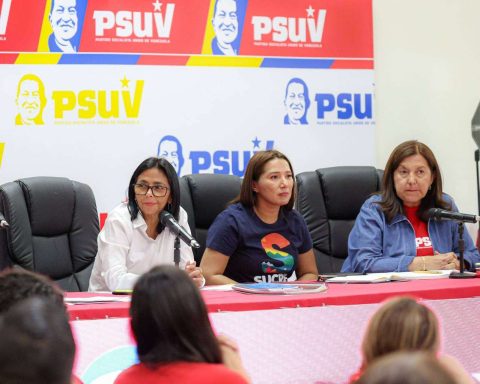
The “institutional opacity” that human rights organizations have claimed has not been dissipated by the statements of senior officials. In a first statement, Jorge Rodríguez limited himself to reporting “a large number.”
Three days later, the Ministry of Penitentiary Service clarified that 116 releases “had been completed.” On Tuesday the 13th, deputy Jorge Rodríguez promised to make public a list with the data of the people who have received precautionary measures, but so far it has not been made known. The promise was made to deputy Luis Florido, and he even dared to include those since December 2024 in the list of more than 400 people released from prison.
But on January 14, a new figure and explanation emerged: Delcy Rodríguez assured that 406 precautionary measures of freedom had been granted since December 2025. She also said that the release process “has not yet been completed” and that it continues, coordinated with the country’s justice system; specifically in charge of the Minister of the Interior, Justice and Peace, Diosdado Cabello.
*Journalism in Venezuela is carried out in a hostile environment for the press with dozens of legal instruments in place to punish the word, especially the laws “against hate”, “against fascism” and “against the blockade.” This content was written taking into consideration the threats and limits that, consequently, have been imposed on the dissemination of information from within the country.
Post Views: 55