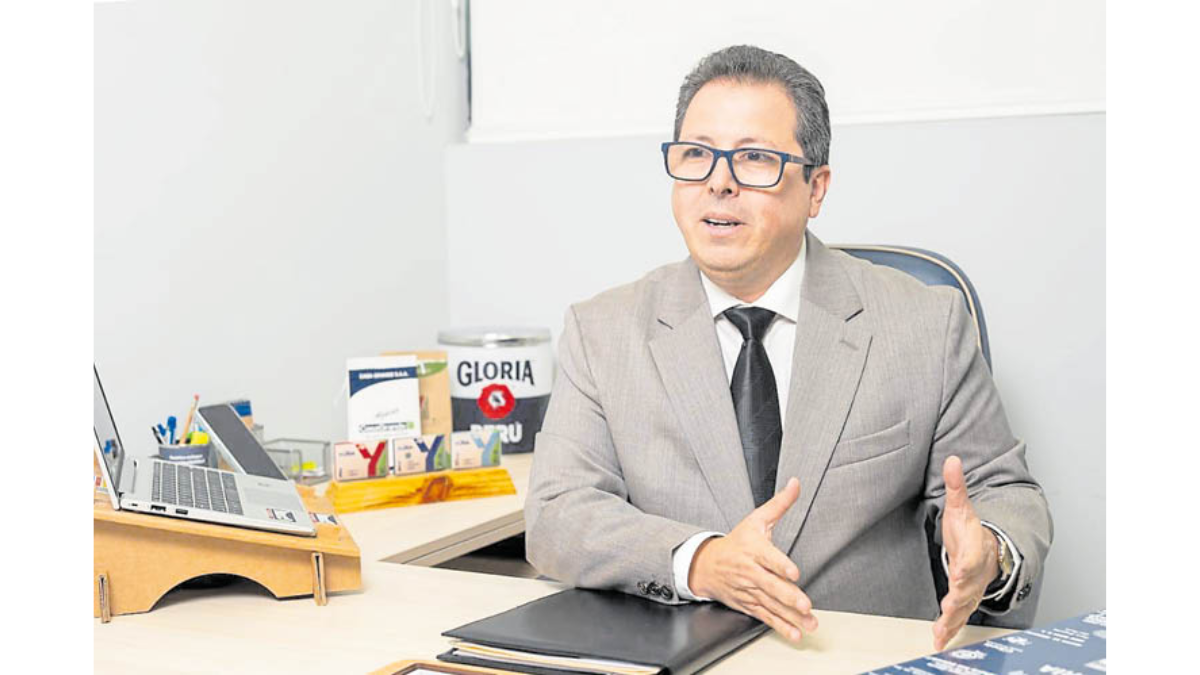
The Gloria Group has four business units: food, cements, agribusiness and trupal. His presence in Ecuador, Colombia, Chile, Argentina and Bolivia, in addition to Peru, goes up, but always with social and environmental responsibility. To learn more about the sustainable work we do, we talked with Reinaldo Serra, corporate manager of public affairs and sustainability of the group.
Within the purposes of Gloria is the responsible expansion of their businesses. What does this imply for the company?
It is the course we have been following and can become a success case to share. The story starts in the middle of the last century with the dream of an entrepreneurial family who conquered the country with the quality of its products, but later, in the 90s, began a diversification process and was internationalized. This whole process responds to a strategy that has been strengthening more and better. Especially now with Claudio Rodríguez as executive president of the group, where innovation and sustainability are the strategy that has allowed our growth and achieve other levels of investments.
What are the sustainability pillars for glory?
First, grow together. Our products reach 60 countries in the world, but it is useless to grow if we do not grow hand in hand with those who are part of our value chains in the different business units and especially the communities where we have operational presence.
How much have they advanced in it?
A lot. Milkish livestock is one of our closest interest groups, with which we also work historically. In the last 10 years, as evidence of our real commitment, we have allocated for and for dairy winners more than S/700 million in technology and studies transfer. We are not a dairy farmer, such as Uruguay, Argentina or Colombia, where each region has a very important livestock basin. Our country is blessed by its nature, however, it has to import food for dairy cows, because we naturally do not allow production or quantity. Currently, cold chains, 500 liter tanks are being placed that allow them to preserve the milk from the farmers in Arequipa and Cajamarca. Progressively, we hope to reach 100% of the farmers who are our raw milk suppliers. In addition, these tanks work with solar panels.
What other pillars have?
Nutrition for all, which has to do not only with the feeding of the human organism, but with the life and dignity of the person. Nurturing Peru with Gloria is a program that responds to this pillar of frontal fight against chronic malnutrition and anemia. Anemia indices in Peru are alarming, but very few take into account what this means for the country in the next 10, 20, 30 years. This is mortgage the future of the country if we do not intervene promptly and effectively with children under five who suffer from anemia.
How did they address this situation?
First, through scientific research that allows us to produce commercial products that respond effectively to anemia. Second, our products are always oriented to the base of the pyramid. It would be useless to have them if they are not available to people with lower resources. Third, through our social intervention programs. There appears nourishing Peru with Gloria, who has already traveled in the last 10 years 14 regions of the country. Right now, in October, we are going to declare to the people of Antioquía, in the Sierra Limaña, free of anemia for those under 18. Until a few years ago the anemia there reached half of its child population.
What has been the work developed in Antioch?
It is a work of nutritional education. We have a team in the Social Production Management, of nutritionists who go, intervene and are there permanently. During this period they see the results. In the last screening we already had about 60% of the children intervened free of anemia. We project that until September or October we would already have 100% without anemia. There comes another challenge, that children do not return to this situation. What we are doing in Antioch is replicated in a nest of the Municipality of Surquillo. At the same time, we are working at a national school in Piura.
On the issue of the production process, what actions did they take?
This responds to the pillar of the protection of the planet. For example, the sugarcane bagasse that we produce in northern Peru was going to stop where the production residues go to the fire. That affected the environment and surrounding communities. Therefore, having a company like Trupal, which works with recycled input packaging, makes this bagozo wasted above become its main input. Trupal works and elaborates products with 100% recycled inputs, it is a circular economy. Another highly efficient investment, an indispensable requirement to be sustainable, is the photovoltaic plant that we inaugurate in Yura, Arequipa. It is the first that generates clean energy of self -consumption in the cement industry and has meant an investment of US $ 25 million. The second requirement for sustainability is transcendence. The Yura plant means 40% of our energy for our operations. Another example, when it comes to food, more than 50% of our containers are tin. And the tin is the most recyclable container. Moreover, our traditional milk jar is the first product in Peru to have the infinite seal, because it is infinitely reusable.
Receive your Peru21 by email or by WhatsApp. Subscribe to our enriched digital newspaper. Take advantage of discounts here.
Recommended video: