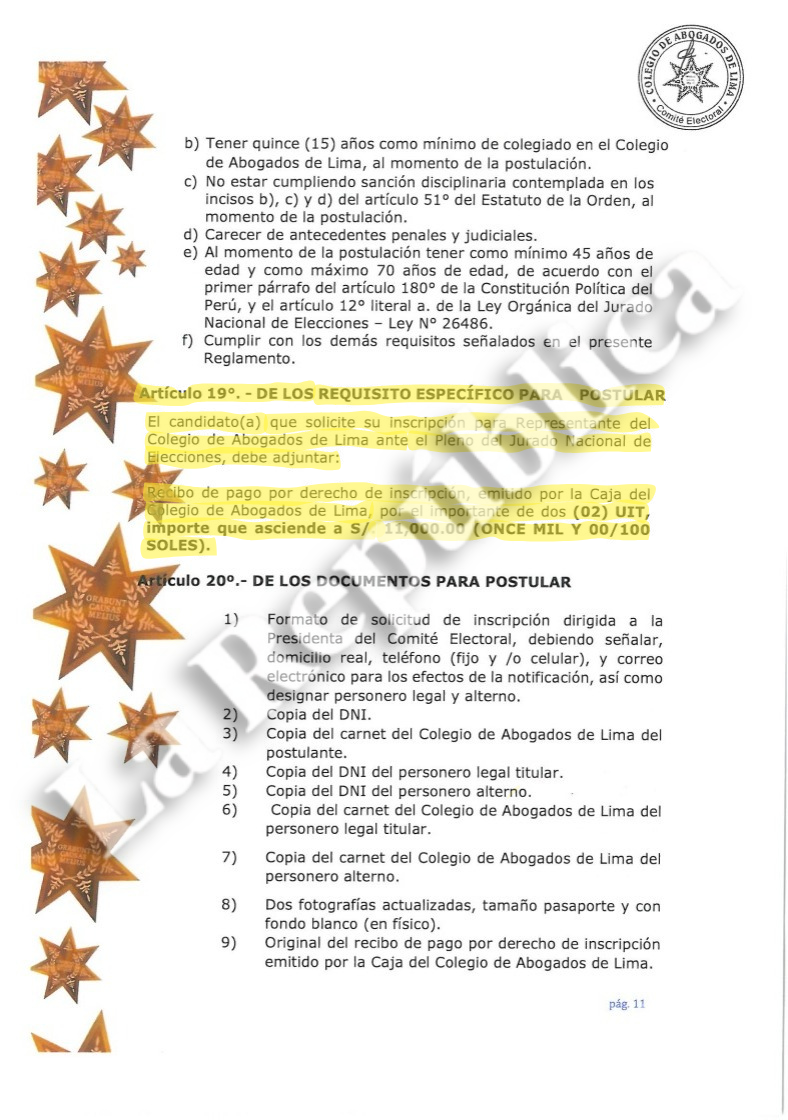
The election of the representative of the Lima Bar Association before the JNE will have a high cost for applicants. The Electoral Committee of LIME established a payment of two Tax Tax Units, equivalent to S/11,000, as a mandatory requirement to register in the process, according to the regulations approved for these elections.
The amount appears in article 19 of the specific application requirements and covers any lawyer collegiate and qualified person who aspires to represent the union before the JNE. The measure introduces an economic barrier in a key election, since the representative of the LIME participates in decisions linked to national electoral processes and elections 2026.
YOU CAN SEE: CAL rejects the decision of the TC and warns about impunity in crimes against humanity: “It limits the investigation”
The collection is not limited to the charge before the JNE. The electoral regulations of the LIME It also sets high rates for other internal positions, such as delegates and positions in the school’s ranks, which has generated criticism for the impact that these economic requirements have on the plurality of candidates.
Since the current management of LIME They specify that the Board of Directors and the Dean’s Office do not intervene in these decisions. The Electoral Committee is an autonomous body, elected by the college assembly, and acts in accordance with its statutory powers, without direct interference from the authorities in office.
YOU CAN SEE: Elections 2026: the new faces of the parties for the next elections
Dean of CAL questions collection and warns of impact on union democracy
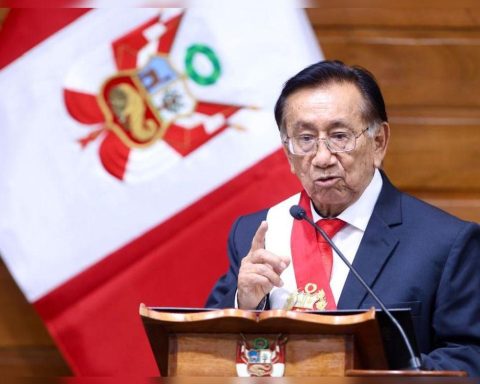
The dean of the Lima Bar Association, Raúl Canelo, harshly questioned the payment of S/11,000 required to apply as a representative before the JNE and described it as a disproportionate measure. “To me the charge seems abusive, too excessive. And this violates freedom of association”, he said in an interview.
Canelo warned that the amount set by the Electoral Committee of the LIME generates an exclusive effect within the union. “It is a clear abuse and it is also a discriminatory act because it is allowing people who have greater resources to apply, discriminating against those who have fewer resources.“, he stated, pointing out that economic demands restrict the participation of lawyers without the capacity to assume that payment.
YOU CAN SEE: Rafael López Aliaga continues in the 2026 Elections: JEE rejects blemishes against the Popular Renewal candidate
The dean also warned that high rates affect internal electoral competition and discourage the formation of lists. “These lists would have to make very high payments to be able to apply. And that would even seem to be aimed at ensuring that there is no democratic nomination by the members.“, he indicated, in reference to the process to elect the representative before the JNE.
Finally, Canelo recalled that the Electoral Committee is an autonomous body and that the Board of Directors cannot intervene in its decisions. However, he maintained that the impact of the measure is serious. “With this, the right of any member to apply to the National Election Jury is being curtailed.” and, he added, “It would seem that only those who have money benefit and that is not correct.“, in a key scenario for the elections 2026.
YOU CAN SEE: How to file a complaint against candidates: definitive guide for the 2026 Elections
High charges also reach positions for the Board of Directors and other positions of the Lima Bar Association
The economic demands of the Electoral Committee of the LIME are not limited to the election of the representative before the JNE. The electoral regulations establish that the lists that apply to the Board of Directors must pay a registration fee equivalent to four ITUwhich amounts to S/22,000in addition to having the support of at least the 3% of active membersa requirement that further raises the barrier to competing in the internal process.
For the Supervisory Board, the regulations establish a payment of an ITUequivalent to S/5,500and requires the support of no less than 50 active registered lawyers. These amounts, added to the formal requirements, configure a restrictive scenario for the participation of members who do not have sufficient financial support, according to Dean Raúl Canelo when referring to the impact of these rules on the democratic life of the LIME.
Added to these payments is the mandatory acquisition of the electoral kitwhose cost varies depending on the position. For the Board of Directors, the amount is 12% of the ITU (S/660); for the Supervisory Board, the 6% of the ITU (S/330); and for delegates, the 3% of the ITU (S/165). The kit includes the registration application, the 2025 Election Regulations and the adherent forms, documents that, although they are available on the website of the LIMEcan only be obtained after the corresponding payment, which reinforces criticism about the economic weight of the internal electoral process.