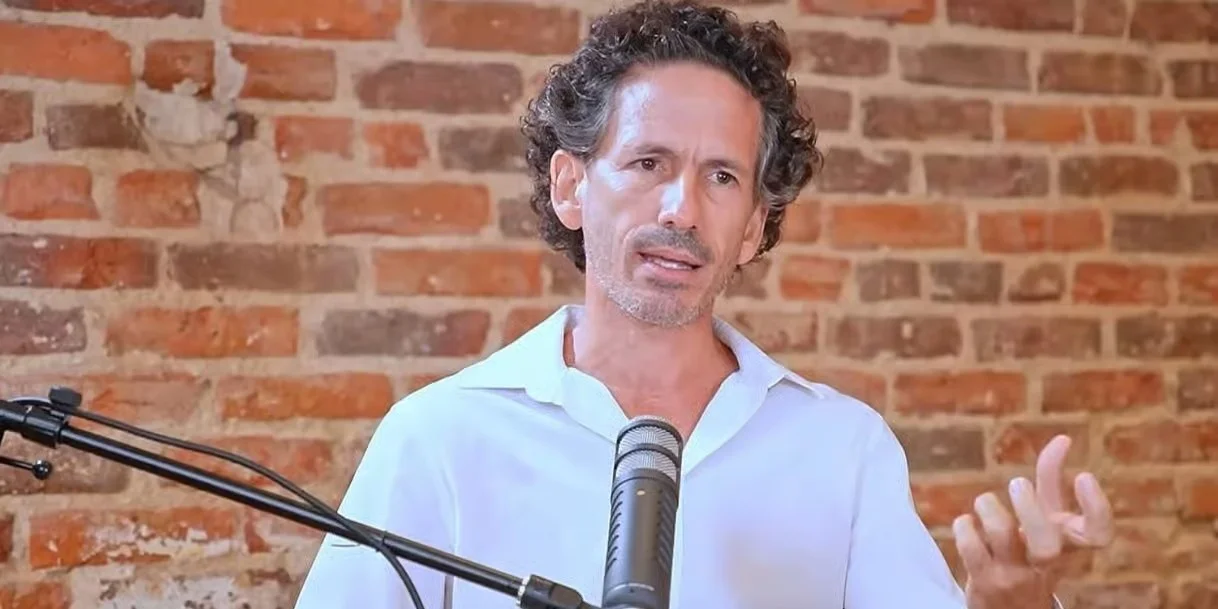
MIAMI, United States. – Independent journalist Boris González Arenas denounced this Wednesday that authorities at the “José Martí” International Airport in Havana prevented him from traveling to the United States to participate in the Edward R. Murrow project for journalists, titled “AI and technology in journalism.”
According to González Arenas himself in a post on your Facebook profilein terminal 3 of the airport he was prohibited from passing customs check due to an alleged “travel impediment.” The journalist identified the official who informed him of the measure as “Ricardo González”, a name that, he assured, appeared on the identification that the employee was wearing around his neck.
González Arenas explained that, after receiving the verbal notification, he wrote a complaint. “I had to return, but not before writing a complaint on a minimal piece of paper that Ricardo gave me. I tried to deliver a copy to obtain his signature and category, but Ricardo did not receive it,” he said.
According to him, the official told him that he should address those who prevented him from traveling. When he asked who they were, he received the answer that he did not know. “This, despite having called ‘someone’ by phone to confirm the blockade of my right,” he added.
“I have no resentment towards Ricardo, he was neither friendly nor hostile, and as a customs official it is his responsibility to carry his identification and put himself on the front line of a complaint in which he is the last culprit,” he expressed in his publication. He also stated that those “mainly” responsible for the decision remain “absolutely invisible.”
The trip was intended to participate in the Edward R. Murrow project for journalists, focused on artificial intelligence and technology applied to journalism. González Arenas described the program as “tremendously prestigious” and highlighted the professional value of exchanging with colleagues from Latin America. “It is one of the projects of the IVLP 2026 (International Visitor Leadership Program), a program that, I have learned during the procedures, is tremendously prestigious and would allow me to share with colleagues on the continent,” he wrote.
The journalist described the invitation as a recognition of his professional career. “One of those recognitions that come after years of work and make you proud when all you do is work in conditions that border on the impossible and earn the esteem of good people,” he said.
In his publication he also made reference to the personal and family impact of this type of restrictions. “The days before my trip are also days of tension for a family that has accumulated 15 years of accompanying an anti-communist human rights defender in a country subjected to such a scoundrel,” he wrote.
González Arenas recalled that this is not the first time he has faced restrictions when leaving the country. “Between 2019 and 2024 my right to exit was permanently blocked. Before, I was prevented from traveling, punctually, on many occasions,” he said. He added that he does not know if the new impediment responds to a “punctual or permanent” decision.
Likewise, he assured that these limitations have had consequences on his professional career. “But these blockades cost a lot to the careers of those of us who are sought after internationally for our efforts,” he wrote. As he explained, on previous occasions he was prevented from traveling to speak in the British Parliament or to attend the election process in Colombia.
In his message, the journalist quoted words addressed to the Cuban authorities: “You are right to prevent me from traveling, every word of mine would strive to break the floor of your filth.”
The island’s regime uses the euphemistic term “regulation” to refer to the discretionary prohibition on leaving the country imposed on activists, opponents, journalists and dissidents in general. The normative basis of these restrictions is in the Immigration Law (Law 1312) and its 2012 reform (Decree-Law 302), which allow passports to be denied or departure prevented for broad reasons such as “national defense and security” or “other reasons of public interest.”
Although Havana eliminated the old “exit permit” in 2013, authorities have maintained discretionary powers to prevent travel by critics and opponents. According to Human Rights Watchthis is a violation of international law.
The Inter-American Commission on Human Rights (IACHR) has repeatedly warned of restrictions on the freedom of movement of activists, journalists and human rights defenders in Cuba, including a ban on travel to attend international conferences and events.
In its 2020 report on Cubathe IACHR asked the State to guarantee freedom of movement “to leave and enter the country” and to refrain from applying these arbitrary restrictions. Amnesty International too registered in 2024 the persistence of the “prohibition of leaving the country” and “forced exile” as tactics of repression against critical voices.
In 2024, the National Assembly published a draft new Immigration Law which, in addition to organizing the system, maintains clauses that enable entry and exit limitations for “national defense and security” and for “other reasons of public interest,” and provides for notifiable restriction measures with limited avenues for challenge.
The official document details, for example, that “any person who is in the national territory cannot leave the country” when causes such as those mentioned exist, and that the Immigration Authority can apply “entry and exit limitations” in exceptional cases. Cuban civil society organizations and media such as the Patmos Institute have kept public records of “regulated” and have underlined the political nature of many prohibitions.