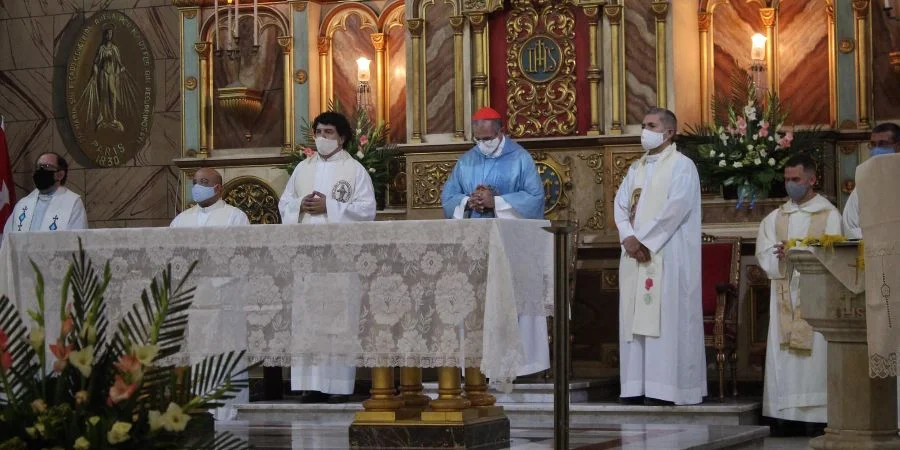
Mexican priest José Ramírez rang the bells as a gesture of solidarity with the residents of Santos Suárez who protested the blackouts.
MIAMI, United States. – The authorities of the Cuban regime informed the Catholic Church that they will not renew the temporary residence of the Mexican priest José Ramírez, a member of the Congregation of the Mission, who This Monday night he rang the bells of the temple of La Milagrosain Santos Suárez, as a gesture of solidarity with the neighbors who protested the prolonged blackouts.
The measure, which implies the departure of the priest from Cuba, was confirmed by an ecclesiastical source to the media. Martí News.
As explained by that source, who spoke on condition of anonymity because he was not authorized to discuss internal Church matters in public, the priest rang the bells after the neighbors had been without electricity service for more than 12 hours.
The decision not to extend his immigration status would have been presented as an administrative measure, but in practice it amounts to a de facto expulsion: once his documentation expires, José Ramírez must leave Cuba and return to Mexico, which — according to the same source — will occur this Thursday.
The person responsible for communicating the measure to the Church was Caridad Diegohead of the Religious Affairs Office of the Central Committee of the Communist Party. According to the version offered to Martí NewsDiego avoided using the term “expulsion” because, according to the source, “it would be a scandal,” but he made it clear that the Government will not renew the religious’s temporary residence.
Sources within the Church itself also indicated that State Security agents directly pressured José Ramírez after the ringing of the bells in La Milagrosa.
With the ringing of the bells, Ramírez joined other Catholic religious who have openly criticized the regime and have expressed solidarity with the population, such as the priests Lester Zayas, Alberto Reyes, Kenny Fernández Delgado and José Conrado Rodríguez Alegre, and the nun Nadiezka Almeida.
This is not the first time that the regime has resorted to the forced departure of a religious critic. In 2022, the Government expelled the Dominican priest David Pantaleón, superior of the Jesuits in Cuba, due to his questions about the dictatorship and his pastoral work. On that occasion, the nun Ariagna Brito Rodríguez, of the Sisters of Charity of Cardinal Sancha, reacted publicly on Facebook with these words: “We regret that the Cuban Government, in use of its faculties of dictatorial power, without principles or values, forces you to leave the country: they fear the truth, they fear the face of good and they want to get rid of what bothers them, it is their only way of proceeding.”
On the other hand, the Foundation for Human Rights in Cuba (FHRC) has pointed out Caridad Diego as responsible for religious repression on the Island and has denounced the use of visas and temporary residences as a tool of control over priests, nuns and lay people. “It is a systematic practice to silence pastoral agents,” he stated to Martí News Luis Domínguez, FHRC researcher.