Technicians speaking in Melo to prevent damage
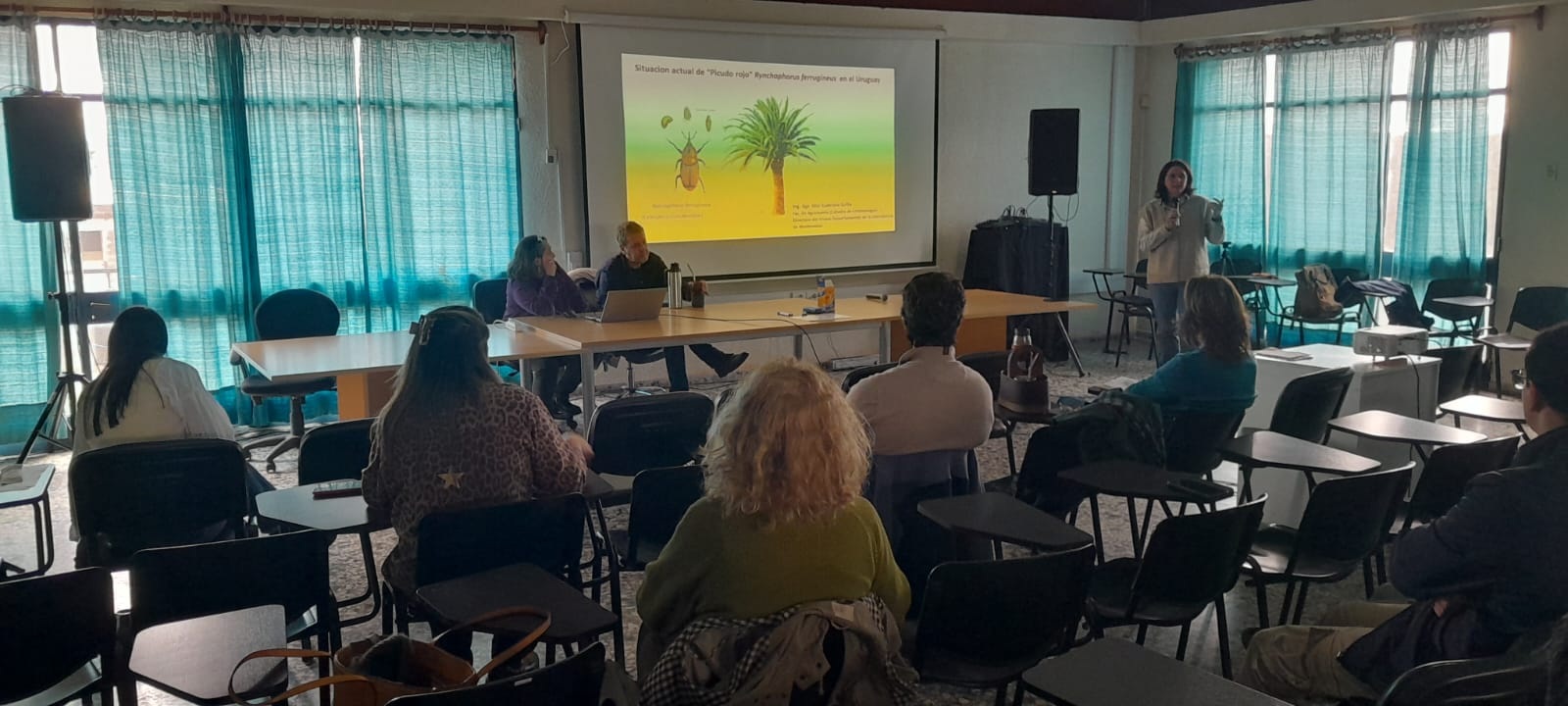
On a day organized by the Experimental Station of Bañado de Medina of the Faculty of Agronomy, extensive information about the red sticker was provided, plague that is attacking the palm trees in the south of the country.
How to be prevented, the risks that are run in places of concentration of many palms were the aspects addressed by two experts on the subject: a teacher of the Faculty of Agronomy of the University of the Republic and the director of Urban Tree of the Intendance of Montevideo.
“Because of a concern that they had from the Faculty of Agronomy of Bañado de Medina, the idea was to be able to convey the situation of the red sticker in Uruguay and the notions that the department has to have to be alert, to be prevented” He held the Ing. Agr. Gabriela Grille.
“It can be done quite exhaustive surveillance, which does not mean that the bug cannot arrive,” accurate. “Surveillance is very important to act immediately once it is detected. That is very important” said to The daily professional.
The presence of the insect has already been detected in 8 departments of the country, located south of the Black River. “In principle it is about half of Uruguay down. You have to work so that it does not extend more” The professor of the Faculty of Agronomy of the University of the Republic convened.
As time progresses, concern grows in departments such as Paysandú and fundamentally Rocha. “This is because of the Butiá. In short, if some attack in Montevideo has been detected in this species, we do not know if there is the possibility of attacking in the palmar. In fact we are seeing that some butiá palm trees that are dead in Montevideo are not directly related to itching. You have to work hard in what the investigation is to know a little more” The engineer Grille said.
“It is an exotic plague of which we had no previous knowledge. It is difficult. We must get progress little by little and the people who are working by institutions are a limited number of people, it is not very large” lament.
Montevideo the most affected
He Ing. Agr. Alfonso Arcos He commented that in some cases the presence of the red sticker in Butiá has been detected. “They have appeared concomitantly sick palm trees near palm trees, but where we have not found the insect or insect galleries” revealed.
“Hypothetically it could be, or something vectorized by the insect or something else that is being manifested at the same time. We are trying to elucidate that matter” express.
In 2022 the first case in the country was detected in the Capurro Park, Santa Lucía, department of Canelones. “Immediately, at 2 or 3 months they began to find cases in Montevideo, in the area of Villa Colón and later in the northern zone, in the racecourse, even in Boulevard Artigas.”
Arcos reported that the insect has a high reproduction capacity and is gregarious, attacks in large quantities. “Unlike the other sticker, black, which is native, less virulent, it has quickly expanded to the entire city in the case of Montevideo and other departments” said.
The capital city is clearly the most affected because it has many palm trees of the Canarian species that is the most suffered by the attack, it is preferred by this insect.
Regarding treatment, engineer Alfonso Arcos said that in some cases it has been possible to reverse damage with surgery techniques. “Actually, when the palm tree has already been attacked, it is very difficult to reverse. It does not mean that that has not happened. When the symptoms are detected it is because it already has a quite severe attack. In palm trees that we have treated, we have found insects dead up. This means that it was, but as it was treated it did not prosper. It came to be, but did not act” concluded.