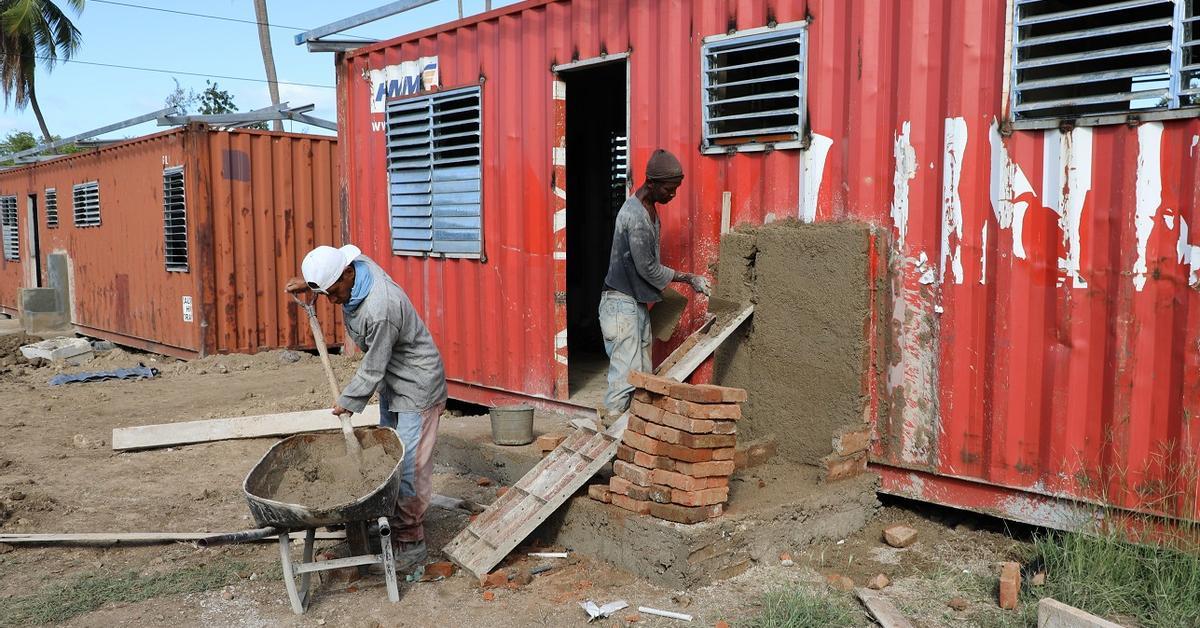
Havana/Four news items that appeared this Friday in official media, different from each other but with the same theme, make it clear how the Government plans to face the housing crisis, mainly due to the lack of resources: converting recycled containers into homes. The solution, which was already being implemented in provinces such as Sancti Spiritus, Las Tunas or in Guantanamo, it seems more than punctual and extends throughout the Island.
In this lastare currently being manufactured 70 container homes: as listed we will win15 in the Buenavista settlement, San Antonio del Sur; 20 in the Cabaña Mariana community of Guantánamo, and 35 in the area near the Airport, in Imías. All of them, they highlight, “are intended for families affected by total landslides caused by hurricanes Óscar and Melissa, as well as by the intense rains of September.”
The program, recalls the provincial newspaper, “is part of the state housing investment plan and arises from the use of containers used for the import of solar panels destined for photovoltaic parks. Once their logistical function has been fulfilled, these metal structures are available and therefore it was proposed to use them as an alternative housing project with technical and regulatory support at the national level.”
It is a project that is also “advancing” in Sancti Spíritus, where it is expected a total of 105 homes. In this province, furthermore, it says this Friday Escambrayall the municipalities have “the established documentation”, in three of them the foundation has begun and 164 containers “have been released”, of which 50 have been delivered, for recycling, to the Ministry of the Armed Forces, and 38 to workshops of other state organizations.
These houses made of containers will be between 32 and 70 square meters
In Santa Clara he helps this work, according to the newspaper. we will wina local development project (PDL), Reluxes Herreríaswhich is about to present an experimental prototype started last November and based on a design from the Ministry of Construction, to which it is “chained.” According to Mario Eduardo Valdivia Beyra, coordinator of the PDL – whose corporate purpose is to market basic hardware products on a retail basis but who has dedicated himself profusely to the repair of state assets, such as sanitary furniture or garbage collection “beds” – during 2026 they are willing to deliver ten homes per quarter, “even though the figure could be subject to specific situations with supplies.” To do this, they have, he said, “a trained workforce,” a total of 42 workers.
Likewise, he announced that after the “definitive approval of their prototype,” they will begin its execution on a larger scale. Reluxes Herrerías is responsible for the “metal mechanical part,” he indicated, while the Construction and Assembly Company will be responsible for the “microlocation of the place where they will be located.”
These houses made of containers will be between 32 and 70 square meters, he reported, and will have “several rooms, including a kitchen, bathroom, dining room and two rooms with closetsas well as doors and windows that will provide greater ventilation.”
The technology, he acknowledged, “is expensive,” although he assured that they have “a number of resources available to reduce costs and continue the proposal with the support of other actors in the economy.” The official also alluded to the greatest concern raised by Cubans regarding this type of housing: how to withstand the heat in a steel structure, not manufactured to house people but to transport goods. The steel, specialists explainhas good weather resistance, but is a conductor of both heat and cold, so it needs to have, to be conditioned as a passenger compartment, a durable insulating system.
/ we will win
“The anti-thermal elements that cover the interior walls guarantee an adequate temperature, in addition to placing the roof above the container,” said Valdivia Beyra, who did not detail the price or the specific type of insulating material that will be used. Instead, he guaranteed: “The homes will have high quality and finish, so that the families who are going to live in them have the minimum essential conditions.”
In Matanzas, he announced Gironthey will become homes 132 of the 142 containers which previously served to bring the equipment and materials from the Chinese photovoltaic parks that are being built to the province. The official newspaper concedes that it is “a novel and unexpected alternative in Matanzas”, but remembers that it has already been implemented in several provinces.
“Before carrying out any action both on the construction site and in the factory, several specialists study the behavior of the terrain, where they analyze the
conditions of the chosen sites. Among them is the accessibility of electricity and drinking water; in the latter case, to know if the creation of elevated tanks, cisterns and pits is necessary,” reads this Friday’s note.
In the case of this province, the Matanzas Architecture and Engineering Projects Company and the group of Community Architects are responsible for the design of these homes. The first, specifically, in the residential area of Río San Juan and the second, in the rest of the municipalities, including the provincial capital. Regarding the execution, there are several firms involved since October, such as the Varadero Tourism Works Construction and Assembly Company, the Matanzas Construction and Assembly Company, the Industrial Technical Services Company (Zeti), the Mario Muñoz Sugar Company, the Provincial Maintenance and Construction Company South or the Matanzas Forming Company Noel Fernández, known as the Cube Factory.
Officials promise that these types of houses take only 15 to 20 days to manufacture. The structure announced for these homes is similar to that described for other provinces, and is reported with similar caveats: “in certain areas they may undergo changes.” This can happen, he says Gironbecause “self-financed companies can develop other models without affecting the State budget, since they have the power to make an investment.”
As for the price, the estimated expense for each home is 900,000 pesos
Regarding the places where these homes will be installed, the official in charge of the Comprehensive Project Directorate, Guillermo López-Calleja Pérez, mentioned an area located on San Sebastián Street, where “plots of eight meters will be left, with the aim that families can progressively continue building”, clarifying that “the best option for this type of processes is to use areas with ready-made bases”, that is, state land, “already prefabricated”, such as those of the meat company in La Jaiba, another of the spaces selected for the “settlement”. Recycled land for recycled houses.
The Matanzas manager did detail some thermal heat-insulating materials, such as glass wool, henequen fiber and Cárdenas bagasse cardboard, “with an availability of 100 sheets,” he assured. Regarding another logical concern, the corrosion of the structure due to humidity, Daniel Arencibia, from Architects of the Community, stated that “waterproof paint will be applied” and “a cover will be placed on top, an element that protects them from the elements and humidity, but at the same time acts as a thermal insulator.”
As Danay Ordúñez García, director of Housing in Guantánamo, clarified, these houses are not donations, although they are “state housing with public financing.” That is, “the beneficiary assumes the value of the container according to the approved budget, while the urbanization and other associated expenses are covered by the State.”
Regarding the price, the estimated expense for each home is 900,000 pesos, said the official, whose payment mechanism would be established “later with the banking system in negotiation and mutual understanding, following the usual procedures of the housing program.”