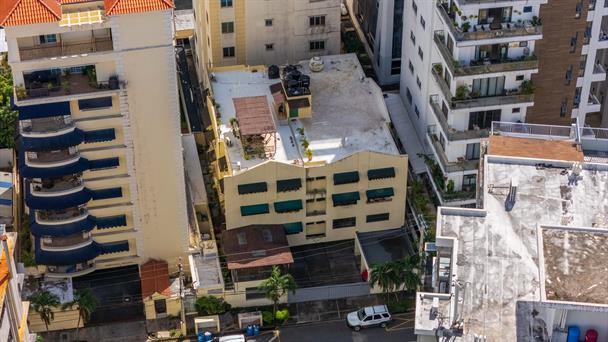
The increasing rise of high towers in urban areas it generates new challenges for residents in single-family homes and buildings low height because they lose visibility, ventilationsecurity and privacy.
Houses or low-rise buildings in sectors such as Piantini, Julieta Morales, part of Naco, Evaristo Morales, del National District, Alma Rosa and other cities of Greater Santo Domingo and Santiago received the light and heat of the sun. Today they are wet wallswith permanent shadows and limited panoramic views.
Since the towers the houses lose privacy. Pools and patios can be observed from any upper floor, which limits the life of its occupants, many of whom resist the tempting developer offers who are looking for houses to build buildings in their place. Some owners end up giving in to the offers.
People who went out to the balcony to sunbathe, especially older adults with physical motor limitations, they can no longer do it because of towers that surround them. They have also limited the intermediary spaces between one building and another for emergency uses such as fires.
The impact is felt on multiple levels. The interior streets, designed for local traffic, are saturated with vehicles due to the insufficient parking in the new condos.
The basic services such as water, storm drainage and waste collection They operate at the limit of their capacity in many cases.
![[object HTMLTextAreaElement]](https://resources.diariolibre.com/images/2026/01/23/22012026-casas-arropadas-por-rasca-cielos-luduis-tapia2-54e171bd.jpg "Real estate development is changing urban life")
Increasingly towers
Victor Felizmunicipal specialist, reveals that in the last five years the types of constructions have changed by 100%. He states that in the National District 93% of the new buildings are condominiums, buildings, and only 7% are one- or two-story single-family homes.
“One of the elements most affected by this change has been respect for boundaries. The old Law 675 on Urbanizations, established mandatory separations between homes, which guaranteed ventilation, natural lighting, safety in the event of emergencies and privacy between neighbors, however, these provisions have become practically obsolete,” he argues.
Shops like filled and other types that previously supplied small neighborhoods must now serve tripled populations or quadrupled, generating greater pressure on urban infrastructure.
According to Féliz, this is compounded by a growing problem: the coexistence. Excessive noise, smoke, pets, improper use of common areas and conflicts over parking are today frequent causes of neighborhood disputes.
“The municipal courts and community prosecutors’ offices are saturated with cases that, in many scenarios, could be resolved through dialogue and prior mediation…the absence of a state or municipal body specialized in neighborhood conciliation aggravates the situation, pushing citizens directly into legal processes that irreversibly deteriorate community relations,” he says.

![[object HTMLTextAreaElement]](https://resources.diariolibre.com/images/2026/01/23/22012026-casas-arropadas-por-rasca-cielos-luduis-tapia11-b65161bb.jpg "Real estate development is changing urban life")
-
Another factor that has deepened the social fracture is the rise of short rentals or Airbnb. Apartments located in permanent residences are used as temporary accommodations without clear regulation or effective tax control. This has caused a constant flow of people from outside the community, with little commitment to the rules of coexistence.
For Victor Feliz and other experts in urban planning, the Law 5038 on Condominiums, remains valid and useful but is insufficient in the face of new urban dynamics. Regulations such as the noise law and the smoke law require updates in accordance with current reality, including recent phenomena such as the use of vapers.
He National Districtwhere according to studies, between 10 and 12% of the country’s Gross Domestic Product is concentrated and more than a million of inhabitants, faces the challenge of modernizing without sacrificing the quality of life of residents.
He vertical growth It is inevitable, but without comprehensive planningrespect for land use and strengthening the culture of coexistencethe city runs the risk of becoming a modern, but socially unviable space.