SONGO LA MAYA, Cuba. – Although in Cuba we frequently talk about water distribution cycles, it is almost never explained what it means, in real terms, to live more than 30 days without the vital liquid. Because it is not just about the absence of a stream from the faucet, but about the wear and tear that accumulates over the days: the body gets tired, the mind becomes irritated and the entire routine begins to revolve around an elemental deficiency.
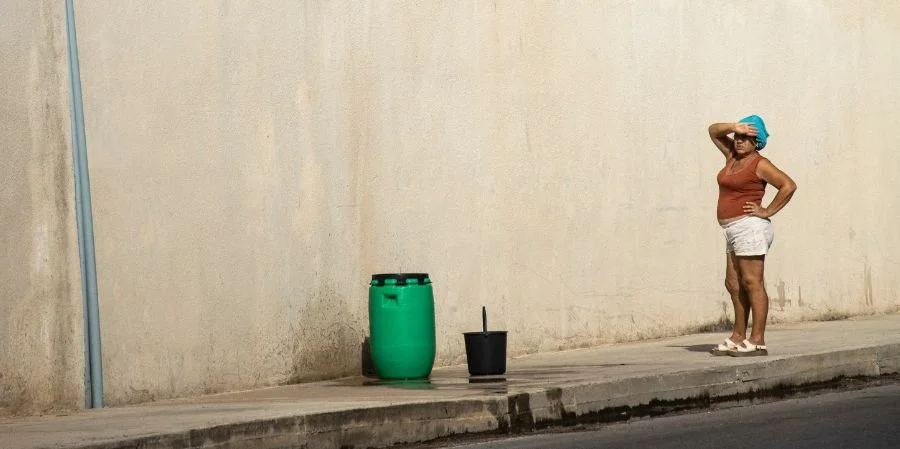
In Pedro Ivonet, in the municipality of Songo La Maya, Dalia does calculations every morning in front of her tanks. It has one of 1,000 liters, made of fiber cement, and two other smaller ones; However, when the water stops arriving, the forecast is barely enough to buy time. During the first 10 days it is still possible to administer it, but then extreme rationing begins and, after the second week, the bottom of the tank appears with distressing clarity. Then there are only two alternatives: buy or order.
Because everything, absolutely everything, needs water: cooking, washing, flushing the toilet, cleaning the floor, washing clothes, washing before going to sleep… “You don’t realize that everything is done with water until it’s gone,” summarizes Dalia. And in that phrase lies the dimension of the problem.
In theory, the solution is to store: cisterns, elevated boxes, several tanks to withstand long cycles. However, most depend on tap water, either because the home cannot support the weight of an additional tank, because there is not enough space or, more commonly, because there is not enough money. A 1,000-liter plastic tank costs around 60,000 pesos in the informal market —about 120 dollars at the current exchange rate—, while those with a larger capacity can reach 200,000. For a state worker who earns around 6,000 pesos per monththat is equivalent to months, even years, of full salary. Manufacturing a cistern is also not viable when a single bag of cement exceeds 8,000 pesos.

Thus, for Dalia – a housewife and mother of a small child – the idea of expanding storage capacity is simply unthinkable. Since the beginning of January, his neighborhood has not received water. For weeks she and her family have survived thanks to the benevolence of neighbors; However, asking also wears out. As the wait lengthens, solidarity becomes more prudent and each family protects the little it keeps.
According to an official from the Aqueduct Company in La Maya – who offered statements to CubaNet under conditions of anonymity, to avoid reprisals, the pump that allows pumping is damaged and, although several starts have been attempted, none have been effective. There is no definitive date for a solution. Meanwhile, life is reorganized around each bucket.
This reorganization involves reducing everything to the essentials. In many homes, the lack of water not only forces us to space out washing or postpone deep cleaning, but it ends up affecting even the most basic physiological needs. Without flushing the toilet, the bathrooms become stinking and the smell invades the house; Therefore, when there is no alternative, the water from washing or bathing is reused to empty the cup. Little by little, almost without realizing it, intimacy also erodes, because living with pestilence and scarcity transforms the relationship with one’s own space.

For Gisela Díaz, 63 years old, each day begins in a natural well near her home. The lines are long, since it is public and serves a good part of the neighborhood. She fills one or two buckets and carries them in small tanks to her house, located on the second floor. Climbing the stairs sends a searing pain up her spine and leaves her breathless; Even so, repeat the journey because there is no other option. She lives with her daughter and grandson, but her daughter suffers from thoracolumbar scoliosis, so any additional exertion incapacitates her for days.
With those two buckets they must cook, half-wash and clean themselves as necessary. Before they bathed two or three times a day, especially because of the heat; Now the water is barely enough to clean intimate areas at night. And although in the cold months the situation was more bearable, the increase in temperatures aggravates the feeling of constant dirt, sticky skin, and unwashed hair.
In a hot province like Santiago de Cuba, that combination of sweat and insufficient baths ends up taking its toll. First the itching appears; then redness and lesions. The skin becomes the visible thermometer of scarcity.
Yanara Medina knows this well. It started with persistent discomfort under the breasts; then small red dots appeared and the skin became rough, scaly. The itching worsens with the heat and, since there is almost never any current to support the fan, the nights become endless. Bathing with a jug is not enough when the body sweats without respite, so the initial problem leads to insomnia, irritation and anxiety.
Added to the physical tension is the economic one. In the municipality, a water pipe can cost between 10,000 and 12,000 pesos due to fuel shortages, although officially the authorized price is around 400. However, neighbors speak of an informal circuit that multiplies the figures and leaves many families out of access. Even with money in hand, some truckers don’t show up. In more central areas of the province, the same volume can reach 30,000 pesos, which makes water a luxury.
The crisis it’s not new. Santiago de Cuba has historically faced supply problems due to prolonged droughts, deteriorated hydraulic networks and equipment breakdowns. In September 2025, the official journal Sierra Maestra He described the situation as “alarming” in the municipal capital and recognized distribution cycles that exceeded 30 days, depressed reservoirs and an electricity deficit that prevented continuous pumping. Although actions and investments were announced to mitigate the crisis, five months later the perception in the neighborhoods is that little has changed.
Thus, more than half a million people in the main municipality continue trapped in cycles that exceed a month. And although the rain has partially alleviated the drought, normality is not returning as quickly.
Because living without water for more than 30 days is not just a figure in a technical report; It is learning to measure each jug, to decide whether to scrub or wash your hair today, to calculate how many flushes you can take in the bathroom.