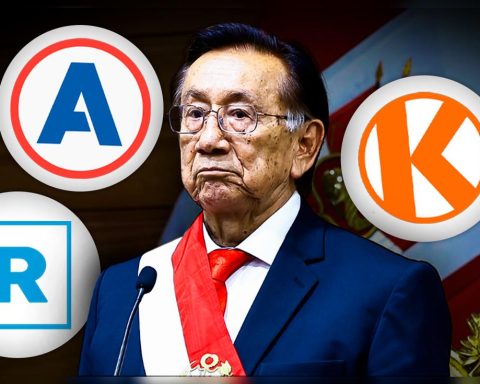
He Qali Warma Case took a new turn this Wednesday after an operation led by the Anticorruption Prosecutor’s Officewhich raided homes and offices in La Libertad, Lima and Ancash. The intervention included the review of properties related to Oscar Acunabrother of Cesar Acuñawho is attributed an alleged intermediary role within the network investigated for influence peddling.
The proceedings were part of an investigation into a alleged criminal organization that would have manipulated health processes and certifications to benefit school food supply companies. Among the companies involved are Frigoinca SACsingled out for obtaining improper advantages at key stages of the program.
YOU CAN SEE: Héctor Acuña distances himself from his brothers: “I am a different person, our parents raised us in a different way”
During the intervention, three former officials linked to regional health management and the man himself were arrested. Qali Warmawho would have coordinated internally to validate observed products and sustain supplier contracts with deficiencies. According to the fiscal thesis, these maneuvers generated a circuit of undue benefits that operated for several years without effective controls.
The intervention also aims to clarify the scope of the coordination between officials, regional operators and political actors close to the Acuña family. The tax file maintains that these connections would have facilitated irregular validations and deliberate omissions.
YOU CAN SEE: Qali Warma: canned horse meat was delivered to 70,972 schoolchildren
The Prosecutor’s Office carries out arrests that uncover the circuit of influences
The mega-operation left Aníbal Morillo, former Health Manager of La Libertad, as the main detainee. The Prosecutor’s Office maintains that Morillo would have provided direct support to questioned suppliers through accelerated health validations and certifications that omitted previous reports of non-compliance.
Jorge Luis Silva, a servant of the Regional Health Management, was also intervened, accused of participating in the preparation of reports without observations, despite the fact that the products presented inconsistencies. His role would have been key to ensuring the continuity of companies investigated within the food program.
The third detainee, Luis Alejandro Álvarez, a former Qali Warma official in Áncash, was accused of maintaining internal communications that provided sanctioned suppliers with the possibility of competing again in tenders. The Prosecutor’s Office identified exchanges and documents that would link it to administrative decisions favorable to Frigoinca and other companies.
YOU CAN SEE: Qali Warma: 15 officials are accused of distributing horse meat and chicken not suitable for consumption
What is the role of César Acuña’s brother?
Óscar Acuña Peralta, brother of Cesar Acuñaremains under investigation within the Qali Warma Casealthough at the moment there is no arrest warrant against him. The Police raided at least two properties related to him, but were unable to find him during the execution of the operation.
The Prosecutor’s Office attributes to him an alleged intermediary role for the benefit of the company Frigoinca SAC, identified as one of the most favored companies through irregular health certifications and omissions in supervision. According to investigation sources, his name appears in statements and communications that show his closeness to some regional operators.
Although a direct accusation has not yet been formalized, the Public Ministry considers that its participation could help explain the political influence that allowed irregularities to be sustained for years. His figure has become one of the most sensitive points of the case, due to the political weight of his brother in La Libertad.
YOU CAN SEE: Intoxicated by Qali Warma to the prosecution: ‘Don’t abandon us!’
What is the Qali Warma Case about?
He Qali Warma Case investigates an alleged network that would have operated between 2021 and 2024 to manipulate health processes and validate products without meeting minimum standards. The structure would be made up of regional officials, former food program employees and operators linked to supplier companies.
According to the Prosecutor’s Officethis organization would have allowed companies with sanctions to continue delivering school meals, which violates food safety regulations and exposes thousands of students. The network would have sustained its operation through illicit payments, political influences and the use of internal channels to speed up procedures.
The investigation also aims to clarify how omissions in inspections, the disappearance of technical observations and the issuance of irregular certifications were coordinated. This process remains in the preliminary stage and new proceedings are planned, including witness statements and expansions of documentary expertise.