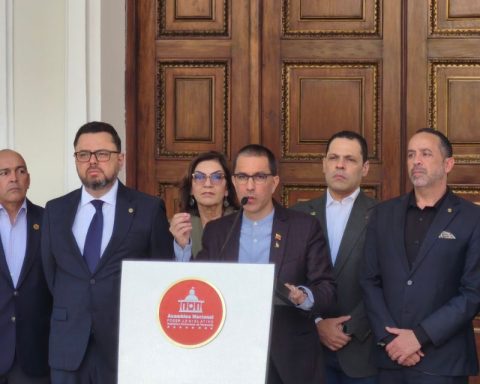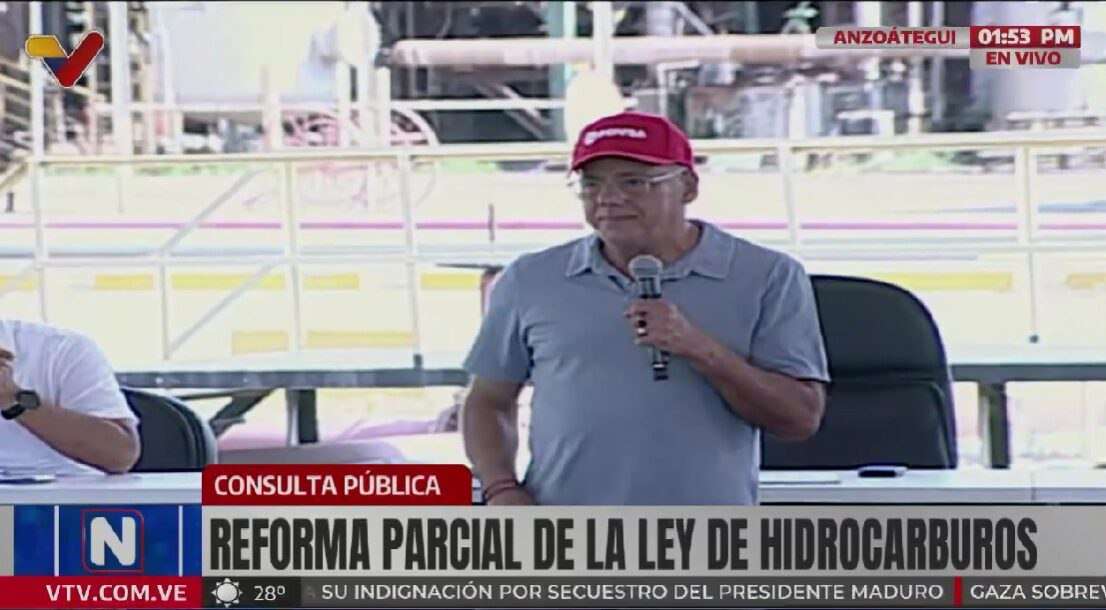
From the Puerto La Cruz refinery, in the state of Anzoátegui, the president of the National Assembly Jorge Rodríguez, led the expansion of the public consultation process on the Hydrocarbons Law, approved in the first discussion this week in Parliament. The head of the Legislature indicated that this consultation process has to begin with the workers in the sector.
“Since we began this consultation on the law, we were convinced that the first ones to talk to were the oil workers of Venezuela, because you are true heroes and heroines,” the parliamentarian commented in his speech.
He reflected that Venezuela “has lived and is living one of the most brutal blockades,” which through more than 900 sanctions tried to “bring our hydrocarbon industry to its knees. Despite all that, we can say that we have a standing oil industry.”
For this reason, he stated that “the main tribute that we can pay to the workers is for you to tell us what you think or what you don’t think about the reform of the Hydrocarbons Law, because it is a law that comes to comply with the word and with the message and with the order that Commander Hugo Chávez gave us”, about increasing oil production.
He insisted that the main motivation for the partial reform of the law is to achieve a substantial increase in oil production “but not so that they are stealing the real money from the work that you do.” He called to counteract “those who want to fish in troubled rivers” regarding the objective of the law and to defend sovereignty over our resources.
“The hydrocarbon products that Venezuela sells will become prosperity for our people,” highlighted the deputy.
Review of royalties and protection of productive links
Also present at the event was the First Vice President of the National Assembly, Pedro Infante, who specified that this law was proposed by the President in charge of the Bolivarian Republic of Venezuela, Delcy Rodríguez, on January 15 and that its consultation will allow for the collection of the people’s proposals to strengthen legislation on energy matters.
For his part, the president of the Energy and Petroleum Commission of the AN, Orlando Camacho, explained that the objectives of the reform of the Hydrocarbons Law seek to provide maximum guarantees to workers who work with oil in the country, as well as protect labor rights within the national strategic industry.
He specified that they also want to carry out a thorough review of the royalties from oil contracts, as well as guarantee that the Communal Councils and Popular Power also have a part in this economic activity.
In another intervention, representing the workers, the General Manager of PDVSA Oriente Refining, Itsvhan Calma, expressed his approval of the reform of the Hydrocarbons Law and highlighted its importance, because it seeks to protect all the productive links of the Venezuelan oil chain.
Furthermore, he highlighted that this legal instrument makes public companies more attractive for investment and national development.
The Operator of the PDVSA Oriente public affairs station, Edgar Fernández, stressed that the reform of the Hydrocarbons Law represents a response to foreign investment in the face of threats from the United States, which have suffocated the nation. He pointed out that this reform means a great improvement for the national energy sector.